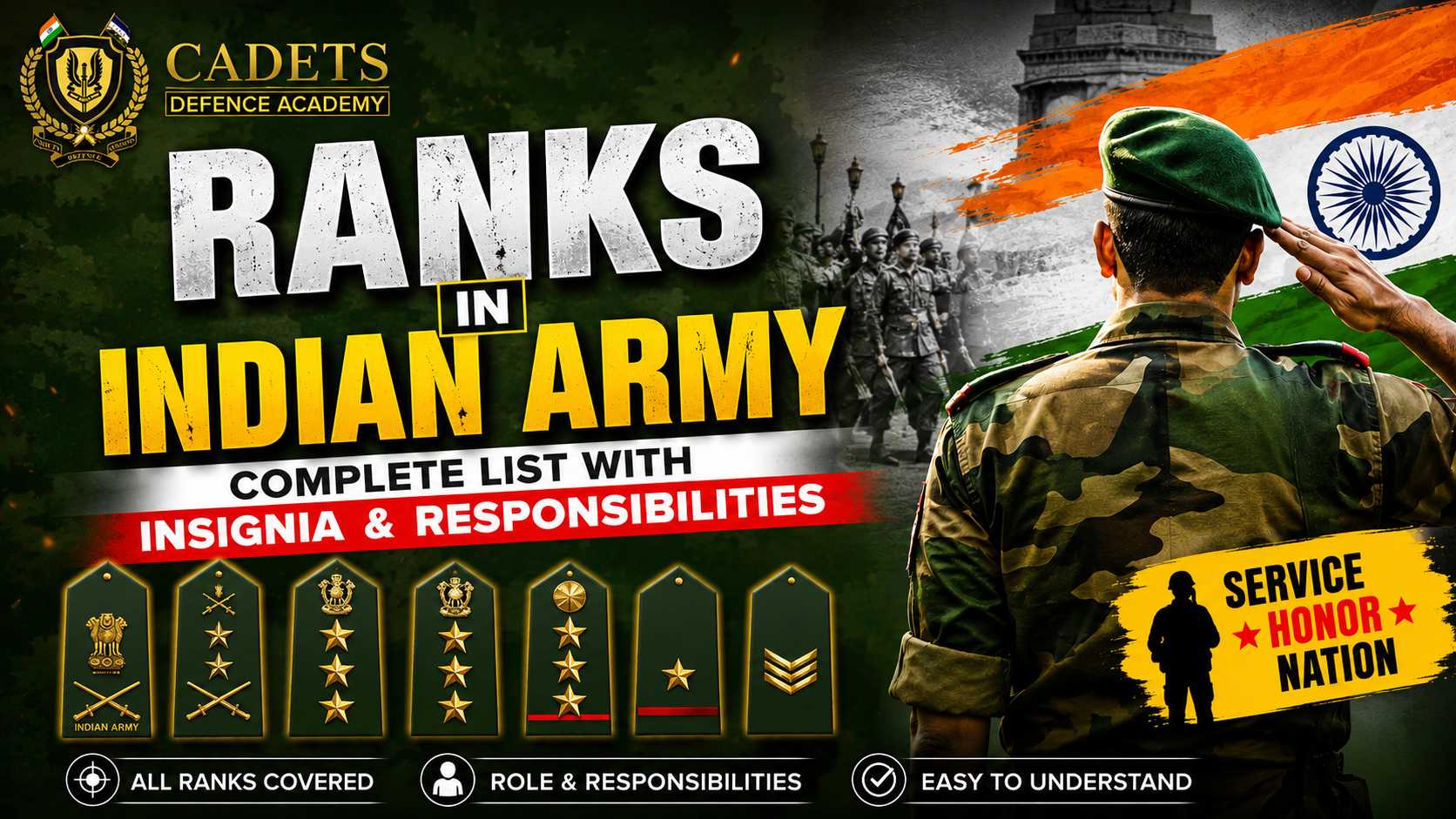
Have you ever watched a Republic Day parade and wondered what those stars, stripes, and crowns on a soldier’s shoulder actually mean? Every badge tells a story of years served, responsibility carried, and trust earned. Understanding the Ranks in Indian Army is not just useful for aspiring cadets preparing for NDA, CDS, or SSB interviews — it also helps every citizen appreciate the discipline and structure behind one of the world’s largest land forces.
In this guide, we will answer the most common questions cadets and parents ask us at Cadets Defence Academy: what are the different ranks, what insignia represents each one, and what duties come with every rank. Let’s break it down in the simplest way possible.
What Is the Rank Structure of the Indian Army?
The Indian Army rank structure is broadly divided into three groups. This military hierarchy decides who commands whom, who takes which decisions, and how the chain of command flows from the top to the soldier on the ground.
The three categories are:
- Commissioned Officers — the leadership cadre that commands units ranging from a platoon to the entire army.
- Junior Commissioned Officers (JCOs) — experienced personnel who bridge the gap between officers and soldiers.
- Non-Commissioned Officers (NCOs) and Other Ranks (OR) — the backbone of the army, made up of soldiers and junior leaders.
Each group has its own insignia, uniform markings, and rank flags, so that anyone trained to recognise them can instantly tell who holds what position in the army’s organisational structure.
Why Should You Know the Ranks in Indian Army?
If you are preparing for a defence career, knowing the army officer ranks and their insignia is part of your basic general knowledge preparation for SSB and written exams. Interviewers often ask candidates to identify rank badges or explain the chain of command. Beyond exams, this knowledge also helps you understand promotion timelines, pay levels, and the kind of responsibilities you can expect at each stage of an army career.
It also helps to remember that the Indian military rank system evolved from the British Indian Army. After independence, symbols like the British crown were replaced with Indian emblems such as the Ashoka Lion Capital, reflecting India’s own identity while keeping the same disciplined structure built over generations.
Now, let’s go through the complete list of military ranks, from the top all the way down.
What Are the Commissioned Officer Ranks in the Indian Army?
Commissioned officers form the leadership backbone of the army. They are responsible for strategic planning, troop command, and decision-making at every level — from a small platoon to an entire army command. Officers join as Gentlemen Cadets or Lady Cadets through the NDA, IMA, or OTA after clearing the SSB interview, and they rise through the ranks based on merit, seniority, and performance in courses like the Young Officers Course and Staff College training.
Here is the complete officer hierarchy, from highest to entry level. There are ten commissioned officer ranks in total, and substantive promotion up to Lieutenant Colonel is largely based on time served and clearing required exams, while promotion to Colonel and above depends on selection boards and performance evaluation. This is why the pyramid narrows sharply as you move toward the top.
Field Marshal
This is a five-star rank and the highest honour an army officer can receive, but it is largely ceremonial and not part of the regular organisational structure. It is given only in rare cases to honour truly exceptional wartime service and leadership. In the history of the Indian Army, only two officers have ever held this distinction, and once awarded, the rank is considered lifelong, meaning the recipient is treated as a serving officer for the rest of their life.
General
The rank of General is the highest active, functional position in the army and is held by the Chief of the Army Staff (COAS), who heads the entire force. A General with a four-star insignia oversees overall strategy, major operational decisions, and the administration of the whole army. The insignia features the Ashoka Lion Capital along with crossed sabres and a star, worn on the shoulder.
Lieutenant General
A three-star rank, Lieutenant General is typically responsible for commanding an army corps, which includes several divisions. Officers at this level also serve in key staff and administrative roles at Army Headquarters, including senior command positions like Vice Chief of the Army Staff.
Major General
Holding a two-star insignia, a Major General commands a division — a large fighting formation made up of multiple brigades. This rank also includes appointments as Additional Director Generals and other senior command and staff roles.
Brigadier
A one-star rank, the Brigadier leads a brigade, which usually comprises around three to four battalions. Brigadiers also serve in important staff appointments such as Brigadier General Staff, helping coordinate operations across multiple units.
Colonel
A Colonel commands a battalion, the basic fighting unit of the army, and is responsible for its training, discipline, and operational readiness. Many officers spend a significant part of their career working toward this rank, and due to limited vacancies at higher levels, a large number of officers retire as Colonels.
Lieutenant Colonel
Serving as the second-in-command of a battalion or regiment, a Lieutenant Colonel supports the Colonel in daily administration, training schedules, and operational planning, stepping in to lead when required.
Major
A Major typically commands a company-sized unit, which is a smaller formation within the battalion. This role involves close supervision of troops, training oversight, and tactical decision-making at the ground level.
Captain
A Captain commands a platoon or assists in running a company, depending on the corps and regiment. This rank involves direct, hands-on leadership of soldiers during both training and operations.
Lieutenant
This is the entry-level commissioned rank for newly trained officers fresh out of the academy. A Lieutenant takes on responsibilities that vary by corps, gaining frontline leadership experience before progressing further. The earlier rank of Second Lieutenant is no longer used; all new officers now join directly as Lieutenants.
What Are the Junior Commissioned Officer (JCO) Ranks?
Junior Commissioned Officers occupy a unique and respected position in the Indian Army’s hierarchy. They are promoted from the NCO cadre based on years of service, merit, and seniority, and they act as the vital link between commissioned officers and the rank and file. JCOs are addressed as “Sahab” by other ranks and enjoy distinct privileges such as a separate JCO’s mess and better travel entitlements.
Subedar Major
This is the senior-most JCO rank, equivalent to a Risaldar Major in cavalry and armoured regiments. A Subedar Major works closely with the Commanding Officer, advising on matters of discipline, welfare, and administration, and is often the most experienced soldier in the unit.
Subedar
A Subedar (called Risaldar in cavalry and armoured units) handles important administrative and supervisory duties at the company level. With decades of field experience, Subedars play a key mentoring role for younger soldiers and officers alike.
Naib Subedar
The entry-level JCO rank, a Naib Subedar (or Naib Risaldar in cavalry regiments) takes care of day-to-day unit operations, supervises smaller groups of soldiers, and assists in training and discipline.
What Are the Non-Commissioned Officer and Other Ranks?
Non-Commissioned Officers and Other Ranks form the largest section of the Indian Army and are the ones who carry out ground-level operations. These soldiers are recruited directly and rise through the ranks based on performance, training, and time served.
Havildar
Equivalent to a sergeant in many other armies, a Havildar (called Daffadar in cavalry regiments) leads a small team or section of soldiers. This rank carries three chevrons as insignia and involves supervising daily tasks, weapon handling, and section-level discipline.
Naik
A Naik (Lance Daffadar in cavalry units) acts as a team leader, guiding a smaller group within a section. The insignia for this rank is two chevrons, and the role involves close coordination with the Havildar above.
Lance Naik
This supervisory rank, marked by a single chevron, is given to soldiers who show leadership potential. A Lance Naik (Acting Lance Daffadar in cavalry) assists in managing small tasks and mentoring newer recruits.
Sepoy
The foundation of the Indian Army, a Sepoy (called Sowar in cavalry and armoured regiments) is the entry-level soldier rank with no insignia. Interestingly, many regiments use different names for this same rank depending on their specialisation — for example, Gunner in the artillery, Rifleman in rifle regiments, Sapper in the Corps of Engineers, Signalman in the Corps of Signals, and Guardsman in the Brigade of the Guards.
How Does Insignia Help Identify Army Ranks?
Insignia, worn on the shoulder epaulettes, is the quickest way to identify someone’s rank and authority in the field. Senior officer ranks use stars and the Ashoka Lion Capital, JCOs use stars combined with a coloured stripe, and NCOs use chevrons, with the number of stars or chevrons increasing as seniority rises. Learning to read this insignia is a basic skill taught early in cadet training, since quick recognition of rank and authority is essential during operations, ceremonies, and daily unit life.
Are There Any Honorary Ranks in the Indian Army?
Yes. The Indian Army also grants honorary ranks to soldiers nearing retirement as recognition of long, dedicated service, and occasionally to notable public figures as a mark of respect and to inspire youth to consider a career in the armed forces. These honorary appointments do not usually carry the pay or pension benefits attached to a regular substantive rank.
How Are Ranks in Indian Army Different from Civilian Designations?
Unlike civilian government posts, army ranks are not purely about years of service. Promotions, especially from Lieutenant Colonel and above, depend heavily on selection boards, performance assessments, and vacancy availability. This is also why the structure becomes narrower as you go up — many officers retire as Colonels, while only a select few reach Brigadier and beyond. This military hierarchy keeps the command structure sharp, accountable, and built on merit at every step.
How Do Soldiers Get Promoted Through Army Ranks?
Promotion in the Indian Army is never automatic. For soldiers and NCOs, moving up depends on years of service, conduct, and clearing specific cadre courses. For JCOs, promotion to the next rank depends on vacancies, merit, and seniority within the unit. For commissioned officers, the journey is even more structured — promotions up to Lieutenant Colonel generally follow time-in-service norms along with mandatory exams, while promotion to Colonel and beyond is decided by selection boards that review an officer’s entire service record, courses completed, and command experience.
This layered promotion system is one reason the army rank structure is often compared to a pyramid. At the base, there are thousands of Sepoys and NCOs; at the very top, only one officer holds the rank of General at any given time. Each step up the ladder demands more training, more responsibility, and a proven ability to lead under pressure.
What Is the Difference Between JCOs and NCOs?
This is a common doubt among aspirants, so it is worth clarifying. NCOs such as Havildar, Naik, and Lance Naik are promoted soldiers who supervise small teams and sections. JCOs such as Subedar Major, Subedar, and Naib Subedar sit a level above NCOs and are treated almost like a separate officer class, with their own mess, better quarters, and senior administrative duties. In short, every JCO has typically served first as an NCO, but not every NCO becomes a JCO — it depends on long service, merit, and available vacancies.
Do Cavalry and Armoured Regiments Use Different Rank Names?
Yes, and this often confuses beginners. While the regular infantry and most other arms use titles like Subedar, Havildar, Naik, and Sepoy, cavalry and armoured regiments use their own traditional titles for the same positions — Risaldar Major, Risaldar, Naib Risaldar, Daffadar, Lance Daffadar, and Sowar. The responsibilities at each level remain the same; only the regimental naming tradition is different, a legacy carried forward from earlier cavalry formations.
Final Thoughts
Understanding the Ranks in Indian Army gives you a clear picture of how authority, command, and responsibility flow within one of the most disciplined institutions in the country. From the ceremonial Field Marshal to the foundational Sepoy, every rank plays an important part in keeping the nation secure. If you are preparing for a career in the defence forces, knowing this army rank structure thoroughly will help you not just in interviews and written exams, but also in understanding the life you are signing up for.
At Cadets Defence Academy, we help aspiring cadets build this kind of foundational knowledge alongside physical training, SSB preparation, and academic coaching — because a strong defence career begins with understanding the system you are about to become a part of.
For More Information
Visit us at – Cadets Defence Academy