

Tattoo Policy for NDA, CDS and AFCAT: What’s Allowed
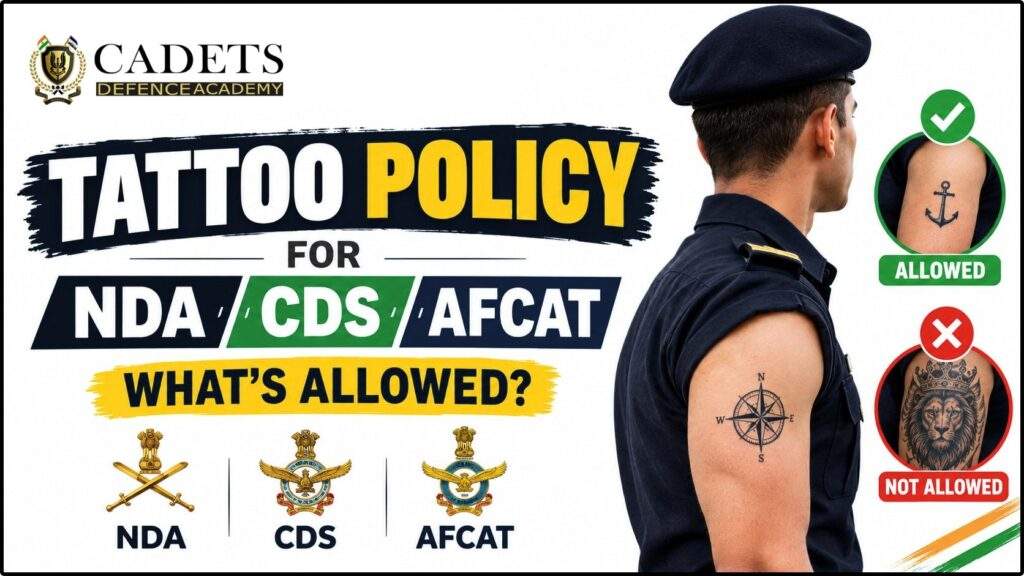
Tattoo Policy for NDA, CDS and AFCAT: What’s Allowed Table of Contents Many defence aspirants ask the same worry just before the medical: “Is my tattoo going to stop me from joining?” If you have a tattoo, or you are thinking of getting one, this guide is for you. The tattoo policy for NDA, CDS and AFCAT is strict, but it is not a total ban. Small tattoos in certain places are accepted. Tattoos in the wrong place or of the wrong kind can end your selection. For NDA, permanent tattoos are accepted only on the inner face of the forearm (from inside the elbow to the wrist) and the back of the hand. Tribal candidates get a special case-by-case rule. CDS and AFCAT follow the medical standards of the Army, Navy and Air Force, which are similar in spirit. Always read the latest official notification before you apply. Can NDA Officers Have Tattoos? Understanding the Official Rule Yes, but only under limits. The armed forces want officers who look sharp in uniform and who follow discipline from day one. So tattoos are checked carefully during the medical examination. The UPSC publishes the tattoo rule in the NDA & NA notification every year. In simple words, the rule says permanent body tattoos are allowed only on certain parts of the arms. Anything outside those areas is not accepted. So, can you join NDA with a tattoo? You can, if the tattoo is within the permitted area and is acceptable in nature. Rules can change from one notification to the next, so always check the latest tattoo rules for NDA, CDS and AFCAT on the official websites given at the end of this blog. Is Tattoo Allowed in the National Defence Academy for Non-Tribal Candidates? For general (non-tribal) candidates, the answer is yes, but only in a very small area. According to the UPSC notification, permanent tattoos are accepted only on the inner face of the forearm and on the back (dorsal side) of the hand. This means a tattoo anywhere else on your body is a risk for your NDA eligibility. That includes the neck, face, chest, back, upper arm, legs and palms. The same idea applies to other entries. Are tattoos allowed for CDS candidates? Can you apply for AFCAT with a tattoo? Yes, in most cases, if the tattoo sits in a permitted area and is small and acceptable. But the exact wording can differ by force and by year, so check the notification of your exam. If you are preparing for these exams, you can also look at our CDS coaching in Dehradun and AFCAT coaching programs for complete guidance. Permitted Areas for Tattoos Where tattoos are allowed for NDA, CDS and AFCAT depends on the official medical rule. For NDA, the accepted places are: The inner face of the forearm, from the inside of the elbow to the wrist The back (dorsal side) of the hand People often ask: can CDS candidates have tattoos on their arms? Only if the tattoo is on the permitted part of the arm. A tattoo on the upper arm or shoulder is usually not accepted. Are tattoos on the neck allowed for AFCAT? No. A visible neck tattoo is a common reason for rejection. Do tattoo rules depend on location for defence medicals? Yes, location is the first thing a doctor checks. As a safe thumb rule, the more visible the tattoo is in uniform, the higher the risk. What about size? The NDA notification text we reviewed does not clearly state a size limit. But some other forces, such as the CAPF, mention that a tattoo should be less than one-fourth of the body part. So a tattoo size limit for defence candidates in India is not always written the same way. The safest choice is a small tattoo, and one that is easy to check. Permitted Nature of Tattoos Besides location, the design also matters. Which tattoos are allowed for NDA, CDS and AFCAT? In general, the board looks kindly at tattoos that are small, neat and respectful. Examples are a small religious symbol or the name of a family member, placed on a permitted area. Are religious tattoos allowed in the Indian Armed Forces? Often yes, if they are small, decent and placed correctly. Can a small religious tattoo affect AFCAT eligibility? It should not, if it follows the rules. But the final decision is always taken by the medical board. Tattoos that carry offensive, obscene, political or hateful messages are not accepted anywhere. If your tattoo can hurt anyone’s feelings or look inappropriate, do not take the risk. Tattoo Rules for Tribal Candidates in NDA India has many tribal communities with old traditions of tattoo marks on the face or body. The armed forces respect this. Under the NDA rule, tribal candidates with tattoo marks made as per their existing custom and tradition are permitted on a case-by-case basis. Are tribal tattoos allowed for NDA candidates? Yes, but each case is checked separately. The same idea is followed in tattoo rules for tribal candidates in CDS. To avoid trouble at the medical, keep your Scheduled Tribe certificate and any proof of your community’s custom with you. A tattoo that is not part of a tribal tradition does not get this benefit. Tattoos That Lead to Direct Rejection Can a tattoo cause rejection in NDA, CDS or AFCAT? Yes. Reasons defence candidates are rejected for tattoos usually include: Tattoos on the neck, face, chest, back, legs or palms (for non-tribal candidates) Tattoos outside the permitted area of the forearm or hand Large tattoos or tattoos that cover a big part of a limb Offensive, political or obscene designs A tattoo that is hidden or not declared at the medical Can an AFCAT medical board reject a candidate for a tattoo? Yes, if the tattoo breaks the rule. Never try to hide it. What to do if rejected for a tattoo in the NDA medical? Candidates declared
NDA Category-Wise Age Relaxation & Reservation Rules Explained (SC/ST/OBC)
NDA Category-Wise Age Relaxation & Reservation Rules Explained (SC/ST/OBC) Table of Contents Every year, thousands of SC, ST, OBC, and EWS candidates search for NDA category-wise age relaxation hoping to find a few extra years to apply. This confusion is completely understandable — after all, exams like the UPSC Civil Services grant SC/ST candidates a 5-year relaxation and OBC candidates a 3-year relaxation. So why wouldn’t the National Defence Academy exam work the same way? The honest answer, backed by official UPSC notifications, is that NDA category-wise age relaxation does not exist in the way most aspirants imagine. The National Defence Academy exam runs on a fixed, uniform age band for every candidate, irrespective of caste or category. What NDA does offer instead is seat reservation — a completely different concept from age relaxation. In this guide by Cadets Defence Academy, Dehradun’s trusted name in defence coaching, we break down exactly how NDA reservation works, what SC/ST/OBC/EWS candidates actually get, the documents you need, and how it compares with CDS and CAPF rules. If you’re preparing for NDA 1 or NDA 2, this is the one article that will clear every doubt around NDA category-wise age relaxation. Does NDA Give Age Relaxation to SC/ST/OBC? (The Truth Most Aspirants Get Wrong) Let’s address the myth head-on: NDA does not give age relaxation to SC, ST, or OBC candidates. This is one of the most searched and most misunderstood topics among defence aspirants, largely because other UPSC exams (like the Civil Services Examination) do offer such relaxation. For the National Defence Academy exam, the upper and lower age limit is fixed at 16.5 to 19.5 years for every applicant — general, SC, ST, OBC, or EWS. There is no additional window of 3 or 5 years added on top of this band for reserved categories. So when an aspirant asks “what is the NDA category-wise age relaxation for OBC candidates,” the direct answer is: there isn’t one. The date-of-birth bracket published in the official UPSC notification applies uniformly to all categories. This is fundamentally different from recruitment exams under the Department of Personnel and Training, where reserved categories receive age relaxation as a matter of policy. NDA, being a defence academy entrance exam tied to physical and medical standards for cadet training, follows a different logic altogether — one based on a fixed training-age window rather than category-based flexibility. Why NDA Doesn’t Offer Age Relaxation to Any Category The absence of NDA category-wise age relaxation isn’t an oversight — it’s a deliberate design choice rooted in how defence training works. Physical and medical readiness: Cadets join the NDA at a young age because the three-year training at Khadakwasla is physically demanding. A narrow, fixed age band ensures every cadet is developmentally suited to the same rigorous routine. Uniform training batches: The Armed Forces prefer cadets who enter training within a tight age bracket so that physical fitness benchmarks, drill standards, and academic pace remain consistent across the batch. Different objective than civil service exams: UPSC CSE selects officers for administrative roles where age relaxation compensates for social disadvantage in career progression. NDA selects cadets for a physically intensive military training pipeline, where the logic of extending age doesn’t align with training requirements. Legal and policy distinction: Age relaxation and reservation are two separate constitutional tools. Reservation ensures representation in seats; age relaxation extends eligibility windows. The Ministry of Defence and UPSC have chosen to apply only the former to NDA, not the latter. Because of this, aspirants preparing at any NDA coaching in Dehradun, including our own NDA Foundation Course, are advised to plan their attempts strictly within the standard 16.5–19.5 age window rather than banking on relaxation that doesn’t exist. NDA Reservation Policy Explained: What Actually Applies While there’s no NDA category-wise age relaxation, there is a genuine reservation policy — and understanding it correctly matters just as much. NDA reservation applies at the seat allocation stage, not the age-eligibility stage or the written cut-off stage. In simple terms: Every candidate, regardless of category, must fall within the same age bracket to even apply. Every candidate, regardless of category, competes on the same written exam paper and cut-off marks. Once candidates clear the written exam and SSB interview, final seat allotment is done against category-wise reserved vacancies (SC, ST, OBC-NCL, EWS) as notified by UPSC for that particular course. This is a crucial distinction that many aspirants miss. Reservation in NDA affects who gets a seat from the final merit list, not who is allowed to sit for the exam or who needs fewer marks to qualify. So while NDA reservation policy genuinely exists and benefits eligible candidates during seat allotment, it should never be confused with age relaxation. Category-wise Seat Reservation Percentage (SC/ST/OBC) UPSC follows the standard Government of India reservation framework for NDA seat allocation. Here’s the category-wise breakdown typically applied: Category Reservation Percentage Applicable At SC (Scheduled Caste) 15% Final seat allotment ST (Scheduled Tribe) 7.5% Final seat allotment OBC (Non-Creamy Layer) 27% Final seat allotment EWS (Economically Weaker Section) 10% Final seat allotment General/Unreserved Remaining seats Final seat allotment These percentages are applied to the total vacancies notified for each NDA course and are subject to change based on the latest UPSC notification. Aspirants should always cross-check the current numbers on the official UPSC website before applying, since reservation percentages can be revised. It’s worth repeating: this table has nothing to do with age. A 19-year-old OBC candidate and a 19-year-old general-category candidate both need to fall within the same date-of-birth window — reservation only decides how many of the final seats are earmarked for each category once merit is established. OBC Non-Creamy Layer Certificate: Format & Requirement To claim the 27% OBC reservation in NDA, a candidate must submit a valid Non-Creamy Layer (NCL) certificate, not just a caste certificate. This is where many otherwise-eligible OBC aspirants lose their reservation benefit due to documentation errors. Key requirements for the OBC-NCL certificate: It must be issued
NDA Maths Formula Sheet 2026: All Chapters, Quick Revision
NDA Maths Formula Sheet 2026: All Chapters, Quick Revision Table of Contents Every NDA aspirant eventually types the same search: “NDA Maths Formula Sheet 2026.” It’s the first thing you bookmark and the last thing you open before the exam. But here’s the honest truth our Maths faculty at Cadets Defence Academy tells every batch on day one — formulas alone won’t get you past 240/300. The NDA Maths paper rewards speed and formula-to-answer conversion, not formula memorization in isolation. Two students can know the same identity; the one who’s drilled it into 50 practice questions finishes the paper 20 minutes earlier and with fewer silly errors. That said, you cannot build speed without a rock-solid, error-free formula base. This is exactly why we built this NDA Maths Formula Sheet 2026 — a single reference document that mirrors the actual UPSC NDA syllabus weightage, so your last 15 days of revision are spent recalling, not searching. How to use this cheat sheet for last-15-day revision: Days 1–5: Read each section once, out loud, and rewrite the formulas you keep forgetting on a separate sheet. Days 6–10: Solve 10 previous-year questions per chapter using only this sheet as reference — no textbook. Days 11–13: Attempt full-length mock tests and circle every formula you hesitated on. Days 14–15: Only revise the circled formulas plus the Quick-Revision Summary Table in Section 11. This NDA Maths Formula Sheet 2026 is designed to work alongside — not replace — regular problem-solving practice, which is exactly the approach followed in our NDA Foundation and NDA-after-12th batches in Dehradun. Think of this NDA Maths Formula Sheet 2026 as your single source of truth during revision week. Instead of flipping between three different textbooks and a dozen browser tabs, you scroll through one page, chapter by chapter, in the exact order the NDA syllabus is usually taught. That alone can save 30–40 minutes of daily revision time, which adds up fast over the final two weeks before the exam. Algebra Algebra typically carries the single largest weightage in the NDA Maths paper, so this part of the NDA Maths Formula Sheet 2026 deserves the most attention. Sets, Relations & Functions n(A∪B) = n(A) + n(B) − n(A∩B) n(A∪B∪C) = n(A)+n(B)+n(C)−n(A∩B)−n(B∩C)−n(A∩C)+n(A∩B∩C) A relation R is an equivalence relation if it is reflexive, symmetric, and transitive. Quadratic Equations For ax² + bx + c = 0: roots = [−b ± √(b²−4ac)] / 2a Sum of roots = −b/a; Product of roots = c/a Discriminant D = b² − 4ac; D > 0 (real, distinct), D = 0 (real, equal), D < 0 (imaginary) Complex Numbers Modulus |z| = √(a² + b²) for z = a + ib Argument θ = tan⁻¹(b/a) De Moivre’s Theorem: (cosθ + i sinθ)ⁿ = cos(nθ) + i sin(nθ) Binary Numbers — Conversion between binary, decimal, octal, and hexadecimal follows base-2, base-8, and base-16 positional value rules; practice at least 5 conversions daily in the last two weeks. Sequences & Series AP: nth term = a + (n−1)d; Sum = n/2 [2a + (n−1)d] GP: nth term = arⁿ⁻¹; Sum = a(rⁿ−1)/(r−1) HP: reciprocal of terms forms an AP Binomial Theorem General term: T(r+1) = ⁿCr aⁿ⁻ʳ bʳ Middle term depends on whether n is even or odd Logarithms log(mn) = log m + log n log(m/n) = log m − log n log(mⁿ) = n log m Permutation & Combination ⁿPr = n! / (n−r)! ⁿCr = n! / [r!(n−r)!] Trigonometry Trigonometry questions in NDA are formula-heavy but pattern-repetitive, which makes this section of the NDA Maths Formula Sheet 2026 extremely high-yield. sin²θ + cos²θ = 1; 1 + tan²θ = sec²θ; 1 + cot²θ = cosec²θ sin(A±B) = sinA cosB ± cosA sinB cos(A±B) = cosA cosB ∓ sinA sinB tan(A±B) = (tanA ± tanB) / (1 ∓ tanA tanB) sin2θ = 2sinθcosθ; cos2θ = 1−2sin²θ = 2cos²θ−1 Inverse functions: sin⁻¹x + cos⁻¹x = π/2; tan⁻¹x + cot⁻¹x = π/2 Heights & Distances: use angle of elevation/depression with tanθ = height/base Matrices & Determinants Matrix addition/subtraction requires identical order; multiplication requires columns of first = rows of second Transpose: (Aᵀ)ᵀ = A; (AB)ᵀ = BᵀAᵀ For a 2×2 matrix, determinant = ad − bc Inverse of matrix A: A⁻¹ = adj(A) / |A|, valid only when |A| ≠ 0 Cramer’s Rule solves linear equations using determinant ratios: x = Dx/D, y = Dy/D, z = Dz/D Coordinate Geometry (2D) Distance formula: √[(x₂−x₁)² + (y₂−y₁)²] Section formula: [(mx₂+nx₁)/(m+n), (my₂+ny₁)/(m+n)] Slope: m = (y₂−y₁)/(x₂−x₁) Distance of a point from a line: |Ax₁+By₁+C| / √(A²+B²) Circle: (x−h)² + (y−k)² = r²; tangent condition — distance from centre equals radius Conics: Parabola y² = 4ax; Ellipse x²/a² + y²/b² = 1; Hyperbola x²/a² − y²/b² = 1 Coordinate Geometry (3D) Distance: √[(x₂−x₁)² + (y₂−y₁)² + (z₂−z₁)²] Direction cosines: l² + m² + n² = 1 Direction ratios are proportional to direction cosines Equation of a line in symmetric form: (x−x₁)/l = (y−y₁)/m = (z−z₁)/n Equation of a plane: ax + by + cz = d Differential Calculus Standard limits: lim(x→0) sinx/x = 1; lim(x→0) (1−cosx)/x = 0 Product rule: d/dx(uv) = u’v + uv’ Quotient rule: d/dx(u/v) = (u’v − uv’) / v² Chain rule: dy/dx = dy/du × du/dx d/dx(xⁿ) = nxⁿ⁻¹; d/dx(sinx) = cosx; d/dx(eˣ) = eˣ Integral Calculus & Differential Equations ∫xⁿ dx = xⁿ⁺¹/(n+1) + C ∫1/x dx = ln|x| + C ∫eˣ dx = eˣ + C Definite integral property: ∫ₐᵇ f(x)dx = −∫ᵇₐ f(x)dx Area under a curve: A = ∫ₐᵇ y dxFirst-order differential equations are solved using variable separation or an integrating factor Vector Algebra Dot product: a·b = |a||b|cosθ Cross product: a×b = |a||b|sinθ n̂ Scalar triple product: [a b c] = a·(b×c) Area of a parallelogram = |a×b|; Volume of a parallelepiped = |a·(b×c)| Statistics & Probability Mean = Σx/n; Median = middle value of ordered data; Mode = most frequent value Variance = Σ(x−x̄)²/n; Standard Deviation = √Variance Addition theorem: P(A∪B) = P(A) + P(B) − P(A∩B)
NDA Online Coaching vs Offline Coaching — Which Should You Choose?
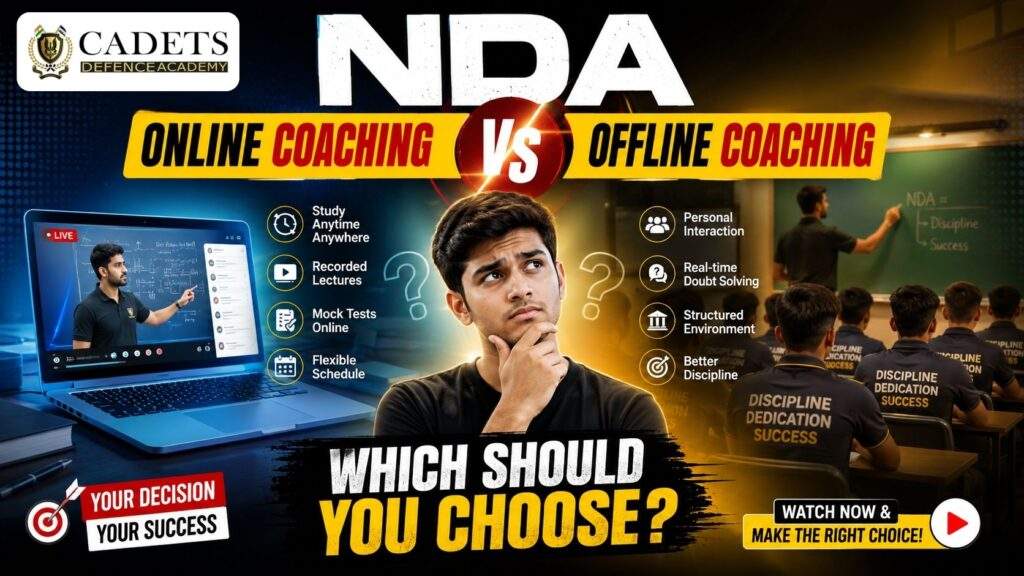
NDA Online Coaching vs Offline Coaching — Which Should You Choose? Table of Contents If you are preparing for the NDA exam, you have probably asked yourself this question at least once: should I join online NDA coaching, or should I move to a city and join a classroom-based institute? This is one of the most common doubts we hear from students and parents every week at Cadets Defence Academy, the leading NDA coaching in Dehradun. There is no single right answer. Thousands of cadets have cleared NDA through purely online preparation, and thousands more through offline, residential coaching. What matters is matching the coaching mode to your own situation — your location, your discipline level, your school schedule, and your budget. In this blog, we will break down NDA online coaching vs offline coaching in simple terms, so you can make a decision that actually works for you. What Is NDA Online Coaching? Online NDA coaching means you attend live online NDA coaching classes from your home, through a laptop or mobile app, instead of travelling to a physical classroom. Most online NDA coaching batches include live lectures, recorded sessions for revision, doubt-clearing sessions, and downloadable study material. What Is NDA Offline Coaching? Offline NDA coaching, on the other hand, means physically attending an NDA coaching center near you. Students sit in a classroom, interact directly with faculty, and often stay in a hostel if they come from outside the city. This is the traditional model most defence coaching institutes, including ours, were originally built around. If you search for an “NDA coaching institute near me,” you will usually find institutes offering classroom coaching along with hostel and mess facilities. Offline batches also give access to physical infrastructure like PT grounds, GTO grounds, and in-person SSB mock interviews — things that are difficult to fully replicate online. NDA Online Coaching vs Offline Coaching: Key Differences Aspect Online Coaching Offline Coaching Location Learn from anywhere in India Must relocate near the institute Interaction Live classes + recorded lectures Direct, face-to-face with faculty Discipline Depends on self-motivation Structured daily routine Physical training Limited or self-managed On-campus PT, drill, GTO ground Cost Generally lower Higher (tuition + hostel + mess) Best suited for Remote areas, repeaters, working students School students, aspirants needing structure Advantages of Online NDA Coaching Online NDA coaching has grown fast in the last few years, and for good reason: Accessibility — students from any state can join an online NDA coaching batch without leaving home Flexibility — recorded lectures let you revise topics at your own pace Lower cost — no hostel or travel expenses, so overall NDA coaching total cost is usually lower online vs offline Good for repeaters — students preparing for a second or third attempt often prefer online NDA coaching for repeaters, since they already understand the syllabus and mainly need guided practice and mock tests Convenient for working students or those managing school alongside preparation If you are unsure, most academies (including ours) allow you to join a live online NDA coaching demo class first, so you can judge the teaching quality before committing to a full batch. Benefits of Offline NDA Coaching Offline coaching still has clear advantages that online classes cannot fully replace: Discipline — a fixed daily routine helps students who struggle with self-study Direct doubt-solving — face-to-face interaction with faculty often clears concepts faster Physical training on campus — PT, drill, and obstacle training are hard to simulate at home In-person SSB preparation — GTO tasks, group discussions, and personal interview practice work best with real interaction, not a screen Peer environment — being surrounded by other serious aspirants builds motivation and healthy competition This is why offline NDA coaching for disciplined study is often recommended for younger students, especially those joining an NDA Foundation-style program right after Class 10, where schooling and NDA preparation run together. NDA Coaching Fees: Online vs Offline Cost is usually the deciding factor for many families. Online NDA coaching fees tend to be lower because there is no hostel, mess, or campus infrastructure involved — you are mainly paying for faculty time and study material. Offline NDA coaching fees are higher because they include classroom infrastructure, physical training grounds, and often residential facilities. When comparing NDA online coaching fees vs offline coaching fees, always check what is included — some online NDA coaching batches offer only pre-recorded content at a low monthly NDA coaching fee, while others include live classes, personal mentoring, and mock SSB sessions similar to what offline students get. Which Coaching Mode Suits You Best? There is no universal winner in the online vs offline NDA coaching debate — it depends on who you are as a student: School students (Class 9–10) aiming for NDA after schooling generally benefit more from offline coaching, since it combines academics, physical training, and discipline in one structured environment Working students or those in Class 11–12 juggling school and preparation often do better with flexible online classes Repeaters who already understand the syllabus and mainly need mock tests and revision usually find online NDA coaching more time-efficient Self-study students who struggle with consistency usually perform better with the structure that offline classroom coaching provides Students in remote areas with no nearby institute naturally lean toward online coaching, simply because there is no other practical option. The Hybrid Approach: Best of Both Worlds At Cadets Defence Academy, we don’t believe students should have to choose one over the other. That’s why we run both a fully residential NDA Foundation course for students who want the complete offline, hostel-based experience, and dedicated online NDA coaching batches for students who cannot relocate to Dehradun. Both formats are taught by the same experienced faculty, follow the same updated syllabus, and include structured mock tests. If you are also preparing for the SSB stage, our SSB coaching program is available for both online and offline batches, so you don’t miss out on interview and GTO practice either way.
OTA (Officers Training Academy) Entry Scheme Explained: Eligibility, Exam, and Career Path
OTA (Officers Training Academy) Entry Scheme Explained: Eligibility, Exam, and Career Path Table of Contents Not every defence aspirant wants to spend three years at a residential academy before wearing the uniform. If you are a graduate who wants to become an Army officer faster, without a long-term service commitment, the OTA (Officers Training Academy) Entry Scheme is worth understanding closely. It is one of the most practical routes into the Indian Army, and yet many students overlook it simply because they don’t know how it works. This guide breaks it down in the simplest way possible. What Is the OTA Entry Scheme? This scheme is a route through which graduates join the Indian Army as Short Service Commission (SSC) officers. Unlike the NDA Foundation route, which trains cadets fresh out of school, OTA is meant for candidates who already hold a degree. You do not appear for a separate “OTA exam.” Instead, you apply through the Combined Defence Services (CDS) Examination, conducted twice a year by the Union Public Service Commission (UPSC), and choose OTA as your preferred academy on the application form. The training itself happens at the Officers Training Academy, Chennai, one of the oldest and most respected officer training institutes in the country. A second campus in Gaya also conducts select courses. On successful completion, candidates are commissioned as Lieutenants in the Indian Army. OTA Entry Scheme at a Glance Parameter Details Conducting Body Union Public Service Commission (UPSC), via CDS Exam Academy Location Chennai (main campus), Gaya (select courses) Age Limit 19 to 25 years (as per official CDS notification) Educational Qualification Bachelor’s degree in any stream Marital Status Unmarried men; unmarried women, issueless widows and issueless divorcees eligible OTA Syllabus (Written Exam) English and General Knowledge only, no Mathematics Selection Stages Written Exam, SSB Interview, Medical Examination, Merit List Physical & Medical Standards Fitness, eyesight, and height standards as per official notification Training Duration 49 weeks (approx. 11 months) Commission Type Short Service Commission (SSC), option for Permanent Commission later Service Tenure 10 years, extendable by 4 years (up to 14 years) Stipend During Training Fixed monthly stipend as per official notification Who Is Eligible for OTA Entry? Eligibility under this scheme is broader than most other defence entries, which is exactly why it attracts so many applicants. Age Limit: Calculated as per the official CDS notification for that cycle. If you’re mapping out the full timeline, our CDS coaching programme covers eligibility, exam pattern, and SSB prep for all four academies, including OTA. Educational Qualification: A degree in any stream is enough — no Physics, Mathematics, or engineering background required, which makes this scheme accessible to arts, commerce, and science graduates alike. Final-year students can also apply, provided they submit their degree certificate before the course begins. Nationality and Marital Status: Only Indian citizens, or persons of Indian origin meeting the conditions in the official notification, can apply. Unmarried men are eligible; for women, unmarried candidates, issueless widows, and issueless divorcees are also eligible. This flexibility on marital status is unique to OTA among the CDS academies. What Are the Eligibility Criteria for Women in the OTA Entry Scheme? The Officers Training Academy is the only CDS academy that women can join, which makes it especially important for female aspirants. Women apply under the Short Service Commission (Non-Technical) course, meet the same academic and age standards as male candidates, and go through an identical selection process, including the SSB interview and medical examination. Height and other physical parameters are assessed as per the standards laid down in the official notification, so it is best to always cross-check the latest figures directly on the source before applying. How Does the OTA Selection Process Work? Selection under this route follows the same broad structure as other CDS entries, with one key difference in the written exam. Written Exam: Only English and General Knowledge papers, no Elementary Mathematics, unlike the IMA, INA, and AFA entries. This makes OTA a genuinely good option for graduates who are not confident with numerical subjects. SSB Interview: Candidates who clear the written exam are called for a five-day Services Selection Board (SSB) interview, including psychological tests, group tasks, and a personal interview. Our SSB interview coaching prepares candidates for this exact stage, regardless of which academy they are applying to. Medical Examination: A thorough test checking overall fitness, eyesight, and other physical standards follows the SSB. Final Merit List: Selection is based on combined performance in the written exam and SSB interview, followed by clearance of the medical test. What Happens During Training at OTA? Once selected, candidates join as Gentleman Cadets or Lady Cadets for a training period of 49 weeks, roughly eleven months, at the Officers Training Academy campus. The training is intense and covers physical fitness, weapon handling, tactics, drill, and leadership development, alongside academic modules. Successful cadets are awarded a Post Graduate Diploma in Defence Management by the University of Madras, along with their commission as Lieutenant in the Indian Army. What Is the OTA Officer Salary and Career Path? During training, cadets receive a fixed monthly stipend, as specified in the official notification, to cover their basic needs. Once commissioned, officers move to the regular pay scale applicable to Lieutenants in the Indian Army, along with allowances. The Short Service Commission is initially granted for ten years, extendable by four more, taking the total tenure up to fourteen years. Officers who wish to continue beyond this period may apply for Permanent Commission, subject to vacancies and performance. OTA vs NDA: Which One Should You Choose? The honest answer depends on where you are in your education and what kind of commitment you want. NDA is meant for students right after Class 12, offering three years of tri-service training followed by a Permanent Commission career. OTA is for graduates who want to join faster, serve for a defined period, and are open to a Short Service Commission. If you are still in school and want
NDA vs OTA (Officers Training Academy): Which Route Is Right for You?
NDA vs OTA (Officers Training Academy): Which Route Is Right for You? Table of Contents If you dream of becoming an officer in the Indian Army, you have probably come across two names again and again — NDA and OTA. Both lead to the same uniform, but the path, the age at which you join, and the type of commission you get are quite different. So when it comes to NDA vs OTA, which one should you choose? This blog breaks down the NDA and OTA difference in simple words, so you can pick the route that fits your age, education, and career goals. NDA vs OTA: What’s the Basic Difference? NDA is for students who know early that they want to join the forces, while OTA is for graduates who decide a little later. NDA (National Defence Academy) is open to students right after Class 12. It trains cadets for the Army, Navy, and Air Force together, and leads to a Permanent Commission. Read our complete NDA Foundation coaching guide if you’re planning to start early. OTA (Officers Training Academy), located in Chennai and Gaya, is one of the academies you can join through the CDS exam after graduation. It offers a Short Service Commission (SSC) in the Army. So, the core NDA vs OTA comparison comes down to this: NDA is the early, long-term route, while OTA is the graduate-level, shorter-service route. Both are respected paths, and both start with the rank of Lieutenant. NDA vs OTA Eligibility: Who Can Apply? Eligibility is usually the first thing aspirants check, so let’s keep it simple. NDA eligibility after 12th: Age: 16.5 to 19.5 years Qualification: Class 12 pass (Physics and Maths required for Air Force and Navy wings) Marital status: Unmarried Only male and female candidates who are unmarried can apply OTA eligibility after graduation (via CDS): Age: 19 to 25 years Qualification: Graduation in any stream — no Maths or Science background needed Marital status: Unlike NDA, OTA allows married candidates to apply So if someone asks, can girls apply for NDA and OTA — yes, both academies accept women. OTA has been training women officers for decades, and NDA opened its doors to women more recently. Check the full eligibility criteria for both age and academic requirements. And for NDA or OTA eligibility for arts students — OTA is more flexible since it accepts graduates from any stream, while NDA’s Air Force and Navy wings need a Science background. NDA vs OTA Entrance Exam and Application Process Both academies are gateways guarded by UPSC exams, but the exams themselves are different. To join NDA, you sit for the NDA entrance exam, held twice a year, which includes Mathematics and a General Ability Test. To join OTA, you don’t apply directly — you apply through the CDS (Combined Defence Services) exam, also conducted twice a year by UPSC. You can check our detailed CDS notification guide for application dates and steps. The good news for non-Maths students is that the OTA paper under CDS has only two sections — English and General Knowledge — with no Mathematics involved. Here’s a quick way to understand NDA exam vs CDS OTA exam: Aspect NDA OTA (via CDS) Papers Maths + GAT English + GK Who can apply Class 12 pass Graduates Frequency Twice a year Twice a year After the written exam, both NDA and OTA aspirants go through the same 5-day SSB interview, followed by a medical examination. NDA vs OTA Training: Life at the Academy NDA cadets train for 3 years at Khadakwasla, Pune, followed by one more year at the Indian Military Academy (for the Army stream), or the respective Naval or Air Force academies. In total, that’s about 4 years of training before commissioning. OTA training, on the other hand, lasts only 49 weeks (around 11 months). It is shorter but far more intense, since candidates are already graduates and the academy focuses on sharpening leadership and Officer Like Qualities in a compressed timeline. If someone asks NDA or OTA which training is harder — both are physically and mentally demanding in their own way. NDA builds a soldier from the ground up over years; OTA sharpens an already mature graduate quickly and intensely. NDA vs OTA Salary, Rank, and Career Growth Here’s something many aspirants don’t realise: once commissioned, NDA and OTA officers draw the same pay scale. Both start as Lieutenants under the same 7th Pay Commission matrix, with similar allowances and perks — see our detailed breakdown in Ranks in Indian Army: Complete List with Insignia & Roles for how pay and rank progress over a career. So there’s no salary disadvantage in choosing OTA over NDA — the real difference in NDA vs OTA career growth shows up in service length and long-term promotion opportunities, which brings us to the next point. Permanent Commission vs Short Service Commission This is the single biggest factor to weigh in the NDA vs OTA decision. NDA leads to a Permanent Commission — a full career in the Army until retirement, along with pension and long-term retirement benefits. OTA offers a Short Service Commission — an initial engagement of 10 years, extendable to 14 years. After that, officers can apply to convert to a Permanent Commission, subject to vacancies and eligibility, or exit with a gratuity. If your goal is a long-term Army career with pension benefits from day one, NDA is the safer bet. But if you’re a graduate who doesn’t want another long training cycle, OTA is a strong option — with a shot at Permanent Commission later. NDA vs OTA Preparation Tips Preparation naturally differs based on which exam you’re targeting. For NDA, focus on strengthening Mathematics fundamentals from the Class 10–12 syllabus, alongside English and General Knowledge for the GAT paper. For OTA (through CDS), since there’s no Maths paper, put your energy into English grammar, comprehension, and current affairs. In both cases, SSB preparation matters just as much as the
SSB Psychology Test Explained: TAT, WAT, SRT & SD with Real Examples
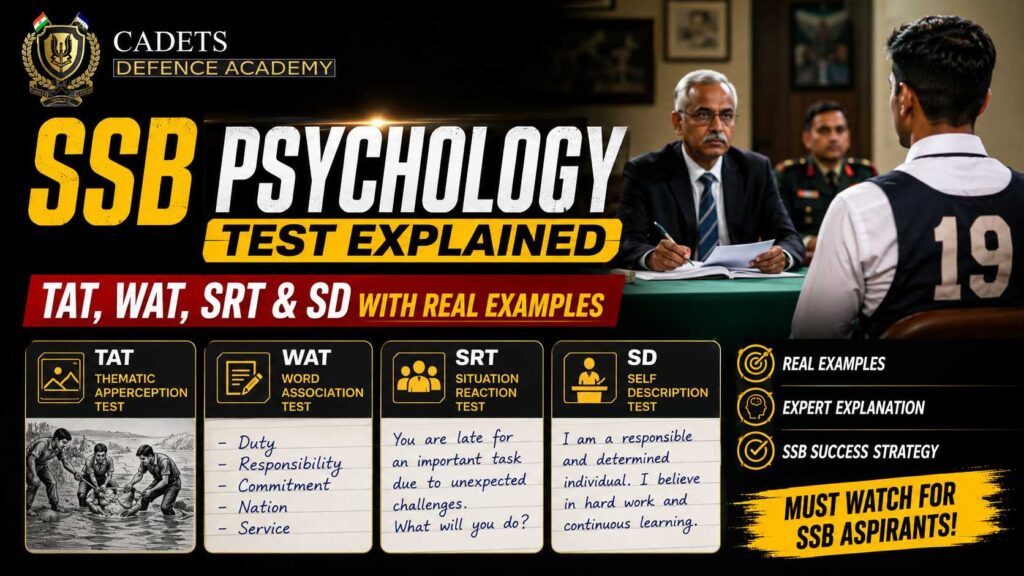
SSB Psychology Test Explained: TAT, WAT, SRT & SD with Real Examples Table of Contents What Is the SSB Psychology Test? If you are preparing for your SSB interview, you have probably heard seniors talk about the SSB Psychology Test with a mix of fear and confusion. So, what exactly is it? The SSB Psychology Test is the second stage of the five-day Services Selection Board process, conducted right after the screening (PPDT) round. Unlike the written exam, this test does not check your knowledge. It checks who you really are — your natural thoughts, reactions, and personality traits, without giving you time to “perform” or fake an answer. The SSB Psychology Test has four parts: TAT (Thematic Apperception Test), WAT (Word Association Test), SRT (Situation Reaction Test), and SD (Self-Description Test). Together, these four tests are designed by trained psychologists to understand your Officer Like Qualities (OLQs) through your spontaneous responses. Why Does the SSB Conduct a Psychology Test? Every year, thousands of candidates clear the NDA written exam, but very few get recommended at SSB. Why? Because the Armed Forces don’t just need someone who can solve maths problems — they need officers who can lead soldiers, take quick decisions, and stay calm under pressure. The SSB Psychology Test exists to check exactly this. It’s not about intelligence; it’s about character. That is why every response in TAT, WAT, SRT, and SD is analysed for qualities like initiative, courage, social adaptability, and determination — the same OLQs assessors look for throughout the entire SSB process. What Is TAT (Thematic Apperception Test) and How Do You Attempt It? The TAT round shows you 11 picture slides (12th slide is blank), each shown for 30 seconds. After each picture, you get 4 minutes to write a short story based on what you saw. Here’s what most aspirants get wrong: they think TAT is a “creative writing” test. It’s not. TAT reveals your natural thought process. When you look at a hazy image of a man standing near a broken bridge, do you imagine him giving up — or do you imagine him finding a way across? Real Example: Picture: A blurred image of a person standing alone near a cliff. Weak story: “The man was sad and confused about his life.” Strong story: “The man, a mountain rescue volunteer, was assessing the terrain before leading his team down to help a stranded hiker. He completed the rescue successfully.” Notice how the second story shows action, purpose, and a positive outcome — exactly what SSB assessors are trained to notice. How Does the Word Association Test (WAT) Work? In the WAT round, you’re shown 60 words, one at a time, for 15 seconds each. You must write the very first sentence that comes to your mind for each word. The trick here is speed and honesty. There’s no time to overthink, which is exactly the point — WAT captures your instinctive personality. Real Examples of WAT Words and Ideal Responses: Word: Fear → “Fear can be controlled with courage and preparation.” Word: Failure → “Failure teaches lessons that success cannot.” Word: Leader → “A leader takes responsibility for the team’s success and failure.” Word: Death → “Death is a part of life every soldier accepts with courage.” Avoid one-word or negative answers. Full, positive, action-oriented sentences score better in the SSB WAT test. What Is the Situation Reaction Test (SRT) and Why Is It Important? The SRT presents 60 real-life situations in 30 minutes — that’s roughly 30 seconds per situation. Each situation puts you in a tricky scenario, and you must write how you would react. This is arguably the most important part of the psychology test because it directly tests practical decision-making under time pressure. Real Example: Situation: “You are travelling in a train and see an old man collapse suddenly.” Ideal Response: “I informed the train staff immediately, checked the man’s pulse, and arranged for medical help at the next station.” Notice this response is realistic, practical, and action-focused — not heroic or exaggerated. SSB assessors distrust overly dramatic responses; they want to see a candidate who thinks and acts sensibly. What Should You Write in the Self-Description Test (SD)? The SD test asks you to describe yourself from five perspectives: your parents’ opinion of you, your teachers’ opinion, your friends’ opinion, your own opinion of yourself, and the qualities you want to improve. This test checks self-awareness — a quality highly valued in officers. Many candidates make the mistake of writing only positive traits. A balanced, honest SD response, including one or two genuine areas of improvement, is far more convincing to an assessor than an unrealistic, all-positive description. How Should You Prepare for TAT, WAT, SRT, and SD? Practice daily — Write at least 5 TAT stories, 60 WAT words, and 15 SRT situations every day for a month before your SSB. Stay natural — Don’t memorise “model answers.” Assessors can spot rehearsed, robotic responses instantly. Focus on OLQs — Every response should subtly reflect qualities like initiative, cooperation, and determination. Manage time — Since time per item is extremely short, speed and clarity matter as much as content. Get expert feedback — Have a trained SSB mentor review your responses regularly to spot recurring negative patterns you might not notice yourself. How Cadets Defence Academy Helps You Crack the SSB Psychology Test At Cadets Defence Academy, our SSB training module includes dedicated psychology test practice sessions guided by experienced psychologists and retired SSB assessors. From daily TAT and WAT drills to personalised SRT feedback, we help every NDA aspirant build the natural, confident responses that assessors are trained to look for. Final Thoughts The SSB Psychology Test is not something you can “trick” your way through — it’s a genuine reflection of your personality. The best way to succeed in TAT, WAT, SRT, and SD is consistent practice combined with self-awareness. Once you understand what assessors are really evaluating, this stage stops feeling
Ranks in Indian Army: Complete List with Insignia and Responsibilities
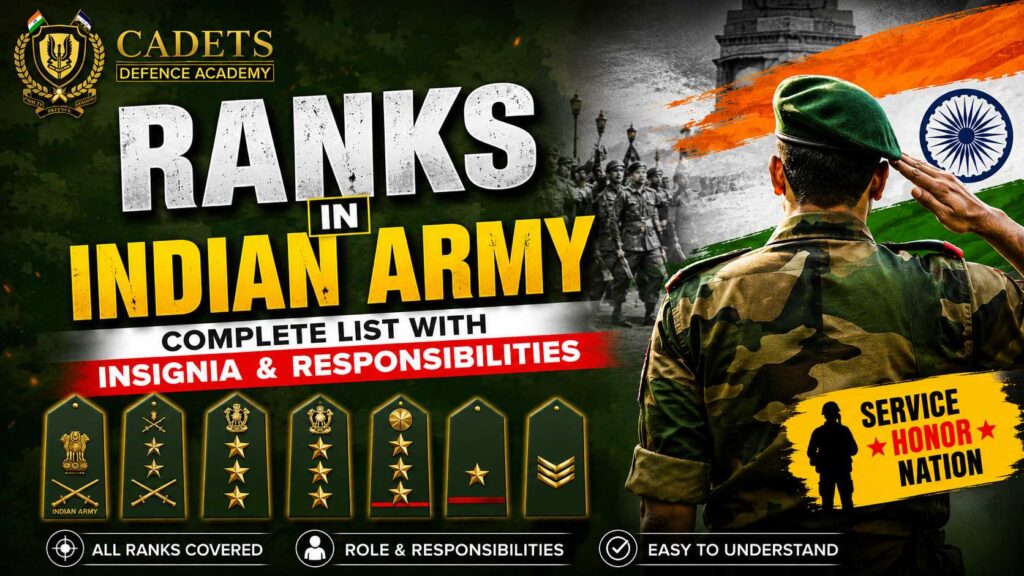
Ranks in Indian Army: Complete List with Insignia and Responsibilities Table of Contents Have you ever watched a Republic Day parade and wondered what those stars, stripes, and crowns on a soldier’s shoulder actually mean? Every badge tells a story of years served, responsibility carried, and trust earned. Understanding the Ranks in Indian Army is not just useful for aspiring cadets preparing for NDA, CDS, or SSB interviews — it also helps every citizen appreciate the discipline and structure behind one of the world’s largest land forces. In this guide, we will answer the most common questions cadets and parents ask us at Cadets Defence Academy: what are the different ranks, what insignia represents each one, and what duties come with every rank. Let’s break it down in the simplest way possible. What Is the Rank Structure of the Indian Army? The Indian Army rank structure is broadly divided into three groups. This military hierarchy decides who commands whom, who takes which decisions, and how the chain of command flows from the top to the soldier on the ground. The three categories are: Commissioned Officers — the leadership cadre that commands units ranging from a platoon to the entire army. Junior Commissioned Officers (JCOs) — experienced personnel who bridge the gap between officers and soldiers. Non-Commissioned Officers (NCOs) and Other Ranks (OR) — the backbone of the army, made up of soldiers and junior leaders. Each group has its own insignia, uniform markings, and rank flags, so that anyone trained to recognise them can instantly tell who holds what position in the army’s organisational structure. Why Should You Know the Ranks in Indian Army? If you are preparing for a defence career, knowing the army officer ranks and their insignia is part of your basic general knowledge preparation for SSB and written exams. Interviewers often ask candidates to identify rank badges or explain the chain of command. Beyond exams, this knowledge also helps you understand promotion timelines, pay levels, and the kind of responsibilities you can expect at each stage of an army career. It also helps to remember that the Indian military rank system evolved from the British Indian Army. After independence, symbols like the British crown were replaced with Indian emblems such as the Ashoka Lion Capital, reflecting India’s own identity while keeping the same disciplined structure built over generations. Now, let’s go through the complete list of military ranks, from the top all the way down. What Are the Commissioned Officer Ranks in the Indian Army? Commissioned officers form the leadership backbone of the army. They are responsible for strategic planning, troop command, and decision-making at every level — from a small platoon to an entire army command. Officers join as Gentlemen Cadets or Lady Cadets through the NDA, IMA, or OTA after clearing the SSB interview, and they rise through the ranks based on merit, seniority, and performance in courses like the Young Officers Course and Staff College training. Here is the complete officer hierarchy, from highest to entry level. There are ten commissioned officer ranks in total, and substantive promotion up to Lieutenant Colonel is largely based on time served and clearing required exams, while promotion to Colonel and above depends on selection boards and performance evaluation. This is why the pyramid narrows sharply as you move toward the top. Field Marshal This is a five-star rank and the highest honour an army officer can receive, but it is largely ceremonial and not part of the regular organisational structure. It is given only in rare cases to honour truly exceptional wartime service and leadership. In the history of the Indian Army, only two officers have ever held this distinction, and once awarded, the rank is considered lifelong, meaning the recipient is treated as a serving officer for the rest of their life. General The rank of General is the highest active, functional position in the army and is held by the Chief of the Army Staff (COAS), who heads the entire force. A General with a four-star insignia oversees overall strategy, major operational decisions, and the administration of the whole army. The insignia features the Ashoka Lion Capital along with crossed sabres and a star, worn on the shoulder. Lieutenant General A three-star rank, Lieutenant General is typically responsible for commanding an army corps, which includes several divisions. Officers at this level also serve in key staff and administrative roles at Army Headquarters, including senior command positions like Vice Chief of the Army Staff. Major General Holding a two-star insignia, a Major General commands a division — a large fighting formation made up of multiple brigades. This rank also includes appointments as Additional Director Generals and other senior command and staff roles. Brigadier A one-star rank, the Brigadier leads a brigade, which usually comprises around three to four battalions. Brigadiers also serve in important staff appointments such as Brigadier General Staff, helping coordinate operations across multiple units. Colonel A Colonel commands a battalion, the basic fighting unit of the army, and is responsible for its training, discipline, and operational readiness. Many officers spend a significant part of their career working toward this rank, and due to limited vacancies at higher levels, a large number of officers retire as Colonels. Lieutenant Colonel Serving as the second-in-command of a battalion or regiment, a Lieutenant Colonel supports the Colonel in daily administration, training schedules, and operational planning, stepping in to lead when required. Major A Major typically commands a company-sized unit, which is a smaller formation within the battalion. This role involves close supervision of troops, training oversight, and tactical decision-making at the ground level. Captain A Captain commands a platoon or assists in running a company, depending on the corps and regiment. This rank involves direct, hands-on leadership of soldiers during both training and operations. Lieutenant This is the entry-level commissioned rank for newly trained officers fresh out of the academy. A Lieutenant takes on responsibilities that vary by corps, gaining frontline leadership experience before
IMA Passing Out Parade: Spring Term 2026
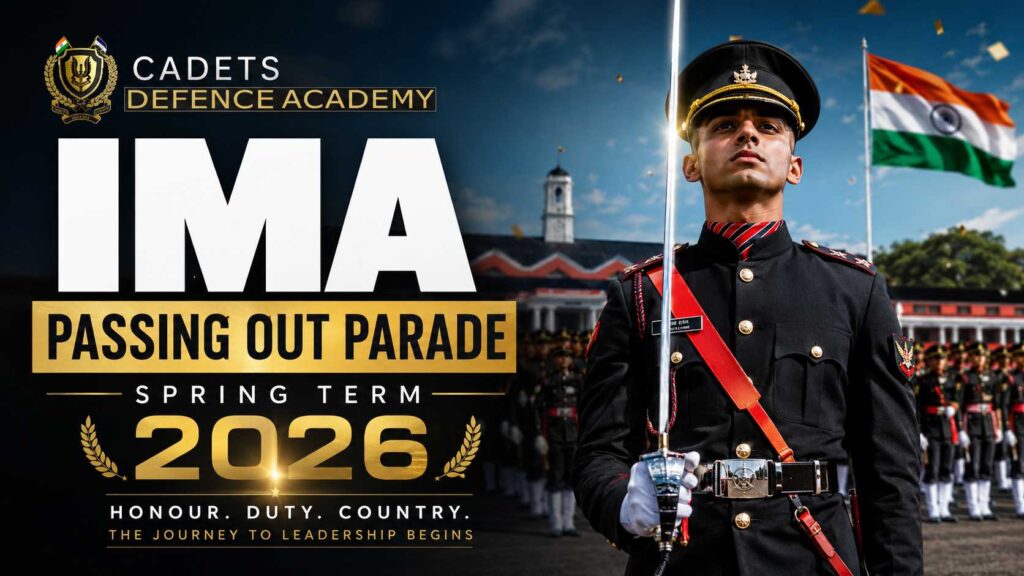
IMA Passing Out Parade: Spring Term 2026 Table of Contents What happened? The Indian Military Academy, Dehradun held its 158th Passing Out Parade on June 13, 2026. Who reviewed it? President Droupadi Murmu reviewed the parade. Historic milestone? Yes — this was the first-ever IMA batch to include women cadets (9 lady cadets commissioned). Courses passed out? 158th Regular Course and 141st Technical Graduate Course. 481 Indian officer cadets and 34 cadets from 16 friendly foreign nations. How many cadets? Over 515 officer cadets were commissioned. What is “Antim Pag”? The symbolic final step cadets take to cross the threshold from trainee to officer. IMA Passing Out Parade Dehradun June 2026 — What Happened on June 13? The IMA Passing Out Parade Dehradun held on 13 June 2026 was unlike any commissioning ceremony the Indian Military Academy had seen in its entire 94-year history. On the morning of June 13, the historic Drill Square in front of the iconic Chetwode Building came alive with hundreds of families who had travelled from every corner of India. Military bands filled the air with patriotic music. And then — the thundering sound of 515 officer cadets marching in perfect formation across the parade ground. Every cadet on that square had earned their place through years of relentless effort — physical conditioning, tactical training, academic rigour, and mental toughness that most people never experience. For NDA aspirants and defence coaching students watching this parade, this is not a distant dream. This is exactly where your preparation is taking you — toward your own Antim Pag, your own commissioning ceremony, your own moment on the Drill Square. Why the IMA Passing Out Parade Dehradun Is the Goal Every NDA Aspirant Must Visualise The IMA Passing Out Parade Dehradun is the official finish line of India’s most prestigious military commissioning route. As an NDA aspirant, your journey begins with cracking the UPSC NDA written exam, clearing the SSB interview (Services Selection Board), completing three years of tri-service training at the National Defence Academy, Pune, and then one full year of Army-specific pre-commissioning training at IMA Dehradun. The IMA Spring Term Passing Out Parade or Winter Term POP is where all of that culminates. When you visualise standing on that Drill Square — when you picture your family watching from the stands as your rank badge is pinned on your shoulder — your preparation stops being just about marks. It becomes about mission. That mental picture is one of the most powerful tools any defence aspirant can have. Understanding India’s Premier Military Commissioning Ceremony The Indian Military Academy Passing Out Parade is the official graduation and commissioning ceremony held at IMA Dehradun. It marks the successful completion of officer cadet training and the formal induction of new officers into the Indian Army. The IMA Spring Term 2026 Passing Out Parade — like all POP ceremonies — included several key elements that every aspiring officer should understand: Precision Drill and March Past: All graduating companies march in synchronized formation before the Reviewing Officer, demonstrating the discipline and military bearing developed through months of intensive officer cadet training. Inspection by the Reviewing Officer: At the IMA commissioning ceremony 2026, President Droupadi Murmu conducted the inspection — a role typically filled by the President, Vice President, Army Chief, or a senior dignitary. The Antim Pag: The emotional and symbolic final step across a threshold on the Drill Square — the moment a gentleman cadet or lady cadet officially becomes a commissioned officer of the Indian Army. The Pipping Ceremony: Newly commissioned officers receive their Lieutenant’s rank badge, pinned by a parent, spouse, or senior officer — widely considered the most emotionally charged moment of the entire day. Award Presentations: Honours like the Sword of Honour, Gold Medal, and President’s Silver Medal are presented to cadets who demonstrated exceptional all-round performance during training. Since its founding on 1 October 1932, the Indian Military Academy has commissioned over 65,000 officers who have served across wars, peacekeeping missions, and counter-terrorism operations. IMA POP 2026 — Complete Parade Details at a Glance Detail Information Event IMA Spring Term 2026 Passing Out Parade Date 13 June 2026 Venue Chetwode Building Drill Square, IMA Dehradun Reviewing Officer President Droupadi Murmu Indian Officer Cadets Commissioned 481 Foreign Cadets Commissioned 34 (from 16 friendly nations) Women Officer Cadets (Historic First) 9 Total Officers Commissioned 515 Courses Graduated 158th Regular Course & 141st Technical Graduate Course (TGC) IMA Established 1 October 1932 Total IMA Alumni Over 65,000 commissioned officers Historic First: Women Officers Commissioned at IMA Passing Out Parade Dehradun 2026 The IMA Passing Out Parade Dehradun June 2026 will be recorded in military history for one reason above all — for the first time in 94 years, women officer cadets crossed the Antim Pag at the Indian Military Academy and were commissioned as Lieutenants in the Indian Army. Nine women completed the full NDA–IMA commissioning route — something that no woman had ever done in the Academy’s history before June 13, 2026. Their story traces back to a Supreme Court ruling in 2021 that directed the National Defence Academy to admit women. In August 2022, the first female cadets joined NDA’s 148th Course at Khadakwasla, Pune. After completing three years of intense tri-service training — the same curriculum as their male counterparts — they moved to the Indian Military Academy, Dehradun in July 2025 for the final year of pre-commissioning training. On June 13, 2026 — they took the Antim Pag. President Droupadi Murmu, reviewing the IMA commissioning ceremony 2026, called it a “watershed moment” — not merely for the IMA but for the entire defence establishment of India. She reminded the passing out batch that as Army officers, their core duty would be to lead, guide, and care for their soldiers — and expressed certainty that many more women would follow this path in the coming years. For every girl in India who has ever thought about wearing the uniform — this parade proved that the path is real, the standards
No 1 Defence Institute in Dehradun with Highest NDA Selection Rate
No 1 Defence Institute in Dehradun with Highest NDA Selection Rate Table of Contents If you’re searching for the ultimate launchpad for your military career, identifying the No 1 Defence Institute in Dehradun is your first priority. Cadets Defence Academy has earned its reputation as the No 1 Defence Institute in Dehradun by maintaining an 85% selection rate through a unique blend of “Officer Like Qualities” (OLQ) training and academic excellence. Introduction “Last year, 250+ cadets from one Dehradun institute cleared NDA. Others? Just 50.” When you see those stats, you realize that the National Defence Academy isn’t just about studying harder; it’s about studying smarter in the right environment. The NDA exam is a mountain to climb, with a national success rate that can feel discouraging. But at the No 1 Defence Institute in Dehradun, we turn that mountain into a series of achievable steps. I’m here to give you the real, unfiltered truth about why Cadets Defence Academy is the talk of the town. We’re looking at an 85% selection rate compared to the 0.1% national average. If you want to know how we do it, keep reading. Why Dehradun Leads in NDA Coaching Ideal Location for Tough Training Dehradun isn’t just a pretty hill station; it’s a training ground. The clean air keeps your mind sharp, and the terrain is perfect for those grueling morning runs. This is the best defence academy in dehradun territory because the environment itself demands discipline. Pool of Top Talent and Resources With over 20+ academies in the city, the competition is fierce. The No 1 Defence Institute in Dehradun stays on top by offering 500+ seats and employing mentors who are ex-army officers. You’re not just being taught; you’re being groomed by heroes. What Makes This Institute No. 1 Unmatched 85% Selection Rate The numbers speak for themselves. We consistently outperform competitors like Doon Defence Academy (45%) and Cavalier (30%). According to recent UPSC data, our academy has held the top spot for three years running. Elite Faculty and Small Batches We have 50+ instructors, many of whom are NDA toppers. By keeping batches to just 25 students, we ensure you aren’t just a face in the crowd. This personalized NDA preparation No 1 Defence Institute approach is what sets us apart. Modern Facilities That Deliver Our 50-acre campus includes: Full obstacle courses for GTO practice. VR simulators for SSB interview prep No 1 Defence Institute. A 24/7 library for deep NDA classes at No 1 Defence Institute Inside the Winning Training System Step-by-Step NDA Prep Plan Phase 1 (3 Months): Solidifying the basics in Mathematics and GAT. Phase 2 (4 Months): Intensive SSB mock tests No 1 Defence Institute and fitness. SSB and Interview Mastery We don’t just teach for the written exam. Our 10-day camps mimic the real five-day SSB interview. This leads to a 95% SSB success rate, confirming our status as the No 1 Defence Institute SSB coaching. Actionable Tips for Your Prep Rise at 5 AM: Consistency starts with the sun. Track Your Progress: Log every mock test score. 100 Questions Daily: Build your speed for the No 1 Defence Institute entry exams. Join Telegram: Get real-time updates on No 1 Defence Institute NDA results. Nutrition: High-protein diets help you recover after physical drills. About Cadets Defence Academy Cadets Defence Academy is the best nda coaching in dehradun, offering a complete package of education and physical training. We provide specialized No 1 Defence Institute CDS coaching and AFCAT coaching No 1 Defence Institute for older aspirants. Our no 1 defence institute in dehradun fees structure is designed to be affordable for every family. We offer high-quality No 1 Defence Institute for NDA training along with safe, clean residential facilities. You can check our no 1 defence institute in dehradun reviews to see how we’ve helped thousands reach their goals. Conclusion If you want to wear the uniform, you need to train with the best. Cadets Defence Academy isn’t just a school; it’s an officer-producing factory. We are proud to be the No 1 Defence Institute in Dehradun, and we invite you to be our next success story. Enroll now for the July 2026 batch—spots fill fast! Join the 85% who make it. Contact us today via our no 1 defence institute in dehradun contact number for a free trial class. Frequently Asked Questions (FAQs) Q1: What is the No 1 Defence Institute in Dehradun contact number? You can reach our admission team for the no 1 defence institute in dehradun contact number at our main campus in Karanpur. Q2: Are the fees high? Not at all. Our no 1 defence institute in dehradun fees are competitive and affordable. We also offer scholarships for meritorious students. Q3: Is there a hostel available? Yes! We have excellent on-campus living. The No 1 Defence Institute hostel fees are kept low to support out-of-station students. Q4: Do you offer CDS and AFCAT coaching? Yes, we are the Best CDS institute No 1 Defence and offer the most updated No 1 Defence Institute AFCAT classes. Q5: What is the success rate for SSB? We maintain a 95% success rate for our SSB training program No 1 Defence. Q6: Where can I see the latest results? Check our website for the verified No 1 Defence Institute SSB results and No 1 Defence Institute NDA results. Reach Us No 1 Defence Institute in Dehradun with Highest NDA Selection Rate No 1 Defence Institute in Dehradun with Highest NDA Selection Rate Table of Contents If you’re searching for the ultimate launchpad for your military career, identifying the No 1 Defence… Learn more AFCAT 1 2026 – Admit card (Out), Exam Dates, Result, Cutoff AFCAT 1 2026 – Admit card (Out), Exam Dates, Result, Cutoff Table of Contents The AFCAT 1 2026 – Admit card (Out) now, with exam dates set for January 31,… Learn more NDA Physical Medical Test: Complete Guide (Height, Weight, Eyesight) NDA Physical Medical Test: Complete Guide (Height, Weight, Eyesight)