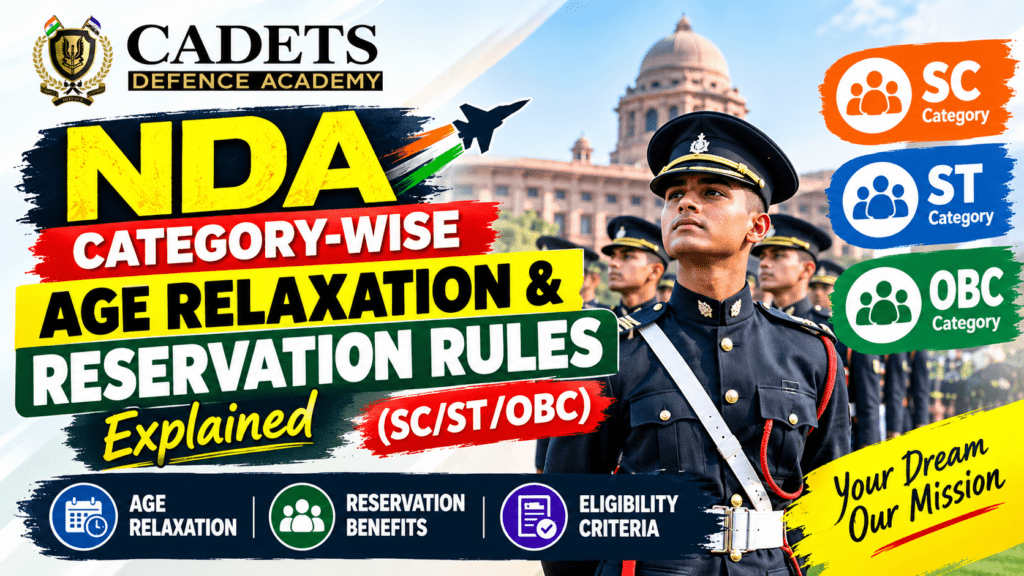
Every year, thousands of SC, ST, OBC, and EWS candidates search for NDA category-wise age relaxation hoping to find a few extra years to apply. This confusion is completely understandable — after all, exams like the UPSC Civil Services grant SC/ST candidates a 5-year relaxation and OBC candidates a 3-year relaxation. So why wouldn’t the National Defence Academy exam work the same way?
The honest answer, backed by official UPSC notifications, is that NDA category-wise age relaxation does not exist in the way most aspirants imagine. The National Defence Academy exam runs on a fixed, uniform age band for every candidate, irrespective of caste or category. What NDA does offer instead is seat reservation — a completely different concept from age relaxation.
In this guide by Cadets Defence Academy, Dehradun’s trusted name in defence coaching, we break down exactly how NDA reservation works, what SC/ST/OBC/EWS candidates actually get, the documents you need, and how it compares with CDS and CAPF rules. If you’re preparing for NDA 1 or NDA 2, this is the one article that will clear every doubt around NDA category-wise age relaxation.
Does NDA Give Age Relaxation to SC/ST/OBC? (The Truth Most Aspirants Get Wrong)
Let’s address the myth head-on: NDA does not give age relaxation to SC, ST, or OBC candidates. This is one of the most searched and most misunderstood topics among defence aspirants, largely because other UPSC exams (like the Civil Services Examination) do offer such relaxation.
For the National Defence Academy exam, the upper and lower age limit is fixed at 16.5 to 19.5 years for every applicant — general, SC, ST, OBC, or EWS. There is no additional window of 3 or 5 years added on top of this band for reserved categories. So when an aspirant asks “what is the NDA category-wise age relaxation for OBC candidates,” the direct answer is: there isn’t one. The date-of-birth bracket published in the official UPSC notification applies uniformly to all categories.
This is fundamentally different from recruitment exams under the Department of Personnel and Training, where reserved categories receive age relaxation as a matter of policy. NDA, being a defence academy entrance exam tied to physical and medical standards for cadet training, follows a different logic altogether — one based on a fixed training-age window rather than category-based flexibility.
Why NDA Doesn't Offer Age Relaxation to Any Category
The absence of NDA category-wise age relaxation isn’t an oversight — it’s a deliberate design choice rooted in how defence training works.
- Physical and medical readiness: Cadets join the NDA at a young age because the three-year training at Khadakwasla is physically demanding. A narrow, fixed age band ensures every cadet is developmentally suited to the same rigorous routine.
- Uniform training batches: The Armed Forces prefer cadets who enter training within a tight age bracket so that physical fitness benchmarks, drill standards, and academic pace remain consistent across the batch.
- Different objective than civil service exams: UPSC CSE selects officers for administrative roles where age relaxation compensates for social disadvantage in career progression. NDA selects cadets for a physically intensive military training pipeline, where the logic of extending age doesn’t align with training requirements.
- Legal and policy distinction: Age relaxation and reservation are two separate constitutional tools. Reservation ensures representation in seats; age relaxation extends eligibility windows. The Ministry of Defence and UPSC have chosen to apply only the former to NDA, not the latter.
Because of this, aspirants preparing at any NDA coaching in Dehradun, including our own NDA Foundation Course, are advised to plan their attempts strictly within the standard 16.5–19.5 age window rather than banking on relaxation that doesn’t exist.
NDA Reservation Policy Explained: What Actually Applies
While there’s no NDA category-wise age relaxation, there is a genuine reservation policy — and understanding it correctly matters just as much.
NDA reservation applies at the seat allocation stage, not the age-eligibility stage or the written cut-off stage. In simple terms:
- Every candidate, regardless of category, must fall within the same age bracket to even apply.
- Every candidate, regardless of category, competes on the same written exam paper and cut-off marks.
- Once candidates clear the written exam and SSB interview, final seat allotment is done against category-wise reserved vacancies (SC, ST, OBC-NCL, EWS) as notified by UPSC for that particular course.
This is a crucial distinction that many aspirants miss. Reservation in NDA affects who gets a seat from the final merit list, not who is allowed to sit for the exam or who needs fewer marks to qualify. So while NDA reservation policy genuinely exists and benefits eligible candidates during seat allotment, it should never be confused with age relaxation.
Category-wise Seat Reservation Percentage (SC/ST/OBC)
UPSC follows the standard Government of India reservation framework for NDA seat allocation. Here’s the category-wise breakdown typically applied:
| Category |
Reservation Percentage |
Applicable At |
| SC (Scheduled Caste) |
15% |
Final seat allotment |
| ST (Scheduled Tribe) |
7.5% |
Final seat allotment |
| OBC (Non-Creamy Layer) |
27% |
Final seat allotment |
| EWS (Economically Weaker Section) |
10% |
Final seat allotment |
| General/Unreserved |
Remaining seats |
Final seat allotment |
These percentages are applied to the total vacancies notified for each NDA course and are subject to change based on the latest UPSC notification. Aspirants should always cross-check the current numbers on the official UPSC website before applying, since reservation percentages can be revised.
It’s worth repeating: this table has nothing to do with age. A 19-year-old OBC candidate and a 19-year-old general-category candidate both need to fall within the same date-of-birth window — reservation only decides how many of the final seats are earmarked for each category once merit is established.
OBC Non-Creamy Layer Certificate: Format & Requirement
To claim the 27% OBC reservation in NDA, a candidate must submit a valid Non-Creamy Layer (NCL) certificate, not just a caste certificate. This is where many otherwise-eligible OBC aspirants lose their reservation benefit due to documentation errors.
Key requirements for the OBC-NCL certificate:
- It must be issued by a competent authority (District Magistrate, SDM, or equivalent) on the prescribed central government format.
- It must be current — most exams, including NDA, require the certificate to be issued within a specific validity period (usually within the same financial year as the application).
- It must explicitly state that the candidate does not fall under the “creamy layer” as per central government income and status criteria.
- A state-issued OBC certificate without the “non-creamy layer” clause is not accepted for central government reservation, including NDA.
Aspirants should apply for a fresh NCL certificate close to the application window rather than reusing an old one, since an expired certificate can lead to rejection of the reservation claim even after qualifying.
EWS Reservation in NDA — How It's Different
The Economically Weaker Section (EWS) category was introduced under the 103rd Constitutional Amendment Act, 2019, and it behaves quite differently from SC/ST/OBC reservation.
- No age relaxation anywhere: Just like other categories in NDA, EWS candidates get zero age relaxation. In fact, across almost all central exams, EWS is the one category that never receives extra years on the upper age limit — a common point of confusion for aspirants.
- Income and asset criteria: EWS reservation is based purely on economic status — family income below the prescribed threshold and specific asset limits — rather than caste or tribe.
- Certificate validity: The EWS certificate must be freshly issued for the current financial year. An old certificate, even if the candidate’s income hasn’t changed, is typically not accepted.
- General category candidates only: EWS reservation applies specifically to candidates from the unreserved/general category who meet the economic criteria — SC/ST/OBC candidates already covered under their own reservation cannot additionally claim EWS.
Understanding this distinction is essential because many first-time applicants assume EWS status automatically brings some age benefit, similar to physical disability categories in other exams. In NDA, it does not.
NDA Category-wise Cut-off Trends (NDA 1 & NDA 2)
This is another area where NDA differs sharply from exams like UPSC CSE or state PSCs. UPSC does not release separate category-wise cut-off marks for the NDA written exam. The written exam cut-off — typically requiring at least 25% qualifying marks in each paper (Mathematics and GAT) plus an aggregate cut-off — applies uniformly to General, SC, ST, OBC, and EWS candidates alike.
In recent years, the expected written cut-off for NDA has hovered in the 350–380 mark range (out of 900), with the final selection cut-off (written + SSB) generally falling between 650–720 marks (out of 1800), though these numbers shift slightly between NDA 1 and NDA 2 based on paper difficulty and total vacancies. Since there’s no separate reserved-category cut-off, an SC, ST, or OBC candidate must clear the exact same merit threshold as a general-category candidate to qualify for the SSB interview.
Category-wise reservation only becomes relevant afterward, at the final seat-allotment stage, where the merit list is segmented to fill SC/ST/OBC/EWS vacancies from within the pool of successful candidates. If you’re targeting a competitive rank, structured preparation through a proven NDA Coaching in Dehradun program with regular mock tests can help you comfortably clear the unified cut-off regardless of category.
Documents Required to Claim Reservation Benefits
To ensure your NDA reservation claim is processed smoothly, keep the following documents ready:
- Caste Certificate (SC/ST) issued by a competent authority in the prescribed central format
- OBC Non-Creamy Layer Certificate, issued within the required validity window
- EWS Certificate, issued for the current financial year with income and asset details
- Date of birth proof — Class 10 mark sheet or certificate
- Domicile/residence proof, where applicable
- Photo ID and Aadhaar card for identity verification
- Self-declaration/undertaking, if required by the specific UPSC notification
Always upload clear, valid scanned copies during the online application and carry originals for physical verification at the SSB stage. Incomplete or expired documents are among the most common reasons genuine reserved-category candidates lose their rightful benefit.
Common Mistakes Reserved-Category Candidates Make
Even well-prepared aspirants trip up on avoidable errors:
- Assuming age relaxation exists: The single biggest mistake — applying (or not applying) based on an incorrect belief about NDA category-wise age relaxation, then finding out at the verification stage that the standard age band applies to everyone.
- Using an expired or state-format OBC certificate: Submitting a caste certificate without the “Non-Creamy Layer” clause, which gets rejected during document verification.
- Applying for EWS with an old certificate: EWS status must be certified fresh each cycle; last year’s certificate is often invalid.
- Ignoring the reservation-vs-cutoff difference: Believing reserved categories get relaxed written-exam marks, then under-preparing for the actual (identical) cut-off.
- Not verifying vacancy-wise reservation numbers: Reservation percentages can shift slightly between NDA 1 and NDA 2 depending on notified vacancies — always check the latest notification rather than relying on last year’s figures.
- Delayed certificate procurement: Applying for the required certificate at the last minute and missing the application deadline entirely.
A structured mentorship program, like the one offered under our SSB Coaching and Foundation courses, helps candidates avoid these documentation pitfalls well before the application window opens.
NDA Reservation vs CDS/CAPF Reservation Rules — Quick Comparison
| Parameter |
NDA |
CDS |
CAPF (Assistant Commandant) |
| Age relaxation for SC/ST/OBC |
Not applicable |
Not applicable |
Not applicable |
| Seat reservation (SC/ST/OBC/EWS) |
Applicable at final allotment |
Applicable at final allotment |
Applicable at final allotment |
| Written exam cut-off |
Uniform for all categories |
Uniform for all categories |
Uniform for all categories |
| OBC-NCL certificate required |
Yes |
Yes |
Yes |
| Upper age limit |
19.5 years |
19–25 years (course-dependent) |
Up to 25 years |
| Entry level |
After Class 12 |
Graduate level |
Graduate level |
As the table shows, the core principle stays consistent across nearly all UPSC-conducted defence exams: reservation applies to seats, not to age eligibility. Whether you’re preparing for NDA, exploring our Best CDS Coaching in Dehradun, or targeting CAPF, the same rule of thumb applies — prepare within the fixed age window and let reservation work purely at the seat-allocation level.
Conclusion
Understanding NDA category-wise age relaxation, reservation percentages, and documentation requirements is only the first step. Clearing the exam requires disciplined preparation across Mathematics, English, General Knowledge, and a strong SSB foundation.
At Cadets Defence Academy, Dehradun, we’ve guided aspirants from every category through the complete journey — from written exam preparation to SSB interviews — with structured batches, experienced faculty, and residential facilities. Whether you’re exploring our NDA Foundation Course after 10th, our NDA Coaching after 12th, or need help checking your eligibility with our NDA Age Calculator, our mentors are here to guide you.
Call us at +91 9997034744 / +91 7599367318, or enquire now to check our upcoming batches and start your journey toward becoming an officer.
FAQ: