
ALL About NDA Exam Pattern 2024

ALL About NDA Exam Pattern 2024 (2)

Table of Contents

Introduction

NDA exam pattern for 2024 consists of two papers General Ability test (GAT) and Mathematics, you get 2.5 hours for each exam. You should Understand the exam pattern, before applying for any exam. This will you prepare for the exam and you can increase your chance of success. In this blog we have provided you NDA exam pattern, you can also download free NDA exam syllabus pdf this will help you understand entire NDA exam structure so you can prepare accordingly.

UPSC conducts NDA exam twice a year. This NDA exam pattern guide will help you understand NDA written exam syllabus, marking scheme and SSB interview pattern.

NDA Exam Pattern 2024

By understanding NDA exam pattern you will get a clear idea how to prepare for the exam, so you can create a study schedule based on it. NDA exam is divided into two parts

Part 1: Written Exam – General Ability test (GAT) and Mathematics

Part 2: SSB Interview

A complete understanding of NDA exam will increase your chance to succeed.

NDA Exam Pattern: Overview

A Quick overview of NDA Written Exam:

Particulars

Details

Exam Mode

 Offline

Papers in NDA Exam

1.Mathematics

2. General Ability Test

Total Marks

1.Mathematics – 300 marks

2. General Ability Test – 600 marks

Total Questions

1.Mathematics – 120 question

2. General Ability Test – 150 question

Negative Marking

1.Mathematics – 0.83 marks

2.General Ability Test – 1.33 marks

Exam Duration

2.5 hours (for each section)

NDA Written Exam Pattern

Written exam is the first step in selection process, NDA Written exam written exam is conducted by the UPSC (Union Public Service Commission) and it is divided into two parts General Ability test (GAT) and Mathematics.

NDA GAT Exam Pattern, Syllabus, Marking Schem

GAT is divided into two parts- English and General Knowledge, it tests your English grammar, vocabulary and reading comprehension and your awareness in current affairs and other subjects.

English: This section of GAT has 50 questions, 4 marks each. Total marks for this section is 200. This section will test your knowledge in English vocabulary, grammar and reading comprehension.

General Knowledge: General Knowledge has 100 questions, 4 marks each. Total marks 400. Question in this section will test your knowledge in subjects like Physics, Chemistry, History, Geography, Polity and Current Affairs.

General Ability Exam Pattern

Total Questions

 150

Total Marks

600 marks

Total questions in English Section

50

Total of questions in General Knowledge Section

100

Total Marks for English

200 marks

Total Marks for G.K

400 marks

Marks for Correct Answers

1.English – 4 marks

2.G.K – 4 marks

Marks for incorrect answer

1.English    – (1.33 marks)

2.G.K   – (1.33 marks)

Exam Duration

2.5 hours

Exam Duration

You’ll get 2.5 hours for GAT exam. This means that you will have 150 minutes for 150 questions.

Tips For preparation

  • Stay updated by daily reading newspapers, make sure to verify the source before, some sites that you can check are (The HinduTimes of India)  and also these Government sites for official statements ( Press Information Bureau (PIB),  Ministry of External Affairs(MEA))
  • For other subjects you can use 11th and 12th class NCERT.
  • Avoid guessing answers, because NDA GAT exam has negative marking scheme.
  • If you want proper guidance you can join an NDA coaching center (optional).

NDA Math’s Exam Pattern, Syllabus, Marking Scheme

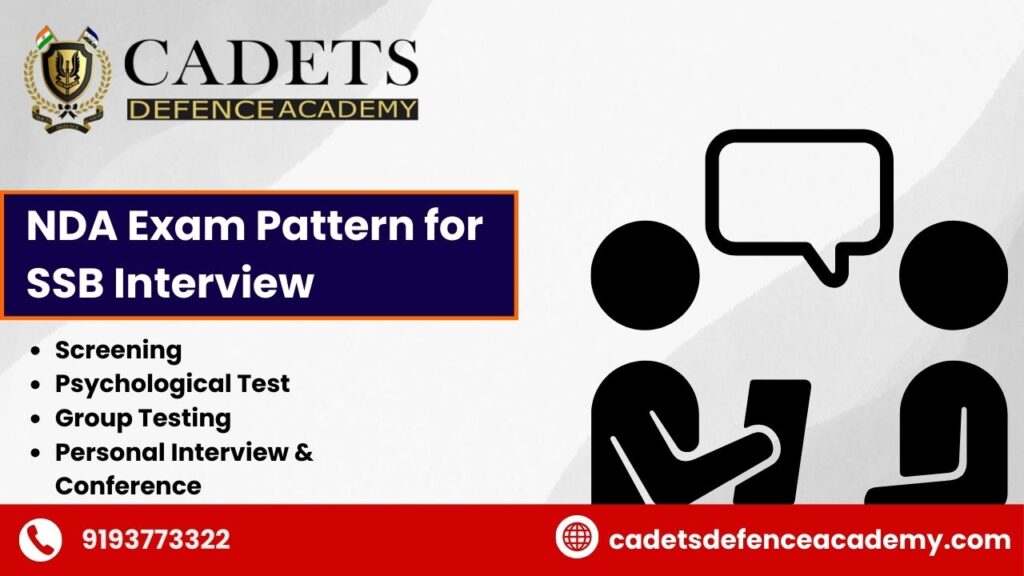
NDA Exam Pattern for SSB Interview

NDA Maths exam consists of 120 questions, 2.5 marks each and -0.83 will be deducted for each wrong answer. Total marks for this exam is 300.  NDA Math’s Exams checks fundamental mathematical concepts covered in 11th, and 12th NCERT.

NDA Mathematics Exam Pattern

Total Questions

120

Total Marks

300

Marks for correct answer

2.5 marks

Marks for incorrect answer

-(0.83) marks

Exam Duration

2.5 hours

Points To Remember During NDA , SSB Interview

Be honest: Do not lie while answering the questions because SSB interviewers are highly trained professionals skilled at catching lies. They can catch your lies by cross questioning or body language and if you are caught lying, you’ll most likely be disqualified from the selection process.

Stay Updated: You can be asked about current affairs, this shows your general awareness and it can increase your chance of selection.

Prepare for Tests: Practice Writing Picture Perception Description Tests (PPDT) and Situation Reaction Tests (SRTs). There are many resources available online and can join good coaching centers to help you prepare for these tests.

Maintain Physical Fitness:  SSB interview also includes physical activities. So make sure you are in good physical condition.

Dress Formally: Be aware of your Dressing sense, Dress decently and appropriately throughout the SSB interview.

Teamwork: The SSB interview heavily focuses on teamwork skills. Be a good listener, participate actively in group discussions, and cooperate with your fellow candidates.

Leadership: Demonstrate leadership qualities by taking initiative, organizing tasks, and motivating others.

NDA Marking Scheme

In the end we will also see NDA Marking Scheme for the written exam:

Elements 

Mathematics

GAT

Total Questions

120

150

Total Marks

300

600

Marks for correct answer

2.5

4

Marks for incorrect answer

-0.83

-1.33

Also, check

Contact Us

For any inquiries or assistance regarding NDA coaching in Dehradun, feel free to reach out to us. Here’s how you can get in touch:

Address:  Sahastradhara Rd, near kriti appartment, opp. shani dev mandir, B Block, Aman Vihar, Dehradun, Uttarakhand 248001
Visit us at our campus located in Dehradun.

Phone Numbers:
You can contact us directly via phone for immediate assistance. Our phone numbers are +91- 099970 34744and + 91-7599367318.

Email: cadetsdefenceacademy@gmail.com
Do you have a question or require additional details? Send us an email at cadetsdefenceacademy@gmail.com  Our team will get back to you promptly with the answers you need.

Website & Social Media Links:
Explore our website, www.cadetsdefenceacademy.com, for comprehensive details about our NDA coaching programs and facilities. Stay updated with the latest news and announcements by following us on social media. Find us on Facebook, Twitter, and Instagram

Feel free to reach out to us through any of the channels mentioned above. We’re here to assist you on your journey towards achieving your NDA coaching goals in Dehradun.

NDA Exam Pattern 2024 FAQs

You need to be 16.5 and 19.5 years old

NDA selection process has two stages:

  1. Written Exam conducted by UPSC.
  2. SSB Interview conducted by Services Selection Board.

Yes NDA exam has negative marking scheme for both Mathematics and GAT.

There is no minimum qualifying marks for the NDA written exam however, to get shortlisted for the SSB interview, you need to score above the cut-off marks set by UPSC.

Reach Us

NDA Medical Test Success Guide: Understanding Requirements and Avoiding Common Disqualifications

NDA Medical Test Success Guide: Understanding Requirements and Avoiding Common Disqualifications

NDA Medical Test Success Guide: Understanding Requirements and Avoiding Common Disqualifications Table of Contents Introduction: Why Medical Fitness Determines Your Military Career You’ve worked hard for months, cleared the challenging NDA written exam, and successfully navigated the intense five-day SSB interview. But your journey to the National Defence Academy isn’t complete yet. The NDA medical examination stands as the final, crucial checkpoint that determines whether you’ll wear the uniform or face unexpected disqualification. Every year, hundreds of deserving candidates receive SSB recommendations only to face rejection during medical tests. At Cadets Defence Academy in Dehradun, we’ve witnessed talented aspirants devastated by preventable medical disqualifications. This comprehensive guide will help you understand NDA medical test requirements, prepare your body systematically, and avoid common pitfalls that end military dreams. Understanding the NDA Medical Examination What is the NDA Medical Test? The NDA medical examination is conducted at Armed Forces Medical Examination Centers after you receive your SSB recommendation. This isn’t a simple health checkup; it’s a comprehensive evaluation ensuring you meet the stringent physical standards for defense aspirants required for rigorous military training and service. Why Medical Standards Are So Strict The Indian Armed Forces operate in the world’s most challenging terrains: Extreme Altitudes: Soldiers serve at Siachen Glacier (21,000 feet) where oxygen levels are 50% lower than sea level. Your heart, lungs, and blood circulation must function optimally. Desert Conditions: Rajasthan border posts experience 50°C temperatures. Your body’s heat regulation system must be flawless. Naval Service: Submarine officers spend months underwater in confined spaces. Claustrophobia, ear problems, or sinus issues can be life-threatening. Aviation Requirements: Pilots need perfect vision, spatial orientation, and cardiovascular fitness for high-G maneuvers. Combat Situations: Officers must carry wounded comrades, operate for days without sleep, and make critical decisions under extreme physical stress. Any medical condition that compromises these capabilities leads to disqualification—not because you’re unworthy, but because safety (yours and your unit’s) is paramount. Medical Examination Process Timeline Step 1: Documentation (Day 1) Report to Armed Forces Medical Center with SSB recommendation Submit required documents and previous medical records Receive initial briefing about examination process Step 2: Preliminary Screening (Day 1) Basic vital signs measurement Initial physical examination Height, weight, and body mass assessment Step 3: Detailed Medical Tests (Day 2-3) Vision and eye examination ENT (Ear, Nose, Throat) evaluation Cardiovascular fitness tests Respiratory system assessment Musculoskeletal examination Dental evaluation Abdominal and internal organ checks Neurological assessment Psychological evaluation Step 4: Specialized Tests (As Required) ECG (Electrocardiogram) for heart function X-rays (chest, spine, joints as needed) Blood tests (hemoglobin, blood group, sugar levels) Urine examination Audiometry for hearing assessment Step 5: Medical Board Review Panel of senior medical officers reviews all reports Determines fitness category Issues final medical certificate or temporary/permanent rejection Detailed NDA Medical Standards and Requirements Height and Weight Standards For Male Candidates (Army and Air Force) Minimum Height: 157.5 cm (5 feet 2 inches) Height can be relaxed to 157 cm for candidates from hilly regions Weight must be proportionate to height and age For Female Candidates (Permanent Commission – Army) Minimum Height: 152 cm (5 feet) Weight must be proportionate to height and age For Naval Candidates Minimum Height: 157 cm for all entries Leg Length: Minimum 81.5 cm Weight Assessment: Medical boards use Body Mass Index (BMI) for evaluation: Acceptable BMI Range: 18.5 to 25 Underweight (BMI below 18): May face temporary rejection Overweight (BMI above 25): Temporary rejection until weight normalized Important: Weight can be corrected before reappearing for medical. Focus on healthy weight gain or loss through proper nutrition and exercise. Vision Standards – Critical Requirements Vision standards are among the strictest and most common disqualification causes: For Army Candidates (Technical Entry) Distant Vision: 6/6 in better eye, 6/9 in worse eye (without glasses) Myopia: Maximum -3.5 D Hypermetropia: Maximum +3.5 D No color blindness No night blindness For Air Force Candidates (Pilot/Navigator) Distant Vision: 6/6 in both eyes (without correction) No refractive error acceptable for pilot entry Perfect color perception No history of eye surgery (including LASIK) For Naval Candidates Distant Vision: 6/6, 6/9 (correctable to 6/6, 6/6 with glasses) Myopia up to -2.5 D acceptable Color perception must be CP-III standard minimum Common Eye Disqualification Causes: Progressive myopia (continuously worsening vision) Color blindness (inability to distinguish red-green) Night blindness (poor vision in low light) Squint or eye muscle weakness Previous eye surgeries or injuries Retinal problems or detachment Prevention Strategy: Get comprehensive eye examination 6 months before NDA exam If wearing glasses, maintain stable prescription Practice eye exercises to reduce strain Eat vitamin A-rich foods (carrots, papaya, eggs) Avoid excessive screen time Never hide eye problems hoping they’ll be overlooked Dental Standards and Requirements Many candidates underestimate dental health importance: Minimum Requirements: At least 14 dental points (specific teeth count as different points) No active dental decay or cavities No severe gum disease (pyorrhea) No impacted wisdom teeth causing problems Adequate bite strength Dental Point System: Each front tooth (incisors) = 1 point Each premolar = 1 point Each molar = 2 points Common Dental Disqualifications: Severe tooth decay affecting multiple teeth Missing teeth without prosthetics Advanced gum disease Jaw alignment problems Insufficient chewing capability Prevention Strategy: Visit dentist immediately after SSB recommendation Get any required fillings or extractions done early Maintain excellent oral hygiene Fix any cavities promptly Get dental clearance certificate before medical Cardiovascular and Respiratory Fitness Your heart and lungs power everything you do in military service: Heart Standards: Normal heart rate: 60-100 beats per minute at rest No murmurs or irregular rhythms Blood pressure: 120/80 mmHg (acceptable range 100/70 to 140/90) No history of heart disease, rheumatic fever, or congenital defects Normal ECG readings Respiratory Standards: Normal breathing patterns No chronic asthma or wheezing No tuberculosis history Chest expansion: Minimum 5 cm difference between full inhalation and exhalation No chronic bronchitis or respiratory allergies Common Cardiovascular Disqualifications: Heart murmurs or valve problems Irregular heartbeat (arrhythmia) High or very low blood pressure History of rheumatic fever Congenital heart defects Prevention Strategy: Regular cardiovascular

Mental Health and Stress Management for NDA Aspirants: Your Complete Wellness Guide

Mental Health and Stress Management for NDA Aspirants: Your Complete Wellness Guide

Mental Health and Stress Management for NDA Aspirants: Your Complete Wellness Guide Table of Contents   Introduction: Why Mental Health Matters in Your NDA Journey Preparing for the National Defence Academy exam is more than just academic excellence and physical fitness. The mental and emotional challenges that defense aspirants face can be equally demanding. At Cadets Defence Academy, we understand that mental health for defense aspirants is a crucial component of successful preparation that often gets overlooked. Every year, thousands of students in Dehradun and across India dream of wearing the uniform and serving the nation. However, the pressure to excel in the NDA written exam, maintain peak physical fitness, and prepare for the rigorous SSB interview can create significant stress. This comprehensive guide will help you understand and manage the psychological aspects of NDA preparation effectively. Understanding Stress in NDA Preparation Common Sources of Stress for Defense Aspirants Defense aspirants face unique pressures that set them apart from other competitive exam candidates: Academic Pressure: The NDA syllabus covers Mathematics and General Ability Test with high competition levels. Students must maintain consistency in both subjects while managing school or college studies simultaneously. Physical Fitness Demands: Unlike other exams, NDA preparation requires daily physical training, running, strength exercises, and maintaining specific fitness standards. Balancing academic study with physical training creates time management challenges. Family Expectations: Many aspiring officers come from families with defense backgrounds or carry the weight of being the first in their family to pursue this career. These expectations can add emotional pressure. Peer Competition: Training alongside other motivated students in coaching institutes can sometimes create comparison anxiety and self-doubt. Financial Investment: The cost of coaching, study materials, and preparation resources adds responsibility and pressure to succeed. Recognizing Signs of Exam Stress and Anxiety Physical Symptoms Your body often signals stress before your mind fully processes it: Difficulty sleeping or irregular sleep patterns Frequent headaches or body aches Loss of appetite or overeating Constant fatigue despite adequate rest Increased heart rate during study sessions Digestive issues or stomach discomfort Emotional and Mental Symptoms Exam anxiety for NDA students manifests through: Feeling overwhelmed by the syllabus Constant worry about failure Difficulty concentrating during study hours Irritability with family and friends Loss of motivation or interest Negative self-talk and self-doubt Panic attacks before mock tests If you experience three or more of these symptoms regularly, it’s time to implement stress management techniques. Effective Stress Management Techniques for NDA Aspirants Daily News: Read newspapers like The Hindu or The Indian Express regularly. Magazines: Subscribe to monthly magazines like Pratiyogita Darpan and Yojana. Online Resources: Use websites like GKToday and government portals for updated information. Effective Stress Management Techniques for NDA Aspirants 1. Time Management and Structured Routine Creating a balanced daily schedule is fundamental to NDA exam stress management: Morning Routine (5:00 AM – 8:00 AM) Wake up at a fixed time daily 30 minutes of meditation or deep breathing Physical training: running, exercises, yoga Healthy breakfast with family Study Sessions (9:00 AM – 1:00 PM) Mathematics practice and concept building Take 10-minute breaks every hour Stay hydrated and maintain posture Afternoon Break (1:00 PM – 3:00 PM) Nutritious lunch 20-minute power nap (optional) Light reading or hobby time Evening Study (3:30 PM – 7:00 PM) General Ability Test preparation Current affairs reading Mock test practice Relaxation Time (7:30 PM – 10:00 PM) Family time and dinner Review daily progress Prepare next day’s schedule Sleep by 10:00 PM This structure creates predictability and reduces anxiety about managing multiple preparation aspects. 2. Breathing Exercises for Instant Calm When stress peaks during study sessions or mock tests, use these techniques: Box Breathing Technique Inhale slowly for 4 counts Hold breath for 4 counts Exhale slowly for 4 counts Hold empty lungs for 4 counts Repeat 5 times This military-taught technique helps regulate your nervous system and improves focus instantly. 4-7-8 Breathing Method Breathe in through nose for 4 seconds Hold breath for 7 seconds Exhale completely through mouth for 8 seconds Practice before sleep for better rest quality 3. Mindfulness and Meditation for Defense Students Mental wellness for NDA coaching includes developing present-moment awareness: Morning Meditation (15 minutes) Sit in a comfortable position Focus on your breath When thoughts arise, acknowledge and return to breathing This builds the mental discipline required for military service Study Break Meditation (5 minutes) Close your eyes between study sessions Visualize successfully completing your exam Imagine yourself in NDA uniform Return to studies with renewed energy Studies show that regular meditation improves concentration by up to 40% and reduces anxiety levels significantly. 4. Physical Activity as Stress Relief Your daily physical training serves dual purposes: Stress Reduction Benefits Running releases endorphins (natural mood elevators) Exercise reduces cortisol (stress hormone) Physical exhaustion improves sleep quality Team sports build social connections Mental Clarity Enhancement Morning runs clear mental fog Yoga improves focus and flexibility Strength training builds confidence Outdoor activities provide mental breaks At Cadets Defence Academy, we integrate physical training with mental wellness practices, understanding their interconnected nature. 5. Nutrition for Mental Performance What you eat directly impacts your mental state: Brain-Boosting Foods Walnuts and almonds for memory Bananas for instant energy and mood regulation Dark chocolate (in moderation) for stress relief Green vegetables for sustained energy Sufficient water intake (3-4 liters daily) Foods to Avoid Excessive caffeine (causes anxiety spikes) Processed sugary snacks (energy crashes) Heavy meals before study sessions Late-night eating (disrupts sleep) 6. Social Support Systems Stress relief techniques for NDA students must include human connection: Family Communication Share your feelings openly with parents Explain the preparation process to them Set realistic expectation levels together Celebrate small victories Peer Support Study groups with fellow aspirants Share challenges and solutions Healthy competition, not comparison Learn from each other’s strengths Mentor Guidance Regular discussions with faculty members Seek advice on specific concerns Professional guidance for career clarity Special Stress Management for SSB Interview Preparation The SSB interview creates unique psychological pressures. Here’s how to manage them: Psychological Test

What is NDA Salary After Selection in 2026? Complete Training to Officer Pay Breakdown

What is NDA Salary After Selection in 2026? Complete Training to Officer Pay Breakdown

What is NDA Salary After Selection in 2026? Training to Officer Pay Breakdown Table of Contents NDA Salary 2026 Overview The NDA 1 2026 notification, expected to be released on 10 December 2025, opens an important opportunity for young aspirants to join the Indian Armed Forces. One of the key attractions of this career path is the structured salary and benefits offered throughout the journey. During the training period, NDA cadets receive a fixed monthly stipend of around ₹56,100, which supports their personal expenses while they undergo rigorous military training. After commissioning as officers, the salary structure becomes more comprehensive. The basic pay starts at ₹56,100 per month (Level 10 pay matrix), along with additional components such as Military Service Pay (₹15,500), Dearness Allowance, and House Rent Allowance (HRA). This brings the total monthly in-hand income to approximately ₹90,000 to ₹1,00,000, depending on posting and allowances. As officers gain experience and move up the ranks, their salary increases significantly, reaching up to ₹2,50,000 or more per month for senior positions like Chief of Army Staff. Along with financial growth, officers also enjoy benefits such as accommodation, transport facilities, medical support, and lifelong pension security. This strong salary structure, combined with respect and career stability, makes NDA one of the most sought-after defence career options in India. NDA Salary After Selection in 2026 One of the biggest attractions of joining the National Defence Academy is the combination of honour, career growth, and financial stability. Many aspirants want to understand how much NDA cadets and officers actually earn after selection. The NDA salary structure in 2026 is divided into two major stages: Training Phase Salary (Cadet Stipend) Commissioned Officer Salary (After Training) Allowances, Benefits & Long-Term Perks The salary gradually increases with rank, experience, and posting location. NDA Salary During Training After clearing the NDA written examination and SSB interview, candidates join the academy as cadets. During the training period, cadets are provided a fixed monthly stipend to support their basic personal expenses. As per the current defence pay structure, NDA cadets receive a monthly stipend of approximately ₹56,100 during training. It is important to understand that this amount is considered a training stipend and not a full officer salary. Since accommodation, meals, uniforms, medical facilities, and training infrastructure are already provided by the government, cadets do not have major living expenses during this period. Many students search for: NDA stipend amount NDA salary during training NDA cadet salary NDA pocket money In reality, the stipend mainly supports personal needs while cadets undergo intensive academic, physical, and leadership training. NDA Officer Salary After Commissioning After completing training at NDA and the respective service academies, cadets are commissioned into the Indian Armed Forces as: Lieutenant (Army) Sub-Lieutenant (Navy) Flying Officer (Air Force) At this stage, the full salary structure becomes applicable. The starting basic pay of an NDA officer begins from Level 10 of the Defence Pay Matrix, which is around ₹56,100 per month. Along with this, officers receive several additional components that significantly increase their total in-hand salary. These include: Military Service Pay (MSP) Dearness Allowance (DA) House Rent Allowance (HRA) Transport Allowance Field and hardship allowances (depending on posting) As a result, the approximate starting in-hand salary of a newly commissioned officer generally ranges between ₹75,000 and ₹90,000 per month. Rank-Wise NDA Officer Salary Growth One of the strongest advantages of an NDA career is steady salary growth with promotions and service experience. Rank / Position Pay Scale (Approx.) Pay Level Cadet Stipend (Training at NDA/IMA/OTA) ₹56,100 per month Level 10 Lieutenant ₹56,100 – ₹1,77,500 Level 10 Captain ₹61,300 – ₹1,93,900 Level 10B Major ₹69,400 – ₹2,07,200 Level 11 Lieutenant Colonel ₹1,21,200 – ₹2,12,400 Level 12A Colonel ₹1,30,600 – ₹2,15,900 Level 13 Brigadier ₹1,39,600 – ₹2,17,600 Level 13A Major General ₹1,44,200 – ₹2,18,200 Level 14 Lieutenant General (HAG Scale) ₹1,82,200 – ₹2,24,100 Level 15 HAG+ Scale ₹2,05,400 – ₹2,24,400 Level 16 Vice Chief of Army Staff / Army Commander / Lt Gen (NFSG) Fixed ₹2,25,000 Level 17 Chief of Army Staff (COAS) Fixed ₹2,50,000 Level 18 NDA Salary Allowances and Benefits Apart from basic salary, defence officers receive several allowances and long-term benefits that make the profession financially secure. Major Allowances Dearness Allowance (DA) Military Service Pay (MSP) House Rent Allowance (HRA) Transport Allowance High Altitude Allowance Field Area Allowance Siachen Allowance for extreme postings In difficult operational locations, special allowances can significantly increase monthly earnings. Additional Facilities Provided to NDA Officers Defence services also provide several non-salary benefits, including: Free medical facilities for self and family Government accommodation or housing benefits Subsidised canteen facilities (CSD) Uniform allowance Insurance cover Pension and retirement benefits Travel concessions These facilities add major long-term value beyond monthly salary. NDA Training Expenses and Pocket Allowance During the initial training phase, cadets may also need to deposit certain one-time training and personal kit charges at the academy. Additionally, a small monthly amount may be adjusted for personal expenses and pocket allowance management. However, since most essential facilities are already covered by the academy, the overall financial burden on families remains limited compared to many civilian professional courses. NDA Career: Salary with Respect and Stability The NDA career path offers much more than just a government salary. It provides: Early career opportunities after 12th Structured promotions Financial security Leadership development Pension benefits National honour and prestige For many aspirants, the combination of disciplined lifestyle, officer status, and strong salary growth makes NDA one of the most respected career options in India. Final Thoughts The NDA career offers a strong combination of financial stability, discipline, and long-term growth. From the training phase to becoming a commissioned officer, the salary structure is well-defined and increases steadily with rank and experience. To summarize, NDA cadets receive a training stipend of around ₹56,100 per month, while after commissioning, officers start with an in-hand salary of approximately ₹75,000 to ₹90,000 per month, along with multiple allowances and benefits. With promotions, the salary can grow significantly up to ₹2,50,000+ per month at

Call Now Button