



How to Build a Personal Exam Progress Dashboard in Google Sheets
How to Build a Personal Exam Progress Dashboard in Google Sheets Table of Contents An exam progress dashboard in Google Sheets is a digital tracking system designed to monitor your preparation journey for competitive exams like NDA, CDS, AFCAT, and other defence examinations. If you’re preparing for the National Defence Academy or pursuing any defence exam, maintaining an organized exam progress dashboard becomes crucial for success. At Cadets Defence Academy, we consistently advise our students to use an exam progress dashboard in Google Sheets because it provides real-time insights into their preparation status. Unlike traditional notebooks, a Google Sheets dashboard allows you to track multiple metrics simultaneously—from subject-wise progress to mock test performance—in one centralized location. The beauty of Google Sheets is its accessibility. Whether you’re at Cadets Defence Academy in Dehradun or studying remotely, you can access your exam progress dashboard from any device, at any time. This flexibility is essential for students juggling classroom learning with self-study routines. Benefits of Tracking Exam Preparation Progress Understanding why you need an exam progress dashboard in Google Sheets is the first step toward consistent preparation. Let’s explore the key advantages: 1. Identifying Weak Areas Early When you maintain a detailed exam progress dashboard, you can quickly identify subjects or topics where your accuracy is below target. This early identification allows you to seek additional support from faculty at institutions like Cadets Defence Academy before the exam. 2. Maintaining Motivation Through Visual Progress Psychological research shows that visual representation of progress significantly boosts motivation. An exam progress dashboard in Google Sheets with charts and progress bars provides tangible evidence of your improvement, keeping you motivated during tough preparation phases. 3. Data-Driven Decision Making Rather than relying on intuition, your exam progress dashboard provides concrete data about: Which study hours are most productive Which subjects need more focus Mock test performance trends Topic-wise accuracy patterns 4. Time Management Optimization By tracking daily study hours in your exam progress dashboard, you can identify your peak productivity hours and optimize your study schedule accordingly. This is particularly useful for NDA aspirants following the rigorous curriculum at Cadets Defence Academy. 5. Performance Analysis for SSB Preparation Beyond written exams, maintaining records in your exam progress dashboard helps with personality development and mock interview performance tracking—essential components of SSB coaching. Setting Up Your Google Sheets Dashboard Creating an effective exam progress dashboard in Google Sheets requires proper planning and organization. Here’s your step-by-step setup guide: Step 1: Create a Master Sheet Begin by creating a new Google Sheet and naming it “Exam Preparation Dashboard 2026.” Create multiple tabs within this single sheet: Dashboard (main overview) Subject Progress (subject-wise tracking) Mock Tests (test scores and analysis) Daily Study Log (daily tracking) Mistake Log (error documentation) Monthly Summary (progress review) Step 2: Design Your Dashboard Layout Your main exam progress dashboard should include: Header Section: Exam Name: NDA 2026 / CDS 2026 / AFCAT 2026 Preparation Start Date Target Exam Date Days Remaining (auto-calculated) Overall Progress Percentage Overview Metrics: Total Study Hours Completed Average Daily Study Hours Number of Mock Tests Taken Current Mock Test Accuracy Topics Completed vs. Total Topics Step 3: Set Color Coding Implement a color-coding system in your exam progress dashboard: Green: 80% or above (Strong) Yellow: 60-79% (Satisfactory) Orange: 40-59% (Needs Improvement) Red: Below 40% (Critical Attention Required) This visual system makes your exam progress dashboard intuitive and action-oriented. Creating a Subject-Wise Progress Tracker The subject-wise component of your exam progress dashboard in Google Sheets is fundamental for defence exam preparation. Create a table with the following columns: Subject Total Topics Topics Completed Completion % Revision Done Accuracy % Target Date Mathematics 15 12 80% 8 75% Oct 15 English 12 10 83% 9 82% Oct 20 General Knowledge 20 15 75% 10 70% Oct 25 Physics 18 14 78% 9 76% Oct 18 Chemistry 16 13 81% 8 79% Oct 22 Pro Tips for Your Subject Tracker: Update this section weekly, not daily Compare your progress with Cadets Defence Academy’s recommended syllabus timeline Allocate more time to weak subjects based on your exam progress dashboard data Review your subject tracker before each revision session Tracking Daily Study Hours and Completed Topics Maintaining daily records in your exam progress dashboard in Google Sheets is critical for consistency. Create a “Daily Study Log” sheet with: Columns: Date Day of Week Subject Studied Topics/Chapters Covered Hours Dedicated Difficulty Level (Easy/Medium/Hard) Notes/Observations Energy Level (1-5 scale) Example Entry: Date Day Subject Topics Hours Level Notes Energy Oct 10 Wednesday Mathematics Trigonometry (Ch. 3-4) 2.5 Hard Struggled with identities 3 Oct 10 Wednesday English Reading Comprehension 1.5 Medium Good pace, need more practice 4 This data in your exam progress dashboard helps identify: Best study times Optimal session duration Topics requiring revision Energy level correlations with subject difficulty Recording Mock Test Scores and Accuracy Mock tests are cornerstone of defence exam preparation. Your exam progress dashboard in Google Sheets should include detailed mock test tracking: Mock Test Analysis Sheet Structure: Test Name Date Total Score Obtained Score Accuracy % Mathematics % English % GK % Time Management (1-5) Weak Topics Status CDS Mock 1 Sept 28 100 78 78% 85% 72% 75% 4 GK – History Satisfactory NDA Mock 2 Oct 2 100 82 82% 88% 78% 80% 3.5 English – Grammar Good Key Metrics in Your Exam Progress Dashboard: Trending Accuracy: Calculate moving average (last 3-5 tests) Subject-wise Performance: Identify consistently weak areas Time Management Score: Track your ability to complete papers Improvement Rate: Measure progress across tests For students at Cadets Defence Academy, this exam progress dashboard data should align with feedback from your instructors. Building a Mistake Log to Identify Weak Areas One of the most powerful features of an exam progress dashboard in Google Sheets is the Mistake Log. This dedicated sheet prevents repetitive errors: Mistake Log Structure: Date Subject Topic Error Type Question What I Did Correct Answer Why I Was Wrong Review Date Oct 5 Math Geometry Calculation Problem 15 Applied
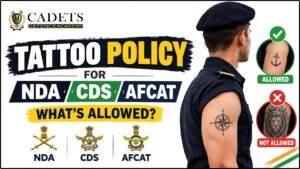
Tattoo Policy for NDA, CDS and AFCAT: What’s Allowed
Tattoo Policy for NDA, CDS and AFCAT: What’s Allowed Table of Contents Many defence aspirants ask the same worry just before the medical: “Is my tattoo going to stop me from joining?” If you have a tattoo, or you are thinking of getting one, this guide is for you. The tattoo policy for NDA, CDS and AFCAT is strict, but it is not a total ban. Small tattoos in certain places are accepted. Tattoos in the wrong place or of the wrong kind can end your selection. For NDA, permanent tattoos are accepted only on the inner face of the forearm (from inside the elbow to the wrist) and the back of the hand. Tribal candidates get a special case-by-case rule. CDS and AFCAT follow the medical standards of the Army, Navy and Air Force, which are similar in spirit. Always read the latest official notification before you apply. Can NDA Officers Have Tattoos? Understanding the Official Rule Yes, but only under limits. The armed forces want officers who look sharp in uniform and who follow discipline from day one. So tattoos are checked carefully during the medical examination. The UPSC publishes the tattoo rule in the NDA & NA notification every year. In simple words, the rule says permanent body tattoos are allowed only on certain parts of the arms. Anything outside those areas is not accepted. So, can you join NDA with a tattoo? You can, if the tattoo is within the permitted area and is acceptable in nature. Rules can change from one notification to the next, so always check the latest tattoo rules for NDA, CDS and AFCAT on the official websites given at the end of this blog. Is Tattoo Allowed in the National Defence Academy for Non-Tribal Candidates? For general (non-tribal) candidates, the answer is yes, but only in a very small area. According to the UPSC notification, permanent tattoos are accepted only on the inner face of the forearm and on the back (dorsal side) of the hand. This means a tattoo anywhere else on your body is a risk for your NDA eligibility. That includes the neck, face, chest, back, upper arm, legs and palms. The same idea applies to other entries. Are tattoos allowed for CDS candidates? Can you apply for AFCAT with a tattoo? Yes, in most cases, if the tattoo sits in a permitted area and is small and acceptable. But the exact wording can differ by force and by year, so check the notification of your exam. If you are preparing for these exams, you can also look at our CDS coaching in Dehradun and AFCAT coaching programs for complete guidance. Permitted Areas for Tattoos Where tattoos are allowed for NDA, CDS and AFCAT depends on the official medical rule. For NDA, the accepted places are: The inner face of the forearm, from the inside of the elbow to the wrist The back (dorsal side) of the hand People often ask: can CDS candidates have tattoos on their arms? Only if the tattoo is on the permitted part of the arm. A tattoo on the upper arm or shoulder is usually not accepted. Are tattoos on the neck allowed for AFCAT? No. A visible neck tattoo is a common reason for rejection. Do tattoo rules depend on location for defence medicals? Yes, location is the first thing a doctor checks. As a safe thumb rule, the more visible the tattoo is in uniform, the higher the risk. What about size? The NDA notification text we reviewed does not clearly state a size limit. But some other forces, such as the CAPF, mention that a tattoo should be less than one-fourth of the body part. So a tattoo size limit for defence candidates in India is not always written the same way. The safest choice is a small tattoo, and one that is easy to check. Permitted Nature of Tattoos Besides location, the design also matters. Which tattoos are allowed for NDA, CDS and AFCAT? In general, the board looks kindly at tattoos that are small, neat and respectful. Examples are a small religious symbol or the name of a family member, placed on a permitted area. Are religious tattoos allowed in the Indian Armed Forces? Often yes, if they are small, decent and placed correctly. Can a small religious tattoo affect AFCAT eligibility? It should not, if it follows the rules. But the final decision is always taken by the medical board. Tattoos that carry offensive, obscene, political or hateful messages are not accepted anywhere. If your tattoo can hurt anyone’s feelings or look inappropriate, do not take the risk. Tattoo Rules for Tribal Candidates in NDA India has many tribal communities with old traditions of tattoo marks on the face or body. The armed forces respect this. Under the NDA rule, tribal candidates with tattoo marks made as per their existing custom and tradition are permitted on a case-by-case basis. Are tribal tattoos allowed for NDA candidates? Yes, but each case is checked separately. The same idea is followed in tattoo rules for tribal candidates in CDS. To avoid trouble at the medical, keep your Scheduled Tribe certificate and any proof of your community’s custom with you. A tattoo that is not part of a tribal tradition does not get this benefit. Tattoos That Lead to Direct Rejection Can a tattoo cause rejection in NDA, CDS or AFCAT? Yes. Reasons defence candidates are rejected for tattoos usually include: Tattoos on the neck, face, chest, back, legs or palms (for non-tribal candidates) Tattoos outside the permitted area of the forearm or hand Large tattoos or tattoos that cover a big part of a limb Offensive, political or obscene designs A tattoo that is hidden or not declared at the medical Can an AFCAT medical board reject a candidate for a tattoo? Yes, if the tattoo breaks the rule. Never try to hide it. What to do if rejected for a tattoo in the NDA medical? Candidates declared
What Happens After Clearing the NDA Written Examination?
What Happens After Clearing the NDA Written Examination? Table of Contents Clearing the NDA written examination is a monumental achievement that marks the beginning of your journey toward becoming an officer in the Indian Armed Forces. However, many aspirants wonder: what happens after clearing the NDA written examination? This comprehensive guide will walk you through every stage of the selection process after you’ve successfully passed the written exam, ensuring you’re fully prepared for what lies ahead. At Cadets Defence Academy, we understand the challenges aspiring cadets face after clearing the written examination. This article provides detailed insights into the post-written exam journey, from SSB interview registration to final merit list preparation. NDA Written Exam Result and Qualification Once you’ve appeared for the NDA written examination conducted by UPSC, the results are declared within 3-4 weeks. Approximately 6,000–7,500 candidates are shortlisted in the NDA written result for SSB interview, making it one of the most competitive stages of the selection process. Key Points After Written Exam Clearance: Results are announced on the official UPSC website Your roll number appears in the qualified candidates list You receive notification via registered email and SMS Qualified candidates proceed to the next stage within 1-2 weeks The significance of clearing the written examination cannot be overstated. It demonstrates your academic proficiency and subject knowledge in Mathematics and General Knowledge. However, this is merely the first milestone in your journey after clearing the NDA written examination. What Is the Next Step After NDA Written Exam? After clearing the NDA written examination, your immediate focus should shift toward preparing for the Services Selection Board (SSB) interview. Aspirants who cleared the written exam should immediately begin preparing for the interview and document verification stages. Immediate Action Steps: Check Your Result – Verify your name and roll number on upsc.gov.in Gather Required Documents – Prepare certificates and testimonials immediately Register for SSB – Complete online registration within the specified timeframe Begin SSB Preparation – Start intensive interview and psychological training Maintain Physical Fitness – Strengthen your body for physical tests The NDA SSB Interview is a five-day process held at Indian Armed Force selection centres across the country. Candidates who clear the NDA exam are called for the SSB interview at various selection centres based on merit and geographical preferences. SSB Interview Call and Selection Process The Services Selection Board (SSB) is the gateway between the written examination and your final selection. After clearing the NDA written examination, you’ll receive an SSB call letter via registered post and email within 1-2 weeks of result declaration. SSB’s Critical Role: Evaluates personality and leadership qualities in depth Assesses psychological fitness and stability Tests physical endurance and coordination abilities Determines officer-like qualities (OLQs) Conducts group discussions and team exercises The SSB interview after clearing the NDA written examination is designed to identify candidates who possess the characteristics required for military leadership. It evaluates not just academic capability, but personality, leadership potential, and overall suitability for a military career. How to Register for the NDA SSB Interview After clearing the NDA written examination, registration for the SSB interview is mandatory and time-sensitive. Candidates must register on joinindianarmy.nic.in to participate in the SSB interview. Step-by-Step Registration Process: Visit the official registration portal: joinindianarmy.nic.in Login with your credentials (roll number and password) Fill in personal and educational details accurately Select your preferred SSB centre from allotted options Upload required documents in specified formats Download and save your admission admit card Pay any applicable registration fees (if required) Important Documents for SSB Registration: 10th and 12th mark sheets (certified copies) Graduation certificate (if applicable) NDA written exam admit card and roll number Valid ID proof (Aadhar, Passport, or PAN card) Medical certificates (if any previous medical conditions) Character certificate from school or college Recent passport-size photographs (4×6 cm) Timely registration after clearing the NDA written examination is crucial, as SSB slots fill up quickly based on preference and merit. Late registration may result in allocation to less preferred centres. What Happens During the SSB Interview? The SSB interview process after clearing the NDA written examination spans five days and includes multiple assessment stages. This comprehensive evaluation includes psychological tests, group exercises, physical tasks, and personal interviews. Day-wise SSB Process Breakdown: Days 1-2: Screening and Aptitude Tests Officer Intelligence Rating (OIR) test evaluation Picture Perception and Discussion Test (PPDT) participation Communication skills evaluation and initial interviews Personal document verification Days 3-4: GTO Tasks and Psychological Tests Group discussion exercises and planning tasks Individual obstacles and physical challenges Comprehensive psychological evaluation Team-based activities and assessments Day 5: Personal Interview and Conference One-on-one interview with assessment panel Comprehensive personality discussion Final assessment and ranking determination Officer-like qualities (OLQs) final evaluation NDA SSB Screening Test The SSB screening test after clearing the NDA written examination is your first hurdle at the SSB centre. This test determines whether you proceed further in the selection process or are recommended for rejection early. Component Duration Details Officer Intelligence Rating (OIR) 20 minutes Numerical and verbal ability assessment Picture Perception & Discussion (PPDT) 60 minutes Observation and discussion skills evaluation Writing Task 30 minutes English language and creativity testing Group Discussion 30 minutes Communication and leadership assessment The screening test after clearing the NDA written examination filters out candidates who may not be suitable for military leadership, ensuring quality candidates proceed to subsequent stages. Approximately 40-50% of SSB candidates are screened out at this stage. Psychological Tests in SSB Psychological assessment is crucial after clearing the NDA written examination. These tests measure your personality traits, decision-making abilities, emotional stability, and psychological fitness for military service. Key Psychological Tests Administered: Thematic Apperception Test (TAT) – Story-telling based evaluation to assess your personality traits and motivations Word Association Test (WAT) – Personality traits assessment through word responses and thinking patterns Situation Reaction Test (SRT) – Decision-making under pressure and crisis management evaluation Self-Description Test (SDT) – Personal strengths and weaknesses identification for self-awareness These psychological tests after clearing the NDA written examination help assess whether
CDS 2 2026 Result Date: Latest UPSC Update & What to Expect
CDS 2 2026 Result Date: Latest UPSC Update & What to Expect Table of Contents The CDS 2 2026 Result Date has become one of the most anticipated announcements for defense aspirants across India. The Union Public Service Commission (UPSC) conducts the Combined Defence Services examination twice yearly, offering a golden opportunity for candidates to join prestigious defense institutions. For aspirants preparing through coaching institutes like Cadets Defence Academy in Dehradun, understanding the result timeline is crucial for proper planning. The CDS 2 2026 Result Date is expected to follow the historical pattern established by UPSC, with results typically declared within 15-40 days of the examination. As per the latest updates from the official UPSC website, candidates who appeared for CDS 2 are eagerly awaiting the announcement. This comprehensive guide covers everything you need to know about the CDS 2 2026 Result Date, including how to check results, what comes after, and preparation strategies. When Will CDS 2 2026 Result Be Released? The CDS 2 2026 Result Date announcement follows a predictable timeline based on historical data. The CDS 2 examination is scheduled for September 13, 2026, and based on previous years’ patterns, the result is expected within 20-30 days of the exam date. Historical Result Timeline: Year Exam Date Result Date Days Taken CDS 1 2026 April 12, 2026 May 8, 2026 26 days CDS 2 2025 September 14, 2025 October 9, 2025 25 days CDS 1 2025 April 13, 2025 April 28, 2025 15 days CDS 2 2024 September 1, 2024 September 20, 2024 19 days CDS 1 2024 April 21, 2024 May 9, 2024 18 days CDS 2 2023 September 3, 2023 October 3, 2023 30 days Based on this analysis, the CDS 2 2026 Result Date is likely to fall between October 3-10, 2026. However, candidates should regularly check the official UPSC portal for the exact date. CDS 2 2026 Result: Expected Release Timeline Understanding the expected release timeline for CDS 2 2026 Result Date helps candidates plan their next steps effectively. The result announcement is typically made in the morning hours, and candidates need to be prepared with their admit card details for quick verification. The evaluation process involves: Answer key release: Within 3-5 days of examination Objection period: Candidates can challenge answers for 3 days Final evaluation: Takes approximately 10-15 days Result declaration: Final merit list released as per CDS 2 2026 Result Date Aspirants preparing at defense academies like Cadets Defence Academy Dehradun understand the importance of meeting these timelines for their SSB interview preparations. How to Check CDS 2 Result 2026 Online? Checking your CDS 2 2026 Result Date outcome is straightforward. Here’s the step-by-step process: Steps to Check Your Result: Visit Official Website: Navigate to the official UPSC portal at www.upsc.gov.in Locate Result Section: Click on “Written Results” in the news section Find CDS 2 Result Link: Search for “CDS 2 2026 Result” or “CDS 2 Result 2026” Download Merit List PDF: Click the PDF link to download the complete merit list Search Your Roll Number: Use Ctrl+F (or Cmd+F on Mac) to find your roll number Verify Details: Confirm your name, roll number, and qualifying status Save for Future Reference: Download and save the PDF for SSB interview purposes Candidates from Dehradun preparing at Cadets Defence Academy should keep their admit cards handy for quick reference of their roll numbers. Where to Download the Official CDS 2 Result PDF? The official CDS 2 2026 Result Date notification and merit list PDF are exclusively available on the UPSC website. This is the most authentic source for result information. Official Download Locations: Primary Source: www.upsc.gov.in – News section Direct Result Link: Will be activated on CDS 2 2026 Result Date Merit List PDF: Available in downloadable format Scorecard: Individual scorecards released alongside merit list Important Note: Be cautious of fraudulent websites claiming to provide results before the official announcement. Always rely on the official UPSC portal for authentic information. What Details Are Mentioned in the CDS 2 Result? The CDS 2 result document contains crucial information for qualified candidates: Details Included in Result Document: Candidate’s name and roll number Date of birth for verification Written exam marks obtained Qualifying status (selected/not selected) Recommended academy (IMA/INA/AFA/OTA) Interview schedule information Instructions for document verification Important dates for SSB process Understanding these details helps candidates from academies like Cadets Defence Academy Dehradun prepare for the subsequent selection stages. CDS 2 2026 Result: How to Check Your Roll Number Your roll number is essential for finding yourself in the merit list after the CDS 2 2026 Result Date announcement. Here’s how to locate and verify it: Finding Your Roll Number: From Admit Card: Your roll number is printed on the CDS 2 admit card From Application: Check your email confirmation for application reference From Registration: Available in your UPSC registration dashboard Verification Process: Match your roll number with admit card details Search Tips for Merit List: Use exact roll number format (leading zeros if applicable) Try searching by name if roll number search fails Check spelling variations of your name Contact UPSC helpline for verification issues What Happens After the CDS 2 2026 Result? Once the CDS 2 2026 Result Date is declared and your name appears in the merit list, the selection process moves to the next crucial stage. Post-Result Timeline: Interview Call Letters: Issued within 5-7 days of result declaration Document Verification: Candidates must submit original documents SSB Interview: Conducted over 4 days per candidate Medical Examination: Follows immediately after SSB Final Selection: Merit list finalized after all stages Joining Date: Communicated 30 days before academy joining Candidates preparing at Cadets Defence Academy in Dehradun should understand this timeline for better preparation. CDS 2 2026 SSB Interview: What Qualified Candidates Should Know The SSB interview is the most crucial stage after the CDS 2 2026 Result Date announcement. This 4-day comprehensive evaluation assesses officer-like qualities. SSB Interview Structure: Stage Duration Focus Officer Intelligence Rating (OIR) 45 minutes Mental reasoning ability Thematic Apperception

AFCAT Online vs Offline Preparation – Which Method Works Better?
AFCAT Online vs Offline Preparation – Which Method Works Better? Table of Contents Preparing for the Air Force Common Admission Test (AFCAT) is a critical step toward achieving your dream of becoming an Indian Air Force officer. With the increasing popularity of online learning platforms, aspiring candidates often find themselves at a crossroads: Should they opt for AFCAT online preparation or traditional offline coaching? This comprehensive guide explores both methods and helps you make an informed decision. At Cadets Defence Academy, we offer both AFCAT online and offline preparation programs designed to maximize your chances of success. AFCAT Preparation: Online vs Offline – What’s the Difference? AFCAT online and offline preparation represent two distinct approaches to exam readiness, each with its unique advantages and challenges. Online AFCAT preparation leverages digital platforms, recorded lectures, and virtual classes accessible from anywhere, anytime. In contrast, offline AFCAT coaching provides face-to-face interaction with instructors, structured classroom environments, and direct mentorship. The core difference lies in delivery methodology. While online preparation for AFCAT emphasizes flexibility and self-paced learning, offline coaching focuses on disciplined routines, peer interaction, and immediate doubt resolution. Understanding these differences is crucial for selecting the preparation method that aligns with your learning style and lifestyle. How Does AFCAT Online Preparation Work? Online AFCAT preparation operates through digital learning platforms where candidates access recorded lectures, study materials, and practice tests remotely. This model allows aspirants to learn at their own pace, pause lessons when needed, and revisit complex topics multiple times. Key Components of Online AFCAT Preparation: Live streaming or pre-recorded video lectures Digital study materials and notes Mobile app-based learning resources Online mock tests and performance analytics Virtual doubt-clearing sessions One-on-one online mentoring options Candidates preparing through AFCAT online coaching benefit from flexibility in scheduling, cost-effectiveness, and access to expert instructors regardless of geographical location. However, this method requires exceptional self-discipline and motivation to maintain consistent preparation routines. At Cadets Defence Academy, our online AFCAT program includes comprehensive video lectures, digital study materials covering entire syllabus, regular online assessments, and virtual mentorship sessions with experienced faculty members. How Does Offline AFCAT Coaching Work? Offline AFCAT coaching operates through traditional classroom-based instruction where students attend regular classes at coaching centers. This method provides structured learning environments, direct interaction with faculty, and peer collaboration opportunities. Key Components of Offline AFCAT Coaching: Daily classroom lectures (3-4 hours minimum) Direct access to qualified faculty members Physical study materials and question banks In-center mock tests and evaluations Regular doubt sessions with instructors Peer learning and group discussions Disciplined routine and environment The offline approach at Cadets Defence Academy emphasizes personalized attention, immediate feedback, and integrated SSB preparation alongside written exam coaching. Our offline batches maintain class sizes of 45-50 students to ensure quality instruction and individual interaction. AFCAT Online vs Offline Preparation: Key Differences Some very common reasons from the NDA medical rejection list are: Aspect Online AFCAT Preparation Offline AFCAT Coaching Flexibility High – Learn anytime, anywhere Low – Fixed schedule and location Cost Generally more affordable Higher due to infrastructure costs Peer Interaction Limited to forums/chat groups Direct classroom interaction Doubt Resolution Delayed or asynchronous Immediate and real-time Study Environment Self-managed, prone to distractions Structured, disciplined atmosphere Faculty Interaction Limited, mostly through recordings Direct, personalized attention Physical Training Not available Integrated fitness programs Mock Tests Online simulations only Center-based and online both SSB Preparation Limited hands-on training Comprehensive GTO practice Motivation Level Required Very high self-motivation needed Group motivation and support Which Method Offers Better AFCAT Study Flexibility? Online AFCAT preparation undoubtedly provides superior flexibility, making it ideal for working students, individuals with family commitments, and those managing multiple responsibilities simultaneously. You can watch lectures during lunch breaks, commute time, or early mornings. However, flexibility can also be a double-edged sword. While online AFCAT preparation allows you to create your own schedule, it requires exceptional discipline to maintain consistency without external structure. Offline AFCAT coaching offers structured flexibility where you commit to specific hours but still manage personal responsibilities outside class. This method works better for candidates who struggle with self-motivation or prefer accountability through fixed schedules. Consider your lifestyle when choosing between AFCAT online vs offline preparation. If you’re a self-driven learner comfortable with minimal external structure, online works well. If you need guidance, routine, and accountability, offline coaching proves more effective. Online vs Offline AFCAT Preparation for Doubt Solving Doubt resolution represents one of the most critical factors distinguishing online and offline AFCAT preparation methods. Offline AFCAT coaching at Cadets Defence Academy provides immediate doubt clearance through daily doubt sessions. Students can ask questions directly, receive instant explanations, and clarify misconceptions immediately. This real-time interaction prevents confusion from accumulating and ensures conceptual clarity essential for AFCAT success. Online AFCAT preparation relies on asynchronous communication where students post queries and wait for responses, often causing delays in understanding. However, quality online platforms provide scheduled live sessions for doubt clearing, partially bridging this gap. The advantage clearly favors offline AFCAT coaching for comprehensive doubt resolution, particularly for complex topics in Mathematics, Reasoning, and General Ability Tests. Which Method Provides Better Mock Tests and Practice? Both preparation methods offer mock tests, but with notable differences: Online Mock Tests: AI-generated performance analytics Immediate result compilation Comparison with national averages Flexible attempt schedules Repeat attempts without limitations Offline Mock Tests: Simulated exam environment Real-time atmosphere similar to actual AFCAT Supervised testing conditions Invigilated exams promoting discipline Detailed feedback discussions AFCAT online preparation provides unlimited mock test attempts with detailed analytics, while offline AFCAT coaching ensures authentic exam experience crucial for managing time pressure and examination anxiety. Cadets Defence Academy conducts full-length mock tests simulating actual AFCAT patterns with rigorous invigilated conditions. AFCAT Preparation: Comparing Study Material and Resources Quality study materials significantly impact AFCAT preparation success. Online Platform Materials: E-books and PDF notes Video explanations with subtitles Downloadable resources for offline access Interactive animations for concept clarity Links to external resources Offline Coaching Materials: Printed textbooks and reference guides Handwritten notes from faculty Question banks with explanations

NDA Category-Wise Age Relaxation & Reservation Rules Explained (SC/ST/OBC)
NDA Category-Wise Age Relaxation & Reservation Rules Explained (SC/ST/OBC) Table of Contents Every year, thousands of SC, ST, OBC, and EWS candidates search for NDA category-wise age relaxation hoping to find a few extra years to apply. This confusion is completely understandable — after all, exams like the UPSC Civil Services grant SC/ST candidates a 5-year relaxation and OBC candidates a 3-year relaxation. So why wouldn’t the National Defence Academy exam work the same way? The honest answer, backed by official UPSC notifications, is that NDA category-wise age relaxation does not exist in the way most aspirants imagine. The National Defence Academy exam runs on a fixed, uniform age band for every candidate, irrespective of caste or category. What NDA does offer instead is seat reservation — a completely different concept from age relaxation. In this guide by Cadets Defence Academy, Dehradun’s trusted name in defence coaching, we break down exactly how NDA reservation works, what SC/ST/OBC/EWS candidates actually get, the documents you need, and how it compares with CDS and CAPF rules. If you’re preparing for NDA 1 or NDA 2, this is the one article that will clear every doubt around NDA category-wise age relaxation. Does NDA Give Age Relaxation to SC/ST/OBC? (The Truth Most Aspirants Get Wrong) Let’s address the myth head-on: NDA does not give age relaxation to SC, ST, or OBC candidates. This is one of the most searched and most misunderstood topics among defence aspirants, largely because other UPSC exams (like the Civil Services Examination) do offer such relaxation. For the National Defence Academy exam, the upper and lower age limit is fixed at 16.5 to 19.5 years for every applicant — general, SC, ST, OBC, or EWS. There is no additional window of 3 or 5 years added on top of this band for reserved categories. So when an aspirant asks “what is the NDA category-wise age relaxation for OBC candidates,” the direct answer is: there isn’t one. The date-of-birth bracket published in the official UPSC notification applies uniformly to all categories. This is fundamentally different from recruitment exams under the Department of Personnel and Training, where reserved categories receive age relaxation as a matter of policy. NDA, being a defence academy entrance exam tied to physical and medical standards for cadet training, follows a different logic altogether — one based on a fixed training-age window rather than category-based flexibility. Why NDA Doesn’t Offer Age Relaxation to Any Category The absence of NDA category-wise age relaxation isn’t an oversight — it’s a deliberate design choice rooted in how defence training works. Physical and medical readiness: Cadets join the NDA at a young age because the three-year training at Khadakwasla is physically demanding. A narrow, fixed age band ensures every cadet is developmentally suited to the same rigorous routine. Uniform training batches: The Armed Forces prefer cadets who enter training within a tight age bracket so that physical fitness benchmarks, drill standards, and academic pace remain consistent across the batch. Different objective than civil service exams: UPSC CSE selects officers for administrative roles where age relaxation compensates for social disadvantage in career progression. NDA selects cadets for a physically intensive military training pipeline, where the logic of extending age doesn’t align with training requirements. Legal and policy distinction: Age relaxation and reservation are two separate constitutional tools. Reservation ensures representation in seats; age relaxation extends eligibility windows. The Ministry of Defence and UPSC have chosen to apply only the former to NDA, not the latter. Because of this, aspirants preparing at any NDA coaching in Dehradun, including our own NDA Foundation Course, are advised to plan their attempts strictly within the standard 16.5–19.5 age window rather than banking on relaxation that doesn’t exist. NDA Reservation Policy Explained: What Actually Applies While there’s no NDA category-wise age relaxation, there is a genuine reservation policy — and understanding it correctly matters just as much. NDA reservation applies at the seat allocation stage, not the age-eligibility stage or the written cut-off stage. In simple terms: Every candidate, regardless of category, must fall within the same age bracket to even apply. Every candidate, regardless of category, competes on the same written exam paper and cut-off marks. Once candidates clear the written exam and SSB interview, final seat allotment is done against category-wise reserved vacancies (SC, ST, OBC-NCL, EWS) as notified by UPSC for that particular course. This is a crucial distinction that many aspirants miss. Reservation in NDA affects who gets a seat from the final merit list, not who is allowed to sit for the exam or who needs fewer marks to qualify. So while NDA reservation policy genuinely exists and benefits eligible candidates during seat allotment, it should never be confused with age relaxation. Category-wise Seat Reservation Percentage (SC/ST/OBC) UPSC follows the standard Government of India reservation framework for NDA seat allocation. Here’s the category-wise breakdown typically applied: Category Reservation Percentage Applicable At SC (Scheduled Caste) 15% Final seat allotment ST (Scheduled Tribe) 7.5% Final seat allotment OBC (Non-Creamy Layer) 27% Final seat allotment EWS (Economically Weaker Section) 10% Final seat allotment General/Unreserved Remaining seats Final seat allotment These percentages are applied to the total vacancies notified for each NDA course and are subject to change based on the latest UPSC notification. Aspirants should always cross-check the current numbers on the official UPSC website before applying, since reservation percentages can be revised. It’s worth repeating: this table has nothing to do with age. A 19-year-old OBC candidate and a 19-year-old general-category candidate both need to fall within the same date-of-birth window — reservation only decides how many of the final seats are earmarked for each category once merit is established. OBC Non-Creamy Layer Certificate: Format & Requirement To claim the 27% OBC reservation in NDA, a candidate must submit a valid Non-Creamy Layer (NCL) certificate, not just a caste certificate. This is where many otherwise-eligible OBC aspirants lose their reservation benefit due to documentation errors. Key requirements for the OBC-NCL certificate: It must be issued