

NDA vs OTA (Officers Training Academy): Which Route Is Right for You?
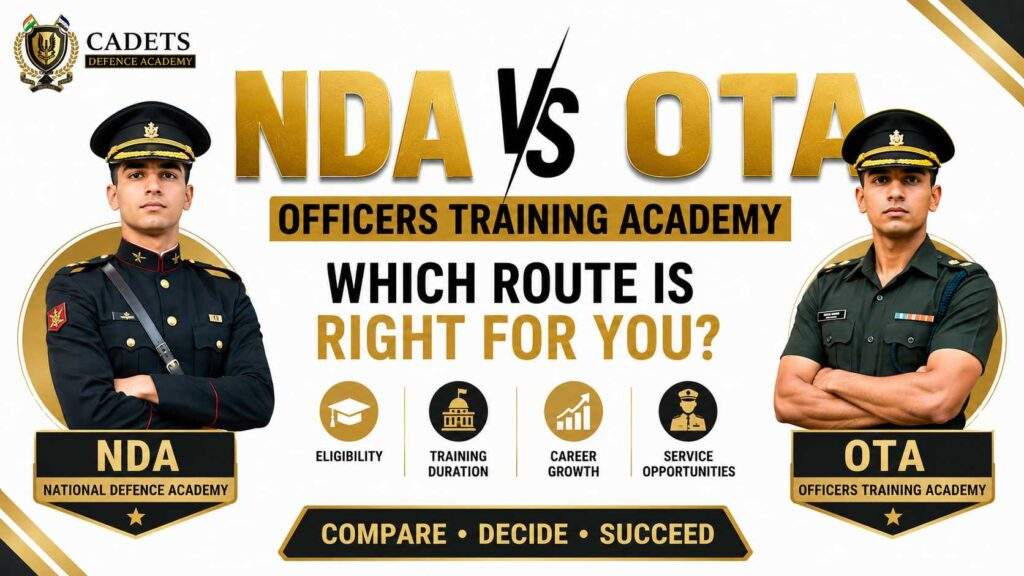
NDA vs OTA (Officers Training Academy): Which Route Is Right for You? Table of Contents If you dream of becoming an officer in the Indian Army, you have probably come across two names again and again — NDA and OTA. Both lead to the same uniform, but the path, the age at which you join, and the type of commission you get are quite different. So when it comes to NDA vs OTA, which one should you choose? This blog breaks down the NDA and OTA difference in simple words, so you can pick the route that fits your age, education, and career goals. NDA vs OTA: What’s the Basic Difference? NDA is for students who know early that they want to join the forces, while OTA is for graduates who decide a little later. NDA (National Defence Academy) is open to students right after Class 12. It trains cadets for the Army, Navy, and Air Force together, and leads to a Permanent Commission. Read our complete NDA Foundation coaching guide if you’re planning to start early. OTA (Officers Training Academy), located in Chennai and Gaya, is one of the academies you can join through the CDS exam after graduation. It offers a Short Service Commission (SSC) in the Army. So, the core NDA vs OTA comparison comes down to this: NDA is the early, long-term route, while OTA is the graduate-level, shorter-service route. Both are respected paths, and both start with the rank of Lieutenant. NDA vs OTA Eligibility: Who Can Apply? Eligibility is usually the first thing aspirants check, so let’s keep it simple. NDA eligibility after 12th: Age: 16.5 to 19.5 years Qualification: Class 12 pass (Physics and Maths required for Air Force and Navy wings) Marital status: Unmarried Only male and female candidates who are unmarried can apply OTA eligibility after graduation (via CDS): Age: 19 to 25 years Qualification: Graduation in any stream — no Maths or Science background needed Marital status: Unlike NDA, OTA allows married candidates to apply So if someone asks, can girls apply for NDA and OTA — yes, both academies accept women. OTA has been training women officers for decades, and NDA opened its doors to women more recently. Check the full eligibility criteria for both age and academic requirements. And for NDA or OTA eligibility for arts students — OTA is more flexible since it accepts graduates from any stream, while NDA’s Air Force and Navy wings need a Science background. NDA vs OTA Entrance Exam and Application Process Both academies are gateways guarded by UPSC exams, but the exams themselves are different. To join NDA, you sit for the NDA entrance exam, held twice a year, which includes Mathematics and a General Ability Test. To join OTA, you don’t apply directly — you apply through the CDS (Combined Defence Services) exam, also conducted twice a year by UPSC. You can check our detailed CDS notification guide for application dates and steps. The good news for non-Maths students is that the OTA paper under CDS has only two sections — English and General Knowledge — with no Mathematics involved. Here’s a quick way to understand NDA exam vs CDS OTA exam: Aspect NDA OTA (via CDS) Papers Maths + GAT English + GK Who can apply Class 12 pass Graduates Frequency Twice a year Twice a year After the written exam, both NDA and OTA aspirants go through the same 5-day SSB interview, followed by a medical examination. NDA vs OTA Training: Life at the Academy NDA cadets train for 3 years at Khadakwasla, Pune, followed by one more year at the Indian Military Academy (for the Army stream), or the respective Naval or Air Force academies. In total, that’s about 4 years of training before commissioning. OTA training, on the other hand, lasts only 49 weeks (around 11 months). It is shorter but far more intense, since candidates are already graduates and the academy focuses on sharpening leadership and Officer Like Qualities in a compressed timeline. If someone asks NDA or OTA which training is harder — both are physically and mentally demanding in their own way. NDA builds a soldier from the ground up over years; OTA sharpens an already mature graduate quickly and intensely. NDA vs OTA Salary, Rank, and Career Growth Here’s something many aspirants don’t realise: once commissioned, NDA and OTA officers draw the same pay scale. Both start as Lieutenants under the same 7th Pay Commission matrix, with similar allowances and perks — see our detailed breakdown in Ranks in Indian Army: Complete List with Insignia & Roles for how pay and rank progress over a career. So there’s no salary disadvantage in choosing OTA over NDA — the real difference in NDA vs OTA career growth shows up in service length and long-term promotion opportunities, which brings us to the next point. Permanent Commission vs Short Service Commission This is the single biggest factor to weigh in the NDA vs OTA decision. NDA leads to a Permanent Commission — a full career in the Army until retirement, along with pension and long-term retirement benefits. OTA offers a Short Service Commission — an initial engagement of 10 years, extendable to 14 years. After that, officers can apply to convert to a Permanent Commission, subject to vacancies and eligibility, or exit with a gratuity. If your goal is a long-term Army career with pension benefits from day one, NDA is the safer bet. But if you’re a graduate who doesn’t want another long training cycle, OTA is a strong option — with a shot at Permanent Commission later. NDA vs OTA Preparation Tips Preparation naturally differs based on which exam you’re targeting. For NDA, focus on strengthening Mathematics fundamentals from the Class 10–12 syllabus, alongside English and General Knowledge for the GAT paper. For OTA (through CDS), since there’s no Maths paper, put your energy into English grammar, comprehension, and current affairs. In both cases, SSB preparation matters just as much as the
CAPF (Assistant Commandant) vs NDA: Career Progression & Salary Comparison

CAPF (Assistant Commandant) vs NDA: Career Progression & Salary Comparison Table of Contents Important Topics You Need To Prepare for AFCAT Exam Every year, thousands of aspiring defence professionals stand at a crossroads: Should I prepare for NDA or CAPF (Assistant Commandant)? It’s one of the most common questions we get at Cadets Defence Academy, and rightfully so. Both are prestigious pathways into India’s paramilitary forces, both offer excellent career prospects, and both provide handsome salaries and respect. But they’re fundamentally different in how you enter, what you do, and where your career takes you. The truth? There’s no “better” choice—only the choice that’s better for YOU. In this guide, we’ll break down everything you need to know about both CAPF (Assistant Commandant) and NDA to help you make an informed decision. Let’s dive in. What is NDA? (Quick Refresher) The National Defence Academy (NDA) is India’s premier tri-service training academy located in Khadakwasla, Pune. It’s the entry point to become a commissioned officer in the Indian Army, Navy, or Air Force. Key Points: Entry Age: 16.5 to 19.5 years (typically after 12th standard) Service: Army, Air Force, or Navy Rank After Training: Second Lieutenant (Army/Air Force) or equivalent in Navy Training Duration: 3 years at NDA + service-specific training Career Span: Up to 60 years (with extension prospects) What is CAPF (Assistant Commandant)? (Explained) CAPF stands for Central Armed Police Force, and there are five main forces under this umbrella: BSF (Border Security Force) CRPF (Central Reserve Police Force) ITBP (Indo-Tibetan Border Police) SSB (Sashastra Seema Bal) NIA (National Investigation Agency – recently added) When we talk about CAPF recruitment for officers, we’re specifically referring to the Assistant Commandant rank—the entry-level officer position in these paramilitary forces. Key Points: Entry Age: 20-23 years (typically after graduation) Service: BSF, CRPF, ITBP, SSB, or NIA Rank: Assistant Commandant (starting position) Training Duration: 6 months to 1 year at respective force academies Career Span: Up to 60 years (with extension prospects) Side-by-Side Comparison: CAPF vs NDA 1. Eligibility Requirements Aspect NDA CAPF (AC) Age 16.5 – 19.5 years 20 – 23 years Education 12th Pass Bachelor’s Degree (Any Stream) Nationality Indian citizen Indian citizen Physical Fit (specific height/vision standards) Fit (specific height standards) Marital Status Unmarried males only Unmarried only Best For School dropouts/12th students College graduates Key Difference: NDA is ideal if you want to start your defence career right after 12th, while CAPF is for those who’ve completed a bachelor’s degree. Verbal Ability in English 2. Recruitment Process NDA Selection Process: Written Exam – 2 papers (Mathematics 300 marks, General Ability Test 600 marks) Medical Test – Physical fitness & medical examination SSB Interview – 5 days of psychological assessment, group tasks, and personal interviews Merit List – Final selection based on cumulative performance Training – 3 years at NDA Pune Total Timeline: ~8-9 months CAPF (AC) Selection Process: Written Exam – 2 papers (General Studies, Law/General Knowledge) Physical Standard Test (PST) – Run 5km, other fitness metrics Medical Examination – Thorough medical checkup Interview – Not as extensive as NDA’s SSB, but still important Final Selection – Merit-based Total Timeline: ~6-7 months Advantage: CAPF has a quicker recruitment process compared to NDA. 3. Training & Academy Experience NDA Training: Duration: 3 years (longest among all defence academies) Location: Khadakwasla, Pune (residential) Focus: Foundation building, leadership development, academics, physical training Facilities: World-class infrastructure, sports, combat training Post-NDA: Service-specific advanced training (1-2 years more) CAPF Training: Duration: 6 months to 1 year (depending on the force) Location: Different for each force (BSF, CRPF have separate academies) Focus: Practical operational training, paramilitary tactics, real-world scenarios Facilities: Good but less extensive than NDA Post-Academy: Direct posting to field operations Advantage: NDA provides more holistic officer training; CAPF is quicker and more field-focused. 4. Initial Salary & Benefits (Year 1) NDA Officer (After 3 years of training, as Second Lieutenant): Component Amount (Monthly) Basic Pay ₹56,100 – ₹58,900* Dearness Allowance (DA) ~₹25,000-30,000 House Rent Allowance (HRA) ₹8,416 – ₹11,780 Technical Allowance ₹5,400 (where applicable) Total In-Hand ₹95,000 – ₹1,06,000 *Subject to current Pay Commission; exact amounts vary by service (Army/Air Force/Navy) Additional Benefits: Free accommodation (on-base) Free medical for self & family Leave travel concession Subsidized rations Gratuity (up to ₹20+ lakhs) Total Compensation (Including Benefits): ₹2.5-3 lakhs/month CAPF Assistant Commandant (First posting): Component Amount (Monthly) Basic Pay ₹44,900 – ₹46,000* Dearness Allowance (DA) ~₹18,000-22,000 House Rent Allowance (HRA) ₹6,735 – ₹8,960 Special Duty Allowance ₹8,000 – ₹15,000 (varies by force) Total In-Hand ₹77,000 – ₹92,000 *Subject to current Pay Commission; exact amounts vary by force Additional Benefits: Free accommodation (on-base) Free medical for self & family Leave travel allowance Gratuity Pension (after 20+ years) Total Compensation (Including Benefits): ₹2-2.5 lakhs/month Salary Advantage: NDA officers earn 15-25% more than CAPF officers at entry level. 5. Career Progression & Promotion NDA Officer Career Path: Second Lieutenant (3 years) ↓ Lieutenant (9-10 years) ↓ Captain (12-13 years) ↓ Major (16-17 years) ↓ Lt. Colonel (20+ years) ↓ Colonel (24+ years) ↓ Brigadier & Above (Senior positions) Key Advantages: Faster promotion track (3-4 year intervals initially) More senior positions available Can reach General/Admiral ranks (highest positions) Better posting opportunities (India & abroad) Higher pension benefits CAPF (AC) Career Path: Assistant Commandant (5-6 years) ↓ Deputy Commandant (8-10 years) ↓ Commandant (13-15 years) ↓ Senior Commandant/Commander (18+ years) ↓ Higher positions limited Key Limitations: Promotion cycle is slower (5-8 year intervals) Fewer senior positions available Limited scope to reach top ranks Mostly field-based operations Posting restricted to force-specific locations Advantage: NDA has significantly better career progression with more promotion opportunities and higher final ranks. 6. Long-Term Salary Growth NDA Officer Salary (By Rank): Rank Years of Service Monthly Salary (In-Hand) Second Lieutenant 0-3 ₹95,000 – ₹1,06,000 Lieutenant 3-9 ₹1,20,000 – ₹1,45,000 Captain 9-12 ₹1,50,000 – ₹1,85,000 Major 12-16 ₹1,95,000 – ₹2,40,000 Lt. Colonel 16-20 ₹2,50,000 – ₹3,00,000 Colonel 20+ ₹3,10,000 – ₹4,00,000+ CAPF (AC) Salary (By Rank): Rank Years of Service Monthly Salary (In-Hand) Assistant Commandant
NDA 1 2026 Offline Batch – Journey for the Uniform Starts at Cadets Defence Academy

NDA 1 2026 Offline Batch – Journey for the Uniform Starts at Cadets Defence Academy Table of Contents Is your heart set on joining the hallowed ranks of the Indian Armed Forces? Does the thought of serving the nation, leading from the front, and wearing the uniform fill you with a sense of purpose? If you’re an aspiring officer, the National Defence Academy (NDA) is your gateway to this prestigious career. The NDA 1 2026 examination is a major milestone, and starting your preparation early with the right guidance is the key to success. Here at Cadets Defence Academy, Dehradun, we understand that a competitive exam like the NDA requires more than just self-study. It demands discipline, a structured approach, expert mentorship, and a holistic development plan. That’s precisely what our NDA 1 2026 Offline Batch is designed to provide. Our new batch starts on September 20, 2025, and this blog post will walk you through everything you need to know about our upcoming batch, from the syllabus and exam pattern to the unique benefits of offline coaching. Why Choose Offline Coaching for NDA 1 2026? In today’s digital world, online courses are readily available, but when it comes to a rigorous, multi-faceted exam like the NDA, offline coaching offers unparalleled advantages. Structured and Disciplined Environment: An offline classroom provides a focused, distraction-free atmosphere. You’ll be part of a community of dedicated aspirants, all working towards a common goal, which fosters motivation and healthy competition. Direct Interaction with Expert Faculty: Direct interaction with expert faculty is a key advantage of offline NDA coaching. It provides a disciplined environment, immediate doubt resolution, and a customized study plan tailored to an individual’s strengths and weaknesses. Holistic Development: For holistic development, our offline batch focuses on more than just the written exam. We include comprehensive training for the SSB Interview, covering physical fitness, mock interviews, and group discussions, to help you develop the “officer-like qualities” (OLQs) needed for success. Access to Resources: Our Dehradun campus offers state-of-the-art facilities, including well-equipped classrooms, a well-stocked library, and a supportive residential environment. You’ll have all the resources you need to focus entirely on your preparation. NDA 1 2026: Exam Structure & Syllabus The NDA exam is conducted by the Union Public Service Commission (UPSC) and consists of two main papers: Mathematics and the General Ability Test (GAT). Mathematics (Paper I): This section carries 300 marks and includes 120 questions. The syllabus covers a wide range of topics, including Algebra, Matrices and Determinants, Trigonometry, Analytical Geometry (2D and 3D), Differential and Integral Calculus, Vector Algebra, Statistics, and Probability. General Ability Test (GAT) (Paper II): This paper is a significant component, carrying 600 marks with 150 questions. It is further divided into two parts: Part A – English (200 marks): This tests your English language skills, including grammar, comprehension, vocabulary, and usage. Part B – General Knowledge (400 marks): This is a broad section with questions from Physics, Chemistry, General Science, History, Geography, and Current Events. The questions are designed to test your general awareness and understanding of the world around you. At Cadets Defence Academy, our curriculum is meticulously crafted to cover every topic in the official NDA syllabus with a special focus on proven shortcut methods and problem-solving techniques. We conduct regular mock tests to help you get a feel for the actual exam environment and identify your strengths and weaknesses. The All-Important SSB Interview Preparation Passing the written exam is only the first step. The SSB interview is a five-day process that is equally, if not more, challenging. It’s a test of your personality, not just your knowledge. Our program includes a comprehensive SSB preparation module led by experienced professionals. The SSB process is divided into two stages: Stage I (Screening Test): Includes Officer Intelligence Rating (OIR) tests and the Picture Perception and Description Test (PP&DT). Stage II (Psychological & Group Testing): This is where the real assessment happens, with a series of tests including the Thematic Apperception Test (TAT), Word Association Test (WAT), Situation Reaction Test (SRT), and Group Testing Officer (GTO) tasks like group discussions and obstacle races. Our training focuses on developing essential skills like effective communication, critical thinking, and leadership, ensuring you are confident and prepared for every stage of the SSB process. NDA 1 2026 Key Dates & Eligibility While the official notification will be released on December 10, 2025, the exam is scheduled for April 12, 2026. This gives you ample time to prepare, but it also highlights the need for a focused and disciplined approach. Educational Qualification: For the Army Wing: You must have passed the 12th Class (10+2 pattern) from a recognized board. For the Air Force and Naval Wings: You must have passed the 12th Class with Physics, Chemistry, and Mathematics (PCM) from a recognized board. Age Limit: You must be unmarried and born between July 2, 2007, and July 1, 2010. If you meet these criteria, you are ready to begin your journey. Don’t wait until the last minute—the competition is fierce, and early preparation gives you a significant advantage. Conclusion: Your Future Awaits at Cadets Defence Academy The path to becoming a commissioned officer in the Indian Armed Forces is a challenging yet immensely rewarding one. It requires unwavering dedication, rigorous preparation, and, most importantly, the right guidance. Our NDA 1 2026 Offline Batch, with its new session starting on September 20, 2025, is more than just a coaching class; it’s a comprehensive training program designed to transform you into a successful candidate. We invite you to take the first step towards your dream. Join our community of dedicated aspirants and let our expert faculty, structured curriculum, and holistic training prepare you for success. Don’t leave your future to chance. Choose the proven path. Join Cadets Defence Academy, Dehradun, and begin your journey toward a life of honour, courage, and service. FAQs about the NDA 1 2026 Offline Batch 1. What is the fee structure for the NDA 1 2026 offline batch? The