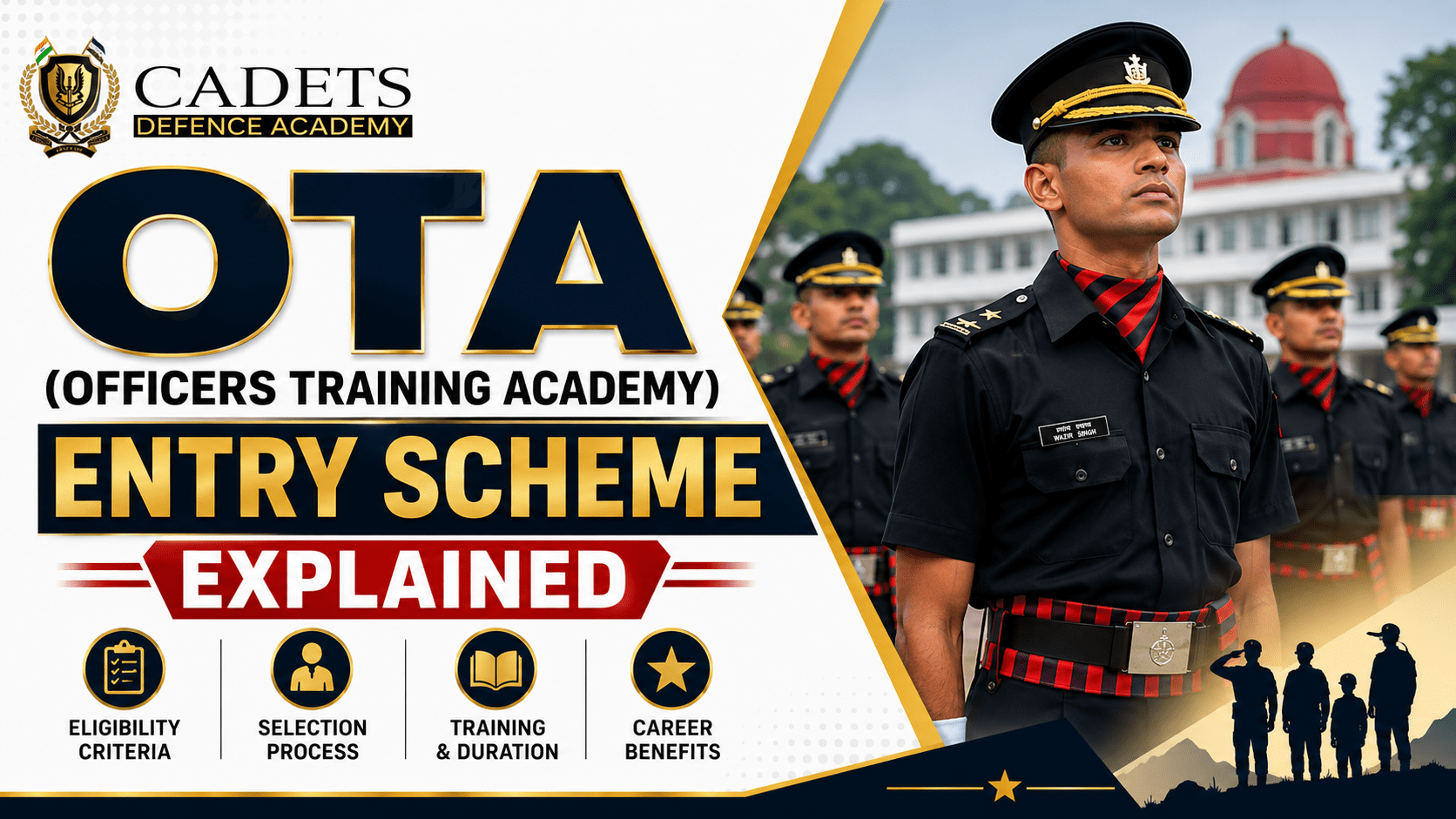
Not every defence aspirant wants to spend three years at a residential academy before wearing the uniform. If you are a graduate who wants to become an Army officer faster, without a long-term service commitment, the OTA (Officers Training Academy) Entry Scheme is worth understanding closely. It is one of the most practical routes into the Indian Army, and yet many students overlook it simply because they don’t know how it works. This guide breaks it down in the simplest way possible.
What Is the OTA Entry Scheme?
This scheme is a route through which graduates join the Indian Army as Short Service Commission (SSC) officers. Unlike the NDA Foundation route, which trains cadets fresh out of school, OTA is meant for candidates who already hold a degree. You do not appear for a separate “OTA exam.” Instead, you apply through the Combined Defence Services (CDS) Examination, conducted twice a year by the Union Public Service Commission (UPSC), and choose OTA as your preferred academy on the application form.
The training itself happens at the Officers Training Academy, Chennai, one of the oldest and most respected officer training institutes in the country. A second campus in Gaya also conducts select courses. On successful completion, candidates are commissioned as Lieutenants in the Indian Army.
OTA Entry Scheme at a Glance
| Parameter |
Details |
| Conducting Body |
Union Public Service Commission (UPSC), via CDS Exam |
| Academy Location |
Chennai (main campus), Gaya (select courses) |
| Age Limit |
19 to 25 years (as per official CDS notification) |
| Educational Qualification |
Bachelor’s degree in any stream |
| Marital Status |
Unmarried men; unmarried women, issueless widows and issueless divorcees eligible |
| OTA Syllabus (Written Exam) |
English and General Knowledge only, no Mathematics |
| Selection Stages |
Written Exam, SSB Interview, Medical Examination, Merit List |
| Physical & Medical Standards |
Fitness, eyesight, and height standards as per official notification |
| Training Duration |
49 weeks (approx. 11 months) |
| Commission Type |
Short Service Commission (SSC), option for Permanent Commission later |
| Service Tenure |
10 years, extendable by 4 years (up to 14 years) |
| Stipend During Training |
Fixed monthly stipend as per official notification |
Who Is Eligible for OTA Entry?
Eligibility under this scheme is broader than most other defence entries, which is exactly why it attracts so many applicants.
- Age Limit: Calculated as per the official CDS notification for that cycle. If you’re mapping out the full timeline, our CDS coaching programme covers eligibility, exam pattern, and SSB prep for all four academies, including OTA.
- Educational Qualification: A degree in any stream is enough — no Physics, Mathematics, or engineering background required, which makes this scheme accessible to arts, commerce, and science graduates alike. Final-year students can also apply, provided they submit their degree certificate before the course begins.
- Nationality and Marital Status: Only Indian citizens, or persons of Indian origin meeting the conditions in the official notification, can apply. Unmarried men are eligible; for women, unmarried candidates, issueless widows, and issueless divorcees are also eligible. This flexibility on marital status is unique to OTA among the CDS academies.
What Are the Eligibility Criteria for Women in the OTA Entry Scheme?
The Officers Training Academy is the only CDS academy that women can join, which makes it especially important for female aspirants. Women apply under the Short Service Commission (Non-Technical) course, meet the same academic and age standards as male candidates, and go through an identical selection process, including the SSB interview and medical examination. Height and other physical parameters are assessed as per the standards laid down in the official notification, so it is best to always cross-check the latest figures directly on the source before applying.
How Does the OTA Selection Process Work?
Selection under this route follows the same broad structure as other CDS entries, with one key difference in the written exam.
- Written Exam: Only English and General Knowledge papers, no Elementary Mathematics, unlike the IMA, INA, and AFA entries. This makes OTA a genuinely good option for graduates who are not confident with numerical subjects.
- SSB Interview: Candidates who clear the written exam are called for a five-day Services Selection Board (SSB) interview, including psychological tests, group tasks, and a personal interview. Our SSB interview coaching prepares candidates for this exact stage, regardless of which academy they are applying to.
- Medical Examination: A thorough test checking overall fitness, eyesight, and other physical standards follows the SSB.
- Final Merit List: Selection is based on combined performance in the written exam and SSB interview, followed by clearance of the medical test.
What Happens During Training at OTA?
Once selected, candidates join as Gentleman Cadets or Lady Cadets for a training period of 49 weeks, roughly eleven months, at the Officers Training Academy campus. The training is intense and covers physical fitness, weapon handling, tactics, drill, and leadership development, alongside academic modules. Successful cadets are awarded a Post Graduate Diploma in Defence Management by the University of Madras, along with their commission as Lieutenant in the Indian Army.
What Is the OTA Officer Salary and Career Path?
During training, cadets receive a fixed monthly stipend, as specified in the official notification, to cover their basic needs. Once commissioned, officers move to the regular pay scale applicable to Lieutenants in the Indian Army, along with allowances.
The Short Service Commission is initially granted for ten years, extendable by four more, taking the total tenure up to fourteen years. Officers who wish to continue beyond this period may apply for Permanent Commission, subject to vacancies and performance.
OTA vs NDA: Which One Should You Choose?
The honest answer depends on where you are in your education and what kind of commitment you want.
- NDA is meant for students right after Class 12, offering three years of tri-service training followed by a Permanent Commission career.
- OTA is for graduates who want to join faster, serve for a defined period, and are open to a Short Service Commission.
If you are still in school and want a long-term career across the Army, Navy, or Air Force, NDA is the natural choice. If you have already completed or are finishing graduation and want a quicker, focused path into the Army specifically, OTA is worth serious consideration.
Final Thoughts
This entry scheme remains one of the most underrated pathways into the Indian Army, especially for graduates who assumed their only option was NDA or a lifelong commitment through IMA. With a simpler written exam, open eligibility for women, and a genuine path to Permanent Commission later, this route deserves serious consideration in your defence career planning.
At Cadets Defence Academy in Dehradun, we guide CDS and OTA aspirants through structured preparation for both the written exam and the interview stage. Many of our OTA candidates actually start earlier, joining our NDA Foundation programme right after school, then returning for focused CDS-OTA preparation once they graduate.
For the latest and most accurate details on age limits, vacancies, and application dates, always refer to the official notification on joinindianarmy.nic.in or upsc.gov.in before applying.