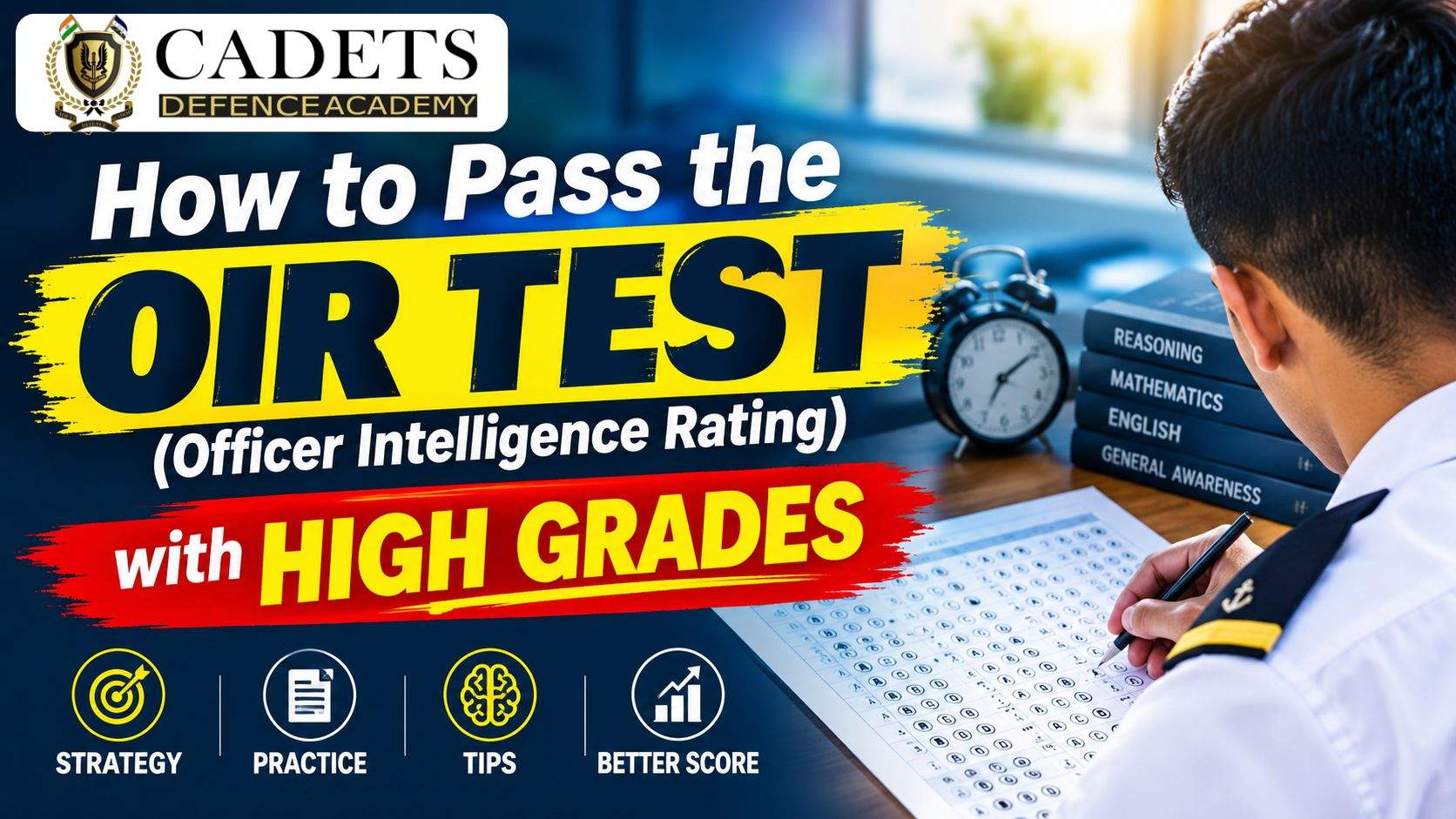
What Is the OIR Test in SSB?
The OIR test is a reasoning test conducted on Day 1 of SSB screening to assess your logical thinking, speed, and problem-solving skills. OIR stands for Officer Intelligence Rating. The test includes basic school-level questions on verbal and non-verbal reasoning, such as number series, analogies, coding-decoding, and patterns. To score high grades, practise regularly, improve accuracy, and manage time effectively. Aim to solve each question within 25–30 seconds to perform well in the test.
The test usually has two booklets:
| Part | Questions (approx.) | Time (approx.) | What it tests |
|---|
| Verbal reasoning | 40–50 | 17–30 minutes | Words, numbers, logic |
| Non-verbal reasoning | 40–50 | 17–30 minutes | Shapes, figures, patterns |
The exact count and time change from batch to batch, so always follow the testing officer’s instructions. The OIR is part of the SSB stage that follows the written exams such as NDA, CDS and AFCAT, so it matters for every defence aspirant.
OIR Rating Scale: What Each Grade Means
A higher OIR grade means a higher chance of staying in the SSB after Day 1 screening, and OIR-1 is the best rating. The board looks at your rating together with your PPDT performance, mostly when your result is borderline.
The score bands below are commonly shared by SSB mentors. Treat them as a rough guide, because the official cut-offs are not published.
| Rating | Level | Approx. score | Effect on screening |
|---|
| OIR-1 | Outstanding | 90% and above | Strong support if PPDT is average |
| OIR-2 | Excellent | 80–89% | Safe zone |
| OIR-3 | Good | 70–79% | PPDT must be strong |
| OIR-4 | Average | 60–69% | Higher risk of screen-out |
| OIR-5 | Low | Below 60% | Very difficult to continue |
So, aim for OIR-1 or OIR-2. A strong rating also supports your Officer Like Qualities (OLQ) profile during the rest of the SSB.
OIR Test Syllabus: Verbal and Non-Verbal Reasoning
The OIR syllabus has two parts: verbal reasoning (words, numbers, logic) and non-verbal reasoning (pictures and shapes). Both parts come from Class 10 level reasoning, so regular practice is enough to master them.
Verbal Reasoning Topics
Verbal reasoning questions test your ability to read short statements and reach the right answer fast. Practise these topics:
- Number and alphabet series: find the missing term in a pattern. Learn squares up to 20 and cubes up to 10.
- Coding-decoding: if a word is coded by shifting letters, decode a new word. Write A–Z with numbers on your rough sheet first.
- Blood relations: draw a small family tree instead of solving in your head.
- Direction sense: sketch the path with arrows and find the final direction or distance.
- Dictionary order and ranking: arrange words or people in order and pick the correct position.
- Analogies and odd one out: spot the link between words quickly.
Non-Verbal Reasoning Topics
Non-verbal reasoning questions test how well you can see patterns and spatial changes in figures. Focus on these:
- Figure series: track rotation, shading and movement of shapes.
- Dice and cubes: use the common-face rule to find the opposite face.
- Mirror and water images: check which side the mirror is placed on.
- Embedded figures: find a small shape hidden in a bigger drawing.
- Paper folding and cutting: unfold the paper step by step in your mind.
Do not skip non-verbal practice. Many candidates are weaker here, so a little extra time can lift your overall rating.
Time Management: The 3-Sweep Method
30-Day OIR Practice Plan
A 30-day plan of daily timed practice is enough to improve speed and accuracy for most aspirants. Follow this simple schedule:
- Days 1–10 (Learn): revise formulas, tricks and shortcuts for each topic. Solve 20 questions daily without a timer.
- Days 11–20 (Speed): solve 40 mixed questions in 20 minutes. Note your mistakes in a small diary.
- Days 21–30 (Test): attempt one full verbal and one full non-verbal mock daily under exam rules. Review wrong answers the same day.
Use a standard reasoning book and previous SSB-style practice sets. Practise on paper, not on a phone, because the real test uses a printed booklet and an OMR sheet. Also read the official updates on Join Indian Army so you know the selection process well.
Common Mistakes to Avoid
The most common OIR mistakes are spending too long on one question, leaving bubbles blank and ignoring non-verbal practice. Avoid these errors:
- Getting stuck on a favourite topic and wasting minutes.
- Marking answers in the wrong OMR row.
- Practising without a timer.
- Learning tricks but never taking full mock tests.
- Reaching the centre tired because of late-night study.
Sleep well before Day 1. A calm mind solves reasoning questions faster.
How Cadets Defence Academy Can Help
Cadets Defence Academy in Dehradun helps aspirants prepare for the OIR test through regular practice, mock tests and guidance from experienced mentors. Our students get Day 1 training along with the full SSB process, including PPDT, psychology tests and GTO tasks.
Explore our SSB coaching in Dehradun to practise under real board conditions. If you are preparing for the written exam first, see our NDA coaching, NDA Foundation course or CDS coaching. You can also pick up our defence exam books, and register online for the upcoming batch.
Final Words
Scoring a high OIR rating becomes easier with smart practice. Learn the verbal and non-verbal topics, use the 3-sweep method, attempt every question, and take timed mocks daily. A strong OIR rating gives you a safer start on Day 1 of the SSB. Start early, stay consistent, and take expert guidance from Cadets Defence Academy, Dehradun, to move closer to your officer dream.
Frequently Asked Questions