

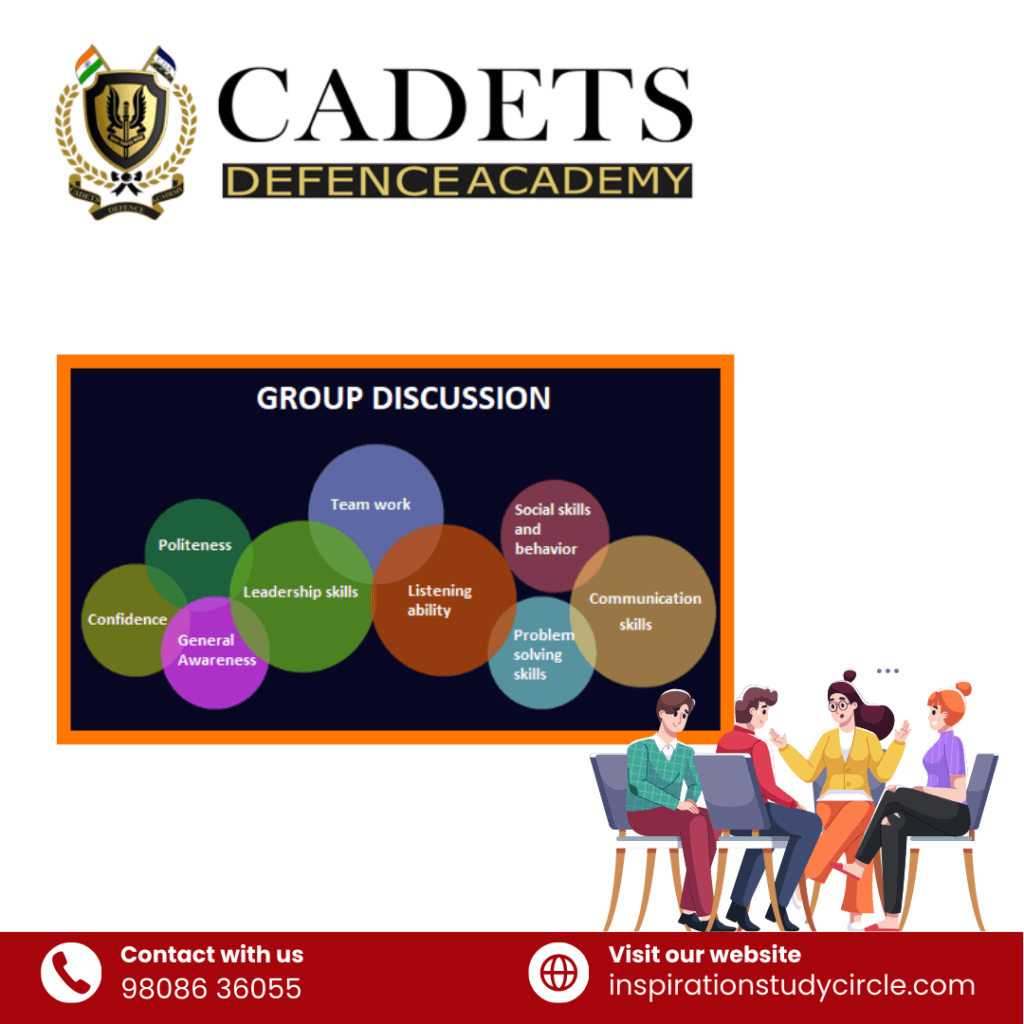

Group Discussion Tips For Interview

Group discussion tips for interview

Table of Contents

Are you ready for the part of the interview which involves a group discussion? We’ve covered several important group discussion tips for interview, so you don’t have to worry. Group discussions can be scary, but with the right preparation and strategy, you can pass them like a pro.Here are some group discussion tips and tricks to boost your self-assurance and make an impact:

How to Start a Group Discussion:

Your participation in a group discussion is influenced by how confidently you begin. Start by greeting everyone respectfully and introducing yourself clearly. Then, focus on drawing attention with a brief comment or question about the discussion topic.

Tips for Clearing Group Discussions:

To clear up group discussions, carefully listen to others’ perspectives and contribute constructively. Wait your turn to talk and refrain from interjecting. Make use of pertinent anecdotes, facts, and examples to bolster your claims and demonstrate your expertise.

Tips for Preparing a Group Discussion:

The secret to passing a group discussion is preparation. Research and familiarize yourself with common subjects for group discussions, such as current affairs, social issues, and recent events. Develop your critical thinking and problem-solving skills to properly handle a variety of settings.

Body Language and Communication Skills:

Be mindful of your body language and make sure to look others in their eyes when speaking. Make sure that everyone can hear you when you speak with clarity, assurance, and assertiveness. Facial expressions and gestures are examples of non-verbal cues that can improve communication.

Leadership and Collaboration:

Showcase your leadership abilities by posing questions, settling conflicts, and guiding the conversation in the direction of a fruitful outcome. But don’t forget to highlight teamwork by acknowledging and appreciating others’ contributions.

Remain Relevant and Focused:

Remain on topic and steer clear of side topics to keep the conversation on course.

Ace the Group Interview:

Use the group interview as a chance to highlight your aptitude for problem-solving, collaboration, and people skills. Keep your composure, self-assurance, and flexibility throughout the conversation.

Practice and Feedback

To improve your confidence and sharpen your skills, practice group talks with mentors or friends. Get feedback on how you conduct discussions, what needs to be improved, and how to do better.

Do’s and don’t of group discussion

Do’s of group discussion

Being an Active Listener: This involves more than just hearing what others have to say. Take careful note of what they say, make an effort to comprehend their viewpoint, and look for ways in which their views might relate to your own. You can expand on what others have said and make a significant contribution to the conversation by actively listening.

Do’s and don’t of group discussion

Speak Clearly and With Confidence: Moderately loudly project your voice while maintaining clear pronunciation. Sayings like “um” and “ah” are filler words that might make your message seem less important. Speaking confidently shows that you believe in your views and makes others take you seriously.

Working together: Teamwork is key to a successful group discussion. Use phrases like “building on what my friend said,” acknowledge the contributions of others, and look for areas of agreement to advance the conversation. This collaborative attitude demonstrates that you’re not just there to advance your own agenda but also to have a fruitful conversation.

Provide Evidence to Back Up Your Arguments: Don’t just express your thoughts and hope for agreement. Provide examples, proof, or logical reasoning to support your claims. This strengthens your claims and increases their appeal to the group.

Time Management: Pay attention to how long you speak. Aim for brief, targeted contributions that provide room for other people to join in. If you have several points to make, think about ranking them and focusing on the most crucial ones.

Positive body language:  Maintain good posture, create eye contact with different members of the group while speaking, and utilise gestures to support your arguments. Your nonverbal cues convey your interest in the conversation, confidence, and decorum.

Don’ts of group discussion

Avoid Dominating the Conversation:

This is an important one. despite the fact that you should be ready to participate, talking too much prevents others from expressing their thoughts. Aim for fair involvement by giving others the opportunity to speak and expand on their ideas.

Avoid drifting From The subject:

While it’s simple to get caught into a side discussion, straying from the main subject will cause the conversation to fall apart. If you have a thought that’s intriguing but not immediately relevant, think about sharing it in brief and suggesting that you look into it further if you have the time.

Don't Use Jargon or Overly Complex Words:

Using confusing language makes people uncomfortable and makes it harder to understand what you’re saying. Make sure that the terminology you use is understandable to all members of the group.

Avoid Displaying Disrespectful Body Language:

Eye rolling, slouched posture, and crossed arms all imply disapproval and lack of interest. When speaking, keep your posture straight, look individuals in the eye, and use non-distracting gestures to support your ideas

Don't Spread Wrong Information:

In a group discussion, facts and supporting evidence are important. Don’t use outdated facts or make statements you can’t back up. Admit your uncertainty and propose that the group do some research on the subject.

How Cadets Defence Academy can help you clear Group Discussion in an Interview?

Group Discussion

Expert Guidance:

Teachers with experience in GDs can provide helpful insights and techniques for improving your performance. They can assess your strengths and weaknesses and advise you on areas for improvement.

Focused Practice:

Include mock GDs in which you can practice with other candidates in a simulated setting. This enables you to get quick feedback on your general involvement style, listening abilities, and communication skills.

Communication Skills:

Our coaches will help you with improving your ability to communicate verbally, including how to pronounce words clearly, project confidence, and use concise language.

Active Listening:

Our coaches can assist you in enhancing your active listening abilities through role-playing and feedback. This includes listening carefully to people, understanding their perspectives, and responding intelligently.

Critical Thinking:

Helping you improve your critical thinking abilities. During the discussion, you’ll gain knowledge of information analysis, how to construct strong arguments, and how to think quickly.

Teamwork:

Participating in group discussions requires cooperation with others. Our coaches can offer techniques for working effectively in a group, such as elaborating on concepts and respectfully expressing your opinions.

Confidence Building:

Practice Makes Perfect: Regular participation in mock GDs can help you gain confidence in your ability to participate effectively.

Support and Feedback: Getting helpful criticism from our coaches will help you pinpoint areas that need work and feel more equipped for the actual GD.

Stress Management: Our coaches can help you learn how to control your anxiety and uneasiness before, or during, a GD. This enables you to convey your ideas clearly and maintain composure.

Conclusion

At Cadets Defence Academy, we understand how important it is to succeed in interviews by developing your group discussion skills. So apart from nda coaching, you’ll be fully prepared to handle group discussions with ease and stand out as a candidate if you apply these group discussion guidelines into your preparation. Remember that effective collaboration requires not only speaking but also listening, comprehending, and collaborating. This is what makes Cadets Defence Academy the best nda Online Course centre in Dehradun and in India.

Reach Us

NDA Category-Wise Age Relaxation & Reservation Rules Explained (SC/ST/OBC)

NDA Category-Wise Age Relaxation & Reservation Rules Explained (SC/ST/OBC)

NDA Category-Wise Age Relaxation & Reservation Rules Explained (SC/ST/OBC) Table of Contents Every year, thousands of SC, ST, OBC, and EWS candidates search for NDA category-wise age relaxation hoping to find a few extra years to apply. This confusion is completely understandable — after all, exams like the UPSC Civil Services grant SC/ST candidates a 5-year relaxation and OBC candidates a 3-year relaxation. So why wouldn’t the National Defence Academy exam work the same way? The honest answer, backed by official UPSC notifications, is that NDA category-wise age relaxation does not exist in the way most aspirants imagine. The National Defence Academy exam runs on a fixed, uniform age band for every candidate, irrespective of caste or category. What NDA does offer instead is seat reservation — a completely different concept from age relaxation. In this guide by Cadets Defence Academy, Dehradun’s trusted name in defence coaching, we break down exactly how NDA reservation works, what SC/ST/OBC/EWS candidates actually get, the documents you need, and how it compares with CDS and CAPF rules. If you’re preparing for NDA 1 or NDA 2, this is the one article that will clear every doubt around NDA category-wise age relaxation. Does NDA Give Age Relaxation to SC/ST/OBC? (The Truth Most Aspirants Get Wrong) Let’s address the myth head-on: NDA does not give age relaxation to SC, ST, or OBC candidates. This is one of the most searched and most misunderstood topics among defence aspirants, largely because other UPSC exams (like the Civil Services Examination) do offer such relaxation. For the National Defence Academy exam, the upper and lower age limit is fixed at 16.5 to 19.5 years for every applicant — general, SC, ST, OBC, or EWS. There is no additional window of 3 or 5 years added on top of this band for reserved categories. So when an aspirant asks “what is the NDA category-wise age relaxation for OBC candidates,” the direct answer is: there isn’t one. The date-of-birth bracket published in the official UPSC notification applies uniformly to all categories. This is fundamentally different from recruitment exams under the Department of Personnel and Training, where reserved categories receive age relaxation as a matter of policy. NDA, being a defence academy entrance exam tied to physical and medical standards for cadet training, follows a different logic altogether — one based on a fixed training-age window rather than category-based flexibility. Why NDA Doesn’t Offer Age Relaxation to Any Category The absence of NDA category-wise age relaxation isn’t an oversight — it’s a deliberate design choice rooted in how defence training works. Physical and medical readiness: Cadets join the NDA at a young age because the three-year training at Khadakwasla is physically demanding. A narrow, fixed age band ensures every cadet is developmentally suited to the same rigorous routine. Uniform training batches: The Armed Forces prefer cadets who enter training within a tight age bracket so that physical fitness benchmarks, drill standards, and academic pace remain consistent across the batch. Different objective than civil service exams: UPSC CSE selects officers for administrative roles where age relaxation compensates for social disadvantage in career progression. NDA selects cadets for a physically intensive military training pipeline, where the logic of extending age doesn’t align with training requirements. Legal and policy distinction: Age relaxation and reservation are two separate constitutional tools. Reservation ensures representation in seats; age relaxation extends eligibility windows. The Ministry of Defence and UPSC have chosen to apply only the former to NDA, not the latter. Because of this, aspirants preparing at any NDA coaching in Dehradun, including our own NDA Foundation Course, are advised to plan their attempts strictly within the standard 16.5–19.5 age window rather than banking on relaxation that doesn’t exist. NDA Reservation Policy Explained: What Actually Applies While there’s no NDA category-wise age relaxation, there is a genuine reservation policy — and understanding it correctly matters just as much. NDA reservation applies at the seat allocation stage, not the age-eligibility stage or the written cut-off stage. In simple terms: Every candidate, regardless of category, must fall within the same age bracket to even apply. Every candidate, regardless of category, competes on the same written exam paper and cut-off marks. Once candidates clear the written exam and SSB interview, final seat allotment is done against category-wise reserved vacancies (SC, ST, OBC-NCL, EWS) as notified by UPSC for that particular course. This is a crucial distinction that many aspirants miss. Reservation in NDA affects who gets a seat from the final merit list, not who is allowed to sit for the exam or who needs fewer marks to qualify. So while NDA reservation policy genuinely exists and benefits eligible candidates during seat allotment, it should never be confused with age relaxation. Category-wise Seat Reservation Percentage (SC/ST/OBC) UPSC follows the standard Government of India reservation framework for NDA seat allocation. Here’s the category-wise breakdown typically applied: Category Reservation Percentage Applicable At SC (Scheduled Caste) 15% Final seat allotment ST (Scheduled Tribe) 7.5% Final seat allotment OBC (Non-Creamy Layer) 27% Final seat allotment EWS (Economically Weaker Section) 10% Final seat allotment General/Unreserved Remaining seats Final seat allotment These percentages are applied to the total vacancies notified for each NDA course and are subject to change based on the latest UPSC notification. Aspirants should always cross-check the current numbers on the official UPSC website before applying, since reservation percentages can be revised. It’s worth repeating: this table has nothing to do with age. A 19-year-old OBC candidate and a 19-year-old general-category candidate both need to fall within the same date-of-birth window — reservation only decides how many of the final seats are earmarked for each category once merit is established. OBC Non-Creamy Layer Certificate: Format & Requirement To claim the 27% OBC reservation in NDA, a candidate must submit a valid Non-Creamy Layer (NCL) certificate, not just a caste certificate. This is where many otherwise-eligible OBC aspirants lose their reservation benefit due to documentation errors. Key requirements for the OBC-NCL certificate: It must be issued

NDA Maths Formula Sheet 2026: All Chapters, Quick Revision

NDA Maths Formula Sheet 2026: All Chapters, Quick Revision

NDA Maths Formula Sheet 2026: All Chapters, Quick Revision Table of Contents Every NDA aspirant eventually types the same search: “NDA Maths Formula Sheet 2026.” It’s the first thing you bookmark and the last thing you open before the exam. But here’s the honest truth our Maths faculty at Cadets Defence Academy tells every batch on day one — formulas alone won’t get you past 240/300. The NDA Maths paper rewards speed and formula-to-answer conversion, not formula memorization in isolation. Two students can know the same identity; the one who’s drilled it into 50 practice questions finishes the paper 20 minutes earlier and with fewer silly errors. That said, you cannot build speed without a rock-solid, error-free formula base. This is exactly why we built this NDA Maths Formula Sheet 2026 — a single reference document that mirrors the actual UPSC NDA syllabus weightage, so your last 15 days of revision are spent recalling, not searching. How to use this cheat sheet for last-15-day revision: Days 1–5: Read each section once, out loud, and rewrite the formulas you keep forgetting on a separate sheet. Days 6–10: Solve 10 previous-year questions per chapter using only this sheet as reference — no textbook. Days 11–13: Attempt full-length mock tests and circle every formula you hesitated on. Days 14–15: Only revise the circled formulas plus the Quick-Revision Summary Table in Section 11. This NDA Maths Formula Sheet 2026 is designed to work alongside — not replace — regular problem-solving practice, which is exactly the approach followed in our NDA Foundation and NDA-after-12th batches in Dehradun. Think of this NDA Maths Formula Sheet 2026 as your single source of truth during revision week. Instead of flipping between three different textbooks and a dozen browser tabs, you scroll through one page, chapter by chapter, in the exact order the NDA syllabus is usually taught. That alone can save 30–40 minutes of daily revision time, which adds up fast over the final two weeks before the exam. Algebra Algebra typically carries the single largest weightage in the NDA Maths paper, so this part of the NDA Maths Formula Sheet 2026 deserves the most attention. Sets, Relations & Functions n(A∪B) = n(A) + n(B) − n(A∩B) n(A∪B∪C) = n(A)+n(B)+n(C)−n(A∩B)−n(B∩C)−n(A∩C)+n(A∩B∩C) A relation R is an equivalence relation if it is reflexive, symmetric, and transitive. Quadratic Equations For ax² + bx + c = 0: roots = [−b ± √(b²−4ac)] / 2a Sum of roots = −b/a; Product of roots = c/a Discriminant D = b² − 4ac; D > 0 (real, distinct), D = 0 (real, equal), D < 0 (imaginary) Complex Numbers Modulus |z| = √(a² + b²) for z = a + ib Argument θ = tan⁻¹(b/a) De Moivre’s Theorem: (cosθ + i sinθ)ⁿ = cos(nθ) + i sin(nθ) Binary Numbers — Conversion between binary, decimal, octal, and hexadecimal follows base-2, base-8, and base-16 positional value rules; practice at least 5 conversions daily in the last two weeks. Sequences & Series AP: nth term = a + (n−1)d; Sum = n/2 [2a + (n−1)d] GP: nth term = arⁿ⁻¹; Sum = a(rⁿ−1)/(r−1) HP: reciprocal of terms forms an AP Binomial Theorem General term: T(r+1) = ⁿCr aⁿ⁻ʳ bʳ Middle term depends on whether n is even or odd Logarithms log(mn) = log m + log n log(m/n) = log m − log n log(mⁿ) = n log m Permutation & Combination ⁿPr = n! / (n−r)! ⁿCr = n! / [r!(n−r)!] Trigonometry Trigonometry questions in NDA are formula-heavy but pattern-repetitive, which makes this section of the NDA Maths Formula Sheet 2026 extremely high-yield. sin²θ + cos²θ = 1; 1 + tan²θ = sec²θ; 1 + cot²θ = cosec²θ sin(A±B) = sinA cosB ± cosA sinB cos(A±B) = cosA cosB ∓ sinA sinB tan(A±B) = (tanA ± tanB) / (1 ∓ tanA tanB) sin2θ = 2sinθcosθ; cos2θ = 1−2sin²θ = 2cos²θ−1 Inverse functions: sin⁻¹x + cos⁻¹x = π/2; tan⁻¹x + cot⁻¹x = π/2 Heights & Distances: use angle of elevation/depression with tanθ = height/base Matrices & Determinants Matrix addition/subtraction requires identical order; multiplication requires columns of first = rows of second Transpose: (Aᵀ)ᵀ = A; (AB)ᵀ = BᵀAᵀ For a 2×2 matrix, determinant = ad − bc Inverse of matrix A: A⁻¹ = adj(A) / |A|, valid only when |A| ≠ 0 Cramer’s Rule solves linear equations using determinant ratios: x = Dx/D, y = Dy/D, z = Dz/D Coordinate Geometry (2D) Distance formula: √[(x₂−x₁)² + (y₂−y₁)²] Section formula: [(mx₂+nx₁)/(m+n), (my₂+ny₁)/(m+n)] Slope: m = (y₂−y₁)/(x₂−x₁) Distance of a point from a line: |Ax₁+By₁+C| / √(A²+B²) Circle: (x−h)² + (y−k)² = r²; tangent condition — distance from centre equals radius Conics: Parabola y² = 4ax; Ellipse x²/a² + y²/b² = 1; Hyperbola x²/a² − y²/b² = 1 Coordinate Geometry (3D) Distance: √[(x₂−x₁)² + (y₂−y₁)² + (z₂−z₁)²] Direction cosines: l² + m² + n² = 1 Direction ratios are proportional to direction cosines Equation of a line in symmetric form: (x−x₁)/l = (y−y₁)/m = (z−z₁)/n Equation of a plane: ax + by + cz = d Differential Calculus Standard limits: lim(x→0) sinx/x = 1; lim(x→0) (1−cosx)/x = 0 Product rule: d/dx(uv) = u’v + uv’ Quotient rule: d/dx(u/v) = (u’v − uv’) / v² Chain rule: dy/dx = dy/du × du/dx d/dx(xⁿ) = nxⁿ⁻¹; d/dx(sinx) = cosx; d/dx(eˣ) = eˣ Integral Calculus & Differential Equations ∫xⁿ dx = xⁿ⁺¹/(n+1) + C ∫1/x dx = ln|x| + C ∫eˣ dx = eˣ + C Definite integral property: ∫ₐᵇ f(x)dx = −∫ᵇₐ f(x)dx Area under a curve: A = ∫ₐᵇ y dxFirst-order differential equations are solved using variable separation or an integrating factor Vector Algebra Dot product: a·b = |a||b|cosθ Cross product: a×b = |a||b|sinθ n̂ Scalar triple product: [a b c] = a·(b×c) Area of a parallelogram = |a×b|; Volume of a parallelepiped = |a·(b×c)| Statistics & Probability Mean = Σx/n; Median = middle value of ordered data; Mode = most frequent value Variance = Σ(x−x̄)²/n; Standard Deviation = √Variance Addition theorem: P(A∪B) = P(A) + P(B) − P(A∩B)

NDA 2 2026 Admit Card & Last 15-Day Revision Strategy

NDA 2 2026 Admit Card & Last 15-Day Revision Strategy

NDA 2 2026 Admit Card & Last 15-Day Revision Strategy Table of Contents You’ve studied hard. You’ve solved hundreds of problems. You’ve cleared countless mock tests. Now comes the final stretch—and every single day counts. With the NDA 2 2026 admit card release imminent, the next 15 days will determine whether your dreams of joining the Indian Armed Forces become reality or remain unfulfilled. This isn’t an exaggeration. The difference between clearing the cutoff and falling short often comes down to smart revision, time management, and mental clarity in the final fortnight. This guide walks you through the complete strategy: from downloading your NDA 2 2026 admit card to conquering the final mock tests, plus crucial insights into SSB preparation that begins while you’re still in exam mode. NDA 2 2026 Exam Date & Key Facts at a Glance Before we dive into revision strategy, let’s anchor the basics. The NDA 2 2026 exam is scheduled for September 13, 2026, in offline mode. This is the only major national defence entrance exam happening this season, making it the focal point for thousands of aspirants across India. Exam Detail Information Exam Name National Defence Academy (NDA) 2 2026 Entrance Exam Exam Date September 13, 2026 Total Marks 900 Marks Exam Mode Pen-and-Paper (Offline) Total Duration 5 Hours (2 papers) Negative Marking Yes (1/3rd mark deduction) Conducting Authority UPSC (Union Public Service Commission) The exam consists of two papers conducted in a single day with a gap for lunch and mental recovery. Understanding this structure helps optimize your exam day stamina—a critical factor many aspirants overlook. NDA 2 2026 Admit Card — Release Timeline, Download Process & Checklist The NDA 2 2026 admit card is the gateway to your exam. Without it, you cannot enter the exam hall, regardless of your preparation level. Here’s everything you need to know about getting and checking your admit card. When Will the NDA 2 2026 Admit Card Be Released? Based on UPSC’s historical pattern, the admit card for NDA 2 2026 is expected around late August 2026, approximately 2-3 weeks before the exam. However, UPSC occasionally releases it 10 days prior—so stay alert to official announcements on upsc.gov.in. How to Download Your NDA 2 2026 Admit Card Visit the official website: Go to upsc.gov.in on your desktop or mobile browser Locate the admit card link: Look for “Admit Card” or “Download e-Admit Card” under the Examinations section Enter your credentials: Input your Application Number and Date of Birth exactly as provided during registration Download and save: Click download, and save the PDF to your device. Take at least 2-3 printed copies Cross-verify details: Immediately check your roll number, exam date, time, and venue Pro Tip from Cadets Defence Academy: Download your admit card as soon as it’s released. Don’t wait until September 12. If there’s any discrepancy in your details (spelling of name, DOB, or exam centre), you have time to contact UPSC and rectify it. Waiting until the last day leaves no room for resolution. Critical Checks Before Printing Your NDA 2 Admit Card Your name is spelled correctly Your date of birth matches your official documents Your roll number and application number are visible The exam date and time are correct (usually 10:00 AM start) Your assigned exam centre location and address Admit card validity (it should be for September 13, 2026 only) Any special instructions for OBC/SC/ST/PwD candidates NDA 2 2026 Exam Centre List & Reporting Guidelines Your exam centre location is mentioned on the NDA 2 2026 admit card. UPSC allocates exam centres based on your location and available capacity. Most major cities in India have multiple exam centres—Dehradun, Delhi, Mumbai, Bangalore, and Kolkata typically have 15-20 centres each. Report at your centre 30-45 minutes before the exam start time Exam typically begins at 10:00 AM Gates close 15 minutes before exam start; late entries are not permitted Arrive with a valid ID proof (as mentioned in admit card) and your printed admit card Keep your phone, smartwatch, and valuables at home or in lockers outside exam halls Reporting Time & Entry Guidelines Report at your centre 30-45 minutes before the exam start time Exam typically begins at 10:00 AM Gates close 15 minutes before exam start; late entries are not permitted Arrive with a valid ID proof (as mentioned in admit card) and your printed admit card Keep your phone, smartwatch, and valuables at home or in lockers outside exam halls ID Proof Requirements The NDA 2 2026 admit card specifies which ID proofs are acceptable. Typically, UPSC accepts: Passport Aadhar Card (with photo) PAN Card Voter ID Driving License School/College ID (for current students) Ensure your ID is valid (not expired) and clearly legible. Reach the exam centre 45 minutes early to allow for entry formalities, verification, and seating arrangements. Understanding the NDA 2 2026 Exam Pattern: Mathematics vs GAT Breakdown Success in the NDA 2 2026 exam depends on understanding the weightage and difficulty distribution. The exam is split into two unequal halves—a strategy that makes Mathematics a major differentiator. Paper Subject Total Marks Duration Questions Marks per Question Paper 1 Mathematics 300 Marks 2 Hours 30 Min 120 Questions 2.5 Marks Paper 2 General Ability Test (GAT) 600 Marks 2 Hours 30 Min 150 Questions 4 Marks GAT includes: English, Physics, Chemistry, Biology, General Knowledge, Current Affairs, Geography, History, Polity The Mathematics Advantage At 300 marks, Mathematics represents 33% of total marks. While Paper 2 (GAT) is larger in absolute marks, Maths is your strength multiplier because: Each correct answer = 2.5 marks (higher accuracy directly translates to higher scores) Fewer topics mean deeper mastery is possible in the final days Maths questions have less ambiguity than GAT topics like GK or current affairs If you’re strong in Maths, a score of 240+/300 puts you in the top tier The GAT Challenge The GAT (600 marks) covers diverse topics, making complete mastery impossible in 15 days. The strategy shifts from depth to breadth—solidifying concepts in high-frequency topics and being strategic about borderline questions. Day-by-Day 15-Day Revision Plan: Your Roadmap to Success This structured 15-day plan divides your time strategically. It’s designed by Cadets Defence Academy based on patterns from successful aspirants. Days 1–5: Mathematics Weak-Area Triage & Problem-Solving Sprint Focus: Identify gaps

Call Now Button