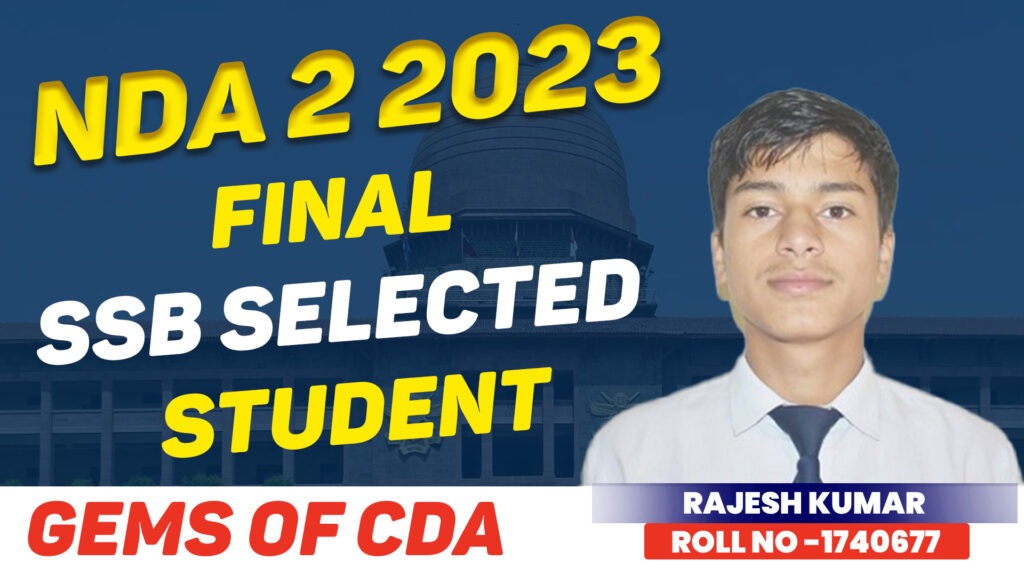

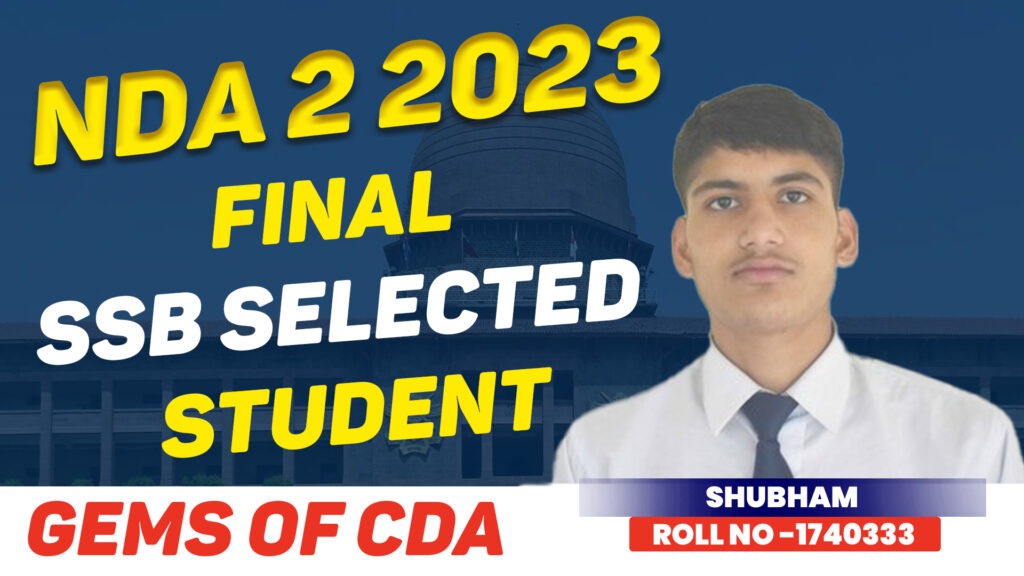

Cadets Defence Academy's Final Selection in NDA 2 2023 SSB

selected student for nda 1 2023

Table of Contents

Introduction

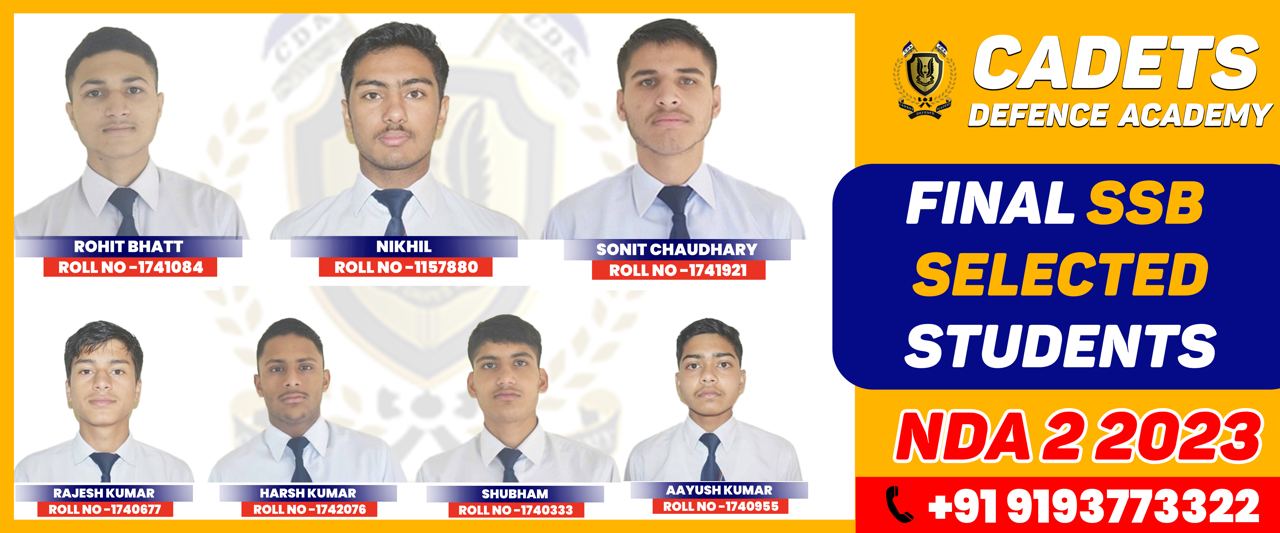
Ready to begin your journey towards a fulfilling career in the Indian Armed Forces? Cadets Defence Academy proudly celebrates the remarkable success stories of our candidates who cleared the final selection in the NDA 2 2023 SSB (Services Selection Board) exam. We take great pride in guiding and nurturing aspiring cadets, helping them achieve their dream of serving the nation.

The success of our candidates is a testament to the effectiveness of our training programs. We are thrilled to share the inspiring journeys of seven cadets who cleared the NDA 2 2023 SSB exam and secured their places in the armed forces.

  1. Rohit Bhatt (Roll no-1741084)
  2. Nikhil (Roll no-1157880)
  3. Sonit Chaudhary (Roll no-1741921)
  4. Rajesh Kumar (Roll no-1740677)
  5. Harsh Kumar (Roll no-1742076)
  6. Shubham (Roll no-1740333)
  7. Aayush Kumar (Roll no-174095)

READY TO PREPARE FOR NDA EXAM

Preparation for NDA exam: Preparation for NDA exam is a rigorous process that demands dedication, perseverance, and strategic planning. At Cadets Defence Academy, we understand the importance of providing comprehensive training that equips candidates with the knowledge and skills needed to excel in the exam. Our expert faculty members employ a structured approach to cover all aspects of the NDA syllabus, ensuring that candidates are well-prepared for every challenge they may encounter.

Getting ready for the NDA exam requires dedication, perseverance, and smart planning. At Cadets Defence Academy, we know how crucial it is to offer thorough training that gives candidates the know-how and skills to ace the test. Our experienced faculty takes a systematic approach to cover all parts of the NDA syllabus, making sure candidates are fully prepared for whatever comes their way.

Written Exam: The written exam is the initial hurdle, comprising two papers General Ability Test (GAT) and Mathematics. Mathematics paper evaluates candidates’ mathematical knowledge and problem-solving abilities, while GAT encompasses English language, physics, chemistry, biology, history, geography, and current affairs.

SSB Training and Mock Interviews: Another crucial aspect of the NDA selection process is SSB interview, during which candidates undergo various tests to evaluate their suitability for a career in the armed forces. To adequately prepare our candidates for this stage, Cadets Defence Academy provides specialized SSB training sessions and conducts mock interviews. These simulations offer candidates invaluable insights into the interview process, help them refine their communication skills, and teach them how to present their best selves to the selection board.

Physical Fitness and Personality Development: Apart from academic prowess, the armed forces prioritize physical fitness and personality attributes like leadership, teamwork, and decision-making. Understanding this, Cadets Defence Academy integrates physical training sessions and personality development workshops into its curriculum. These activities aim to improve candidates’ physical endurance and nurture the qualities essential for success in the armed forces.

Structured Curriculum: Our academy offers a meticulously designed curriculum that covers every aspect of the NDA exam syllabus. From mathematics and general ability to current affairs and English language, we leave no stone unturned in preparing you for the challenges ahead.

Expert Faculty: Our team of experienced faculty members comprises seasoned professionals who bring a wealth of knowledge and expertise to the table. With their guidance, you’ll gain a deeper understanding of key concepts and develop the skills necessary to excel in the exam.

Personalized Coaching: We understand that each aspirant has unique strengths and weaknesses. That’s why we offer personalized coaching tailored to your specific needs. Whether you require extra help in mathematics or English, our mentors are here to provide individualized support every step of the way.

With our unwavering support and guidance, you can be confident in your ability to crack the NDA exam and realize your dream of serving the nation. Join us at Cadets Defence Academy as we are the best nda coaching in dehradun and let’s embark on this journey towards success together

Our NDA Preparation courses

Dehradun, the cradle of numerous esteemed defence academies, is your stepping stone to a prestigious career in the Indian Armed Forces. We take immense pride in being a leading provider of NDA coaching programs in the city. We offer two distinct programs designed to cater to students at different stages of their academic journey:

1. NDA Coaching After 12th:

Targeted Preparation for the Written Exam:
Our result-oriented program meticulously covers all subjects of the NDA written exam – Mathematics, English, General Science, History, Geography, and Current Affairs.

Experienced faculty provide in-depth subject knowledge and exam-focused strategies.

Comprehensive study materials, including topic-wise practice questions and mock tests, ensure thorough preparation.

SSB Interview Guidance:
We understand that the SSB interview is a crucial stage in NDA selection. We equip you with the necessary skills to excel in all aspects – Officer Intelligence Rating (OIR) tests, Picture Perception Description Test (PPDT), group discussions, leadership tasks, and the interview.

Ex-defense officers and SSB assessors provide invaluable insights and conduct mock interviews to hone your communication, problem-solving, and leadership qualities.

Rigorous physical training prepares you for the strenuous activities during the SSB.

2. NDA Foundation Course (Schooling Included) After 10th:

This unique program offers a comprehensive learning experience, combining quality school education with dedicated NDA coaching. Here’s what sets it apart:

Strong Academic Foundation: We are affiliated with a reputed school board, ensuring students receive a well-rounded education alongside NDA preparation.

Early Exposure to NDA Preparation: Our experienced faculty introduce NDA concepts from an early stage, nurturing a focused mindset and a strong foundation.

Integrated Coaching: Regular NDA coaching sessions alongside academic studies ensure a holistic approach, maximizing learning efficiency.

Holistic Development: We go beyond academics, fostering leadership qualities, teamwork, and physical fitness through various co-curricular activities and sports.

Other Courses we provide

While NDA coaching is our forte, we recognize the diverse aspirations of students seeking careers in the Indian Armed Forces. We offer a comprehensive suite of programs designed to equip you for success in various defense entrance exams:

1. Air Force Coaching (X/Y Group):

Our program caters specifically to the requirements of the Air Force X Group (Technical) and Y Group (Non-Technical) exams.

We cover subjects like Physics, Chemistry, Mathematics, English, and Reasoning, aligned with the latest exam pattern.

2. Navy Coaching (AA/SSR):

Focused Approach: Our Navy coaching program prepares you for both the Navy AA (Assistant Artificer) and SSR (Sailor) entrance exams.

We cover subjects like Mathematics, Science, English, and Reasoning, with a specific focus on areas relevant to the Navy.

3. CDS Coaching:

Comprehensive Preparation: Our CDS coaching program equips you for the Combined Defence Services Examination, a gateway to careers in the Indian Military Academy (IMA), Indian Naval Academy (INA), and Indian Air Force Academy (AFA).

We cover all subjects tested in the CDS exam, including English, Mathematics, General Knowledge, and Current Affairs.

Strategic Guidance: Experienced faculty provide insights and strategies to excel in each section of the CDS exam.

4. AFCAT Coaching:

Specialized Focus: Our AFCAT coaching program prepares you for the Air Force Common Admission Test, the entry route for Officer positions in the Indian Air Force.

We cover subjects like English, Reasoning & Military Aptitude Test (RMAT), Mathematics & Physics (for specific branches).

Regular mock tests and practice sessions replicate the AFCAT exam format, helping you refine your time management and test-taking abilities.

At Cadets Defence Academy, our mission is to empower aspiring cadets to realize their dreams of serving the nation. Through our comprehensive training programs, expert faculty, and personalized guidance, we ensure that every candidate is equipped with the knowledge, skills, and confidence needed to excel in the NDA exam and beyond. Join us on this transformative journey and take the first step towards a successful career in the Indian Armed Forces.

Contact Us

For any inquiries or assistance regarding NDA coaching in Dehradun, feel free to reach out to us. Here’s how you can get in touch:

Address:  Sahastradhara Rd, near kriti appartment, opp. shani dev mandir, B Block, Aman Vihar, Dehradun, Uttarakhand 248001
Visit us at our campus located in Dehradun.

Phone Numbers:
You can contact us directly via phone for immediate assistance. Our phone numbers are +91- 099970 34744and + 91-7599367318.

Email: cadetsdefenceacademy@gmail.com
Do you have a question or require additional details? Send us an email at cadetsdefenceacademy@gmail.com  Our team will get back to you promptly with the answers you need.

Website & Social Media Links:
Explore our website, www.cadetsdefenceacademy.com, for comprehensive details about our NDA coaching programs and facilities. Stay updated with the latest news and announcements by following us on social media. Find us on Facebook, Twitter, and Instagram

Feel free to reach out to us through any of the channels mentioned above. We’re here to assist you on your journey towards achieving your NDA coaching goals in Dehradun.

Reach Us

AFCAT Online vs Offline Preparation – Which Method Works Better?

AFCAT Online vs Offline Preparation – Which Method Works Better?

AFCAT Online vs Offline Preparation – Which Method Works Better? Table of Contents Preparing for the Air Force Common Admission Test (AFCAT) is a critical step toward achieving your dream of becoming an Indian Air Force officer. With the increasing popularity of online learning platforms, aspiring candidates often find themselves at a crossroads: Should they opt for AFCAT online preparation or traditional offline coaching? This comprehensive guide explores both methods and helps you make an informed decision. At Cadets Defence Academy, we offer both AFCAT online and offline preparation programs designed to maximize your chances of success. AFCAT Preparation: Online vs Offline – What’s the Difference? AFCAT online and offline preparation represent two distinct approaches to exam readiness, each with its unique advantages and challenges. Online AFCAT preparation leverages digital platforms, recorded lectures, and virtual classes accessible from anywhere, anytime. In contrast, offline AFCAT coaching provides face-to-face interaction with instructors, structured classroom environments, and direct mentorship. The core difference lies in delivery methodology. While online preparation for AFCAT emphasizes flexibility and self-paced learning, offline coaching focuses on disciplined routines, peer interaction, and immediate doubt resolution. Understanding these differences is crucial for selecting the preparation method that aligns with your learning style and lifestyle. How Does AFCAT Online Preparation Work? Online AFCAT preparation operates through digital learning platforms where candidates access recorded lectures, study materials, and practice tests remotely. This model allows aspirants to learn at their own pace, pause lessons when needed, and revisit complex topics multiple times. Key Components of Online AFCAT Preparation: Live streaming or pre-recorded video lectures Digital study materials and notes Mobile app-based learning resources Online mock tests and performance analytics Virtual doubt-clearing sessions One-on-one online mentoring options Candidates preparing through AFCAT online coaching benefit from flexibility in scheduling, cost-effectiveness, and access to expert instructors regardless of geographical location. However, this method requires exceptional self-discipline and motivation to maintain consistent preparation routines. At Cadets Defence Academy, our online AFCAT program includes comprehensive video lectures, digital study materials covering entire syllabus, regular online assessments, and virtual mentorship sessions with experienced faculty members. How Does Offline AFCAT Coaching Work? Offline AFCAT coaching operates through traditional classroom-based instruction where students attend regular classes at coaching centers. This method provides structured learning environments, direct interaction with faculty, and peer collaboration opportunities. Key Components of Offline AFCAT Coaching: Daily classroom lectures (3-4 hours minimum) Direct access to qualified faculty members Physical study materials and question banks In-center mock tests and evaluations Regular doubt sessions with instructors Peer learning and group discussions Disciplined routine and environment The offline approach at Cadets Defence Academy emphasizes personalized attention, immediate feedback, and integrated SSB preparation alongside written exam coaching. Our offline batches maintain class sizes of 45-50 students to ensure quality instruction and individual interaction. AFCAT Online vs Offline Preparation: Key Differences Some very common reasons from the NDA medical rejection list are: Aspect Online AFCAT Preparation Offline AFCAT Coaching Flexibility High – Learn anytime, anywhere Low – Fixed schedule and location Cost Generally more affordable Higher due to infrastructure costs Peer Interaction Limited to forums/chat groups Direct classroom interaction Doubt Resolution Delayed or asynchronous Immediate and real-time Study Environment Self-managed, prone to distractions Structured, disciplined atmosphere Faculty Interaction Limited, mostly through recordings Direct, personalized attention Physical Training Not available Integrated fitness programs Mock Tests Online simulations only Center-based and online both SSB Preparation Limited hands-on training Comprehensive GTO practice Motivation Level Required Very high self-motivation needed Group motivation and support Which Method Offers Better AFCAT Study Flexibility? Online AFCAT preparation undoubtedly provides superior flexibility, making it ideal for working students, individuals with family commitments, and those managing multiple responsibilities simultaneously. You can watch lectures during lunch breaks, commute time, or early mornings. However, flexibility can also be a double-edged sword. While online AFCAT preparation allows you to create your own schedule, it requires exceptional discipline to maintain consistency without external structure. Offline AFCAT coaching offers structured flexibility where you commit to specific hours but still manage personal responsibilities outside class. This method works better for candidates who struggle with self-motivation or prefer accountability through fixed schedules. Consider your lifestyle when choosing between AFCAT online vs offline preparation. If you’re a self-driven learner comfortable with minimal external structure, online works well. If you need guidance, routine, and accountability, offline coaching proves more effective. Online vs Offline AFCAT Preparation for Doubt Solving Doubt resolution represents one of the most critical factors distinguishing online and offline AFCAT preparation methods. Offline AFCAT coaching at Cadets Defence Academy provides immediate doubt clearance through daily doubt sessions. Students can ask questions directly, receive instant explanations, and clarify misconceptions immediately. This real-time interaction prevents confusion from accumulating and ensures conceptual clarity essential for AFCAT success. Online AFCAT preparation relies on asynchronous communication where students post queries and wait for responses, often causing delays in understanding. However, quality online platforms provide scheduled live sessions for doubt clearing, partially bridging this gap. The advantage clearly favors offline AFCAT coaching for comprehensive doubt resolution, particularly for complex topics in Mathematics, Reasoning, and General Ability Tests. Which Method Provides Better Mock Tests and Practice? Both preparation methods offer mock tests, but with notable differences: Online Mock Tests: AI-generated performance analytics Immediate result compilation Comparison with national averages Flexible attempt schedules Repeat attempts without limitations Offline Mock Tests: Simulated exam environment Real-time atmosphere similar to actual AFCAT Supervised testing conditions Invigilated exams promoting discipline Detailed feedback discussions AFCAT online preparation provides unlimited mock test attempts with detailed analytics, while offline AFCAT coaching ensures authentic exam experience crucial for managing time pressure and examination anxiety. Cadets Defence Academy conducts full-length mock tests simulating actual AFCAT patterns with rigorous invigilated conditions. AFCAT Preparation: Comparing Study Material and Resources Quality study materials significantly impact AFCAT preparation success. Online Platform Materials: E-books and PDF notes Video explanations with subtitles Downloadable resources for offline access Interactive animations for concept clarity Links to external resources Offline Coaching Materials: Printed textbooks and reference guides Handwritten notes from faculty Question banks with explanations

NDA Category-Wise Age Relaxation & Reservation Rules Explained (SC/ST/OBC)

NDA Category-Wise Age Relaxation & Reservation Rules Explained (SC/ST/OBC)

NDA Category-Wise Age Relaxation & Reservation Rules Explained (SC/ST/OBC) Table of Contents Every year, thousands of SC, ST, OBC, and EWS candidates search for NDA category-wise age relaxation hoping to find a few extra years to apply. This confusion is completely understandable — after all, exams like the UPSC Civil Services grant SC/ST candidates a 5-year relaxation and OBC candidates a 3-year relaxation. So why wouldn’t the National Defence Academy exam work the same way? The honest answer, backed by official UPSC notifications, is that NDA category-wise age relaxation does not exist in the way most aspirants imagine. The National Defence Academy exam runs on a fixed, uniform age band for every candidate, irrespective of caste or category. What NDA does offer instead is seat reservation — a completely different concept from age relaxation. In this guide by Cadets Defence Academy, Dehradun’s trusted name in defence coaching, we break down exactly how NDA reservation works, what SC/ST/OBC/EWS candidates actually get, the documents you need, and how it compares with CDS and CAPF rules. If you’re preparing for NDA 1 or NDA 2, this is the one article that will clear every doubt around NDA category-wise age relaxation. Does NDA Give Age Relaxation to SC/ST/OBC? (The Truth Most Aspirants Get Wrong) Let’s address the myth head-on: NDA does not give age relaxation to SC, ST, or OBC candidates. This is one of the most searched and most misunderstood topics among defence aspirants, largely because other UPSC exams (like the Civil Services Examination) do offer such relaxation. For the National Defence Academy exam, the upper and lower age limit is fixed at 16.5 to 19.5 years for every applicant — general, SC, ST, OBC, or EWS. There is no additional window of 3 or 5 years added on top of this band for reserved categories. So when an aspirant asks “what is the NDA category-wise age relaxation for OBC candidates,” the direct answer is: there isn’t one. The date-of-birth bracket published in the official UPSC notification applies uniformly to all categories. This is fundamentally different from recruitment exams under the Department of Personnel and Training, where reserved categories receive age relaxation as a matter of policy. NDA, being a defence academy entrance exam tied to physical and medical standards for cadet training, follows a different logic altogether — one based on a fixed training-age window rather than category-based flexibility. Why NDA Doesn’t Offer Age Relaxation to Any Category The absence of NDA category-wise age relaxation isn’t an oversight — it’s a deliberate design choice rooted in how defence training works. Physical and medical readiness: Cadets join the NDA at a young age because the three-year training at Khadakwasla is physically demanding. A narrow, fixed age band ensures every cadet is developmentally suited to the same rigorous routine. Uniform training batches: The Armed Forces prefer cadets who enter training within a tight age bracket so that physical fitness benchmarks, drill standards, and academic pace remain consistent across the batch. Different objective than civil service exams: UPSC CSE selects officers for administrative roles where age relaxation compensates for social disadvantage in career progression. NDA selects cadets for a physically intensive military training pipeline, where the logic of extending age doesn’t align with training requirements. Legal and policy distinction: Age relaxation and reservation are two separate constitutional tools. Reservation ensures representation in seats; age relaxation extends eligibility windows. The Ministry of Defence and UPSC have chosen to apply only the former to NDA, not the latter. Because of this, aspirants preparing at any NDA coaching in Dehradun, including our own NDA Foundation Course, are advised to plan their attempts strictly within the standard 16.5–19.5 age window rather than banking on relaxation that doesn’t exist. NDA Reservation Policy Explained: What Actually Applies While there’s no NDA category-wise age relaxation, there is a genuine reservation policy — and understanding it correctly matters just as much. NDA reservation applies at the seat allocation stage, not the age-eligibility stage or the written cut-off stage. In simple terms: Every candidate, regardless of category, must fall within the same age bracket to even apply. Every candidate, regardless of category, competes on the same written exam paper and cut-off marks. Once candidates clear the written exam and SSB interview, final seat allotment is done against category-wise reserved vacancies (SC, ST, OBC-NCL, EWS) as notified by UPSC for that particular course. This is a crucial distinction that many aspirants miss. Reservation in NDA affects who gets a seat from the final merit list, not who is allowed to sit for the exam or who needs fewer marks to qualify. So while NDA reservation policy genuinely exists and benefits eligible candidates during seat allotment, it should never be confused with age relaxation. Category-wise Seat Reservation Percentage (SC/ST/OBC) UPSC follows the standard Government of India reservation framework for NDA seat allocation. Here’s the category-wise breakdown typically applied: Category Reservation Percentage Applicable At SC (Scheduled Caste) 15% Final seat allotment ST (Scheduled Tribe) 7.5% Final seat allotment OBC (Non-Creamy Layer) 27% Final seat allotment EWS (Economically Weaker Section) 10% Final seat allotment General/Unreserved Remaining seats Final seat allotment These percentages are applied to the total vacancies notified for each NDA course and are subject to change based on the latest UPSC notification. Aspirants should always cross-check the current numbers on the official UPSC website before applying, since reservation percentages can be revised. It’s worth repeating: this table has nothing to do with age. A 19-year-old OBC candidate and a 19-year-old general-category candidate both need to fall within the same date-of-birth window — reservation only decides how many of the final seats are earmarked for each category once merit is established. OBC Non-Creamy Layer Certificate: Format & Requirement To claim the 27% OBC reservation in NDA, a candidate must submit a valid Non-Creamy Layer (NCL) certificate, not just a caste certificate. This is where many otherwise-eligible OBC aspirants lose their reservation benefit due to documentation errors. Key requirements for the OBC-NCL certificate: It must be issued

NDA Maths Formula Sheet 2026: All Chapters, Quick Revision

NDA Maths Formula Sheet 2026: All Chapters, Quick Revision

NDA Maths Formula Sheet 2026: All Chapters, Quick Revision Table of Contents Every NDA aspirant eventually types the same search: “NDA Maths Formula Sheet 2026.” It’s the first thing you bookmark and the last thing you open before the exam. But here’s the honest truth our Maths faculty at Cadets Defence Academy tells every batch on day one — formulas alone won’t get you past 240/300. The NDA Maths paper rewards speed and formula-to-answer conversion, not formula memorization in isolation. Two students can know the same identity; the one who’s drilled it into 50 practice questions finishes the paper 20 minutes earlier and with fewer silly errors. That said, you cannot build speed without a rock-solid, error-free formula base. This is exactly why we built this NDA Maths Formula Sheet 2026 — a single reference document that mirrors the actual UPSC NDA syllabus weightage, so your last 15 days of revision are spent recalling, not searching. How to use this cheat sheet for last-15-day revision: Days 1–5: Read each section once, out loud, and rewrite the formulas you keep forgetting on a separate sheet. Days 6–10: Solve 10 previous-year questions per chapter using only this sheet as reference — no textbook. Days 11–13: Attempt full-length mock tests and circle every formula you hesitated on. Days 14–15: Only revise the circled formulas plus the Quick-Revision Summary Table in Section 11. This NDA Maths Formula Sheet 2026 is designed to work alongside — not replace — regular problem-solving practice, which is exactly the approach followed in our NDA Foundation and NDA-after-12th batches in Dehradun. Think of this NDA Maths Formula Sheet 2026 as your single source of truth during revision week. Instead of flipping between three different textbooks and a dozen browser tabs, you scroll through one page, chapter by chapter, in the exact order the NDA syllabus is usually taught. That alone can save 30–40 minutes of daily revision time, which adds up fast over the final two weeks before the exam. Algebra Algebra typically carries the single largest weightage in the NDA Maths paper, so this part of the NDA Maths Formula Sheet 2026 deserves the most attention. Sets, Relations & Functions n(A∪B) = n(A) + n(B) − n(A∩B) n(A∪B∪C) = n(A)+n(B)+n(C)−n(A∩B)−n(B∩C)−n(A∩C)+n(A∩B∩C) A relation R is an equivalence relation if it is reflexive, symmetric, and transitive. Quadratic Equations For ax² + bx + c = 0: roots = [−b ± √(b²−4ac)] / 2a Sum of roots = −b/a; Product of roots = c/a Discriminant D = b² − 4ac; D > 0 (real, distinct), D = 0 (real, equal), D < 0 (imaginary) Complex Numbers Modulus |z| = √(a² + b²) for z = a + ib Argument θ = tan⁻¹(b/a) De Moivre’s Theorem: (cosθ + i sinθ)ⁿ = cos(nθ) + i sin(nθ) Binary Numbers — Conversion between binary, decimal, octal, and hexadecimal follows base-2, base-8, and base-16 positional value rules; practice at least 5 conversions daily in the last two weeks. Sequences & Series AP: nth term = a + (n−1)d; Sum = n/2 [2a + (n−1)d] GP: nth term = arⁿ⁻¹; Sum = a(rⁿ−1)/(r−1) HP: reciprocal of terms forms an AP Binomial Theorem General term: T(r+1) = ⁿCr aⁿ⁻ʳ bʳ Middle term depends on whether n is even or odd Logarithms log(mn) = log m + log n log(m/n) = log m − log n log(mⁿ) = n log m Permutation & Combination ⁿPr = n! / (n−r)! ⁿCr = n! / [r!(n−r)!] Trigonometry Trigonometry questions in NDA are formula-heavy but pattern-repetitive, which makes this section of the NDA Maths Formula Sheet 2026 extremely high-yield. sin²θ + cos²θ = 1; 1 + tan²θ = sec²θ; 1 + cot²θ = cosec²θ sin(A±B) = sinA cosB ± cosA sinB cos(A±B) = cosA cosB ∓ sinA sinB tan(A±B) = (tanA ± tanB) / (1 ∓ tanA tanB) sin2θ = 2sinθcosθ; cos2θ = 1−2sin²θ = 2cos²θ−1 Inverse functions: sin⁻¹x + cos⁻¹x = π/2; tan⁻¹x + cot⁻¹x = π/2 Heights & Distances: use angle of elevation/depression with tanθ = height/base Matrices & Determinants Matrix addition/subtraction requires identical order; multiplication requires columns of first = rows of second Transpose: (Aᵀ)ᵀ = A; (AB)ᵀ = BᵀAᵀ For a 2×2 matrix, determinant = ad − bc Inverse of matrix A: A⁻¹ = adj(A) / |A|, valid only when |A| ≠ 0 Cramer’s Rule solves linear equations using determinant ratios: x = Dx/D, y = Dy/D, z = Dz/D Coordinate Geometry (2D) Distance formula: √[(x₂−x₁)² + (y₂−y₁)²] Section formula: [(mx₂+nx₁)/(m+n), (my₂+ny₁)/(m+n)] Slope: m = (y₂−y₁)/(x₂−x₁) Distance of a point from a line: |Ax₁+By₁+C| / √(A²+B²) Circle: (x−h)² + (y−k)² = r²; tangent condition — distance from centre equals radius Conics: Parabola y² = 4ax; Ellipse x²/a² + y²/b² = 1; Hyperbola x²/a² − y²/b² = 1 Coordinate Geometry (3D) Distance: √[(x₂−x₁)² + (y₂−y₁)² + (z₂−z₁)²] Direction cosines: l² + m² + n² = 1 Direction ratios are proportional to direction cosines Equation of a line in symmetric form: (x−x₁)/l = (y−y₁)/m = (z−z₁)/n Equation of a plane: ax + by + cz = d Differential Calculus Standard limits: lim(x→0) sinx/x = 1; lim(x→0) (1−cosx)/x = 0 Product rule: d/dx(uv) = u’v + uv’ Quotient rule: d/dx(u/v) = (u’v − uv’) / v² Chain rule: dy/dx = dy/du × du/dx d/dx(xⁿ) = nxⁿ⁻¹; d/dx(sinx) = cosx; d/dx(eˣ) = eˣ Integral Calculus & Differential Equations ∫xⁿ dx = xⁿ⁺¹/(n+1) + C ∫1/x dx = ln|x| + C ∫eˣ dx = eˣ + C Definite integral property: ∫ₐᵇ f(x)dx = −∫ᵇₐ f(x)dx Area under a curve: A = ∫ₐᵇ y dxFirst-order differential equations are solved using variable separation or an integrating factor Vector Algebra Dot product: a·b = |a||b|cosθ Cross product: a×b = |a||b|sinθ n̂ Scalar triple product: [a b c] = a·(b×c) Area of a parallelogram = |a×b|; Volume of a parallelepiped = |a·(b×c)| Statistics & Probability Mean = Σx/n; Median = middle value of ordered data; Mode = most frequent value Variance = Σ(x−x̄)²/n; Standard Deviation = √Variance Addition theorem: P(A∪B) = P(A) + P(B) − P(A∩B)

Call Now Button