
साइकिल चालकों के लिए रेस ट्रैक (racing track) 10 m त्रिज्या का एक समतल वृत्तीय पथ है। तीन साइकिल चालक P, Q और R की एक जैसी साइकिलें हैं, जो क्रमशः 2 m/s, 3 m/s और 5 m/s की चाल से इस ट्रैक पर साइकिल चलाते हैं। यदि पहिए और सड़क के बीच घर्षण गुणांक 0.1 है, तो कौन-सा साइकिल चालक फिसल जाएगा? (मान लीजिए g = 10 m/s²)
A bicycle racing track is a level circular road of radius 10 m. Three cyclists P, Q and R with identical cycles are cycling on the track with speeds 2 m/s, 3 m/s and 5 m/s respectively. If the coefficient of friction between the tyres and the road is 0.1, then which cyclist will slip? (Take g = 10 m/s²)
समतल मोड़ पर अभिकेंद्र बल घर्षण से मिलता है, अतः अधिकतम सुरक्षित चाल v_max = √(μgr) = √(0.1 × 10 × 10) = √10 ≈ 3.16 m/s। P (2 m/s) और Q (3 m/s) इससे कम हैं, पर R (5 m/s) अधिक है, इसलिए केवल R फिसलेगा।
On a level curve, friction supplies the centripetal force, so the safe speed limit is v_max = √(μgr) = √(0.1 × 10 × 10) = √10 ≈ 3.16 m/s. P (2 m/s) and Q (3 m/s) are below this, but R (5 m/s) is above it, so only R slips.
किसी सरल लोलक के गोलक को उसके माध्य स्थान से विस्थापित करके पुनः उसके माध्य स्थान से 0.20 m ऊपर विरामावस्था से छोड़ा जाता है। गोलक के माध्य स्थान से गुज़रते समय उसकी चाल कितनी है? (मान लीजिए g = 10 m/s²)
The bob of a simple pendulum is displaced from its mean position and then released from rest 0.20 m above its mean position. What is the speed of the bob as it passes through the mean position? (Take g = 10 m/s²)
खोई गई स्थितिज ऊर्जा गतिज ऊर्जा बन जाती है: mgh = ½mv², अतः v = √(2gh) = √(2 × 10 × 0.20) = √4 = 2 m/s।
The potential energy lost becomes kinetic energy: mgh = ½mv², so v = √(2gh) = √(2 × 10 × 0.20) = √4 = 2 m/s.
कोई टेनिस की गेंद, जिसका द्रव्यमान 350 g है, 4 m/s की चाल से ऊपर की ओर ऊर्ध्वाधर फेंकी जाती है। यदि गेंद की अधिकतम गुरुत्वीय स्थितिज ऊर्जा M है और उसकी अधिकतम ऊँचाई H है, तो निम्नलिखित में से कौन-सा सही है? (मान लीजिए g = 10 m/s²)
A tennis ball of mass 350 g is thrown vertically upwards at a speed of 4 m/s. If M is the maximum gravitational potential energy of the ball and H is the maximum height it reaches, then which one of the following is correct? (Take g = 10 m/s²)
शीर्ष पर पूरी गतिज ऊर्जा स्थितिज ऊर्जा बन जाती है: M = ½mv² = ½ × 0.35 × 4² = 2.8 J। ऊँचाई H = v²/(2g) = 16/20 = 0.8 m (जाँच: mgH = 0.35 × 10 × 0.8 = 2.8 J)।
At the top, all the kinetic energy has become potential energy: M = ½mv² = ½ × 0.35 × 4² = 2.8 J. Height H = v²/(2g) = 16/20 = 0.8 m (check: mgH = 0.35 × 10 × 0.8 = 2.8 J).
दो भिन्न प्रकाशिक माध्यमों (optical media) के बीच अंतरापृष्ठ पर पूर्ण आंतरिक परावर्तन (total internal reflection) से संबंधित निम्नलिखित में से कौन-सा सही है?
Which of the following is correct regarding the total internal reflection at the interface between two different optical media?
पूर्ण आंतरिक परावर्तन के लिए दो शर्तें हैं: प्रकाश सघन माध्यम (उच्च अपवर्तनांक) से विरल माध्यम की ओर जाए, और आपतन कोण क्रांतिक कोण से बड़ा हो। दोनों शर्तें केवल (b) में हैं।
Total internal reflection needs two conditions: light must travel from a denser medium (higher refractive index) towards a rarer one, and the angle of incidence must be greater than the critical angle. Both are stated only in (b).
निम्नलिखित कथनों पर विचार कीजिए:
I. पृथ्वी के पृष्ठ पर किसी पिंड (object) का भार सभी स्थानों पर समान होता है, किंतु उसका जड़त्वीय द्रव्यमान भिन्न हो सकता है।
II. किसी पिंड का जड़त्वीय द्रव्यमान और गुरुत्वीय द्रव्यमान समानुपाती होते हैं, और समानुपातिकता स्थिरांक (proportionality constant) सभी स्थानों पर समान होता है।
III. किसी पिंड का जड़त्वीय द्रव्यमान और भार, पृथ्वी के भिन्न स्थानों पर समान होता है।
उपर्युक्त में से कौन-सा/कौन-से कथन सही है/हैं?
Consider the following statements:
I. The weight of an object is the same everywhere on the surface of the Earth, but its inertial mass could be different.
II. The inertial mass and gravitational mass of an object are proportional and the proportionality constant is the same everywhere.
III. The inertial mass and weight of an object are the same at different places on Earth.
Which of the statements given above is/are correct?
द्रव्यमान हर जगह समान रहता है, पर भार W = mg बदलता है क्योंकि g ध्रुवों पर विषुवत् रेखा से अधिक होता है। अतः I और III गलत हैं। जड़त्वीय और गुरुत्वीय द्रव्यमान समानुपाती पाए गए हैं और स्थिरांक हर जगह समान है (मात्रकों के चयन से 1), अतः II सही है।
Mass stays the same everywhere, but weight W = mg changes because g is larger at the poles than at the equator. So I and III are wrong. Inertial and gravitational mass are found to be proportional with the same constant everywhere (taken as 1 by choice of units), so II is correct.
निम्नलिखित पर विचार कीजिए:
I. किसी गोलाकार पिंड के कारण गुरुत्वीय क्षेत्र
II. किसी बिंदु आवेश के कारण स्थिरवैद्युत क्षेत्र
III. प्रोटॉन के कारण प्रबल परमाणु बल क्षेत्र
IV. किसी छड़ चुंबक के कारण चुंबकीय क्षेत्र
उपर्युक्त में से कितने व्युत्क्रम वर्ग नियम (inverse square law) का पालन करते हैं?
Consider the following:
I. Gravitational field due to a spherical body
II. Electrostatic field due to a point charge
III. Strong nuclear force field due to a proton
IV. Magnetic field due to a bar magnet
How many of the above follow the inverse square law?
गोलाकार पिंड के बाहर गुरुत्वीय क्षेत्र (g = GM/r²) और बिंदु आवेश का विद्युत क्षेत्र (E = kq/r²) दोनों 1/r² के अनुसार घटते हैं। प्रबल नाभिकीय बल बहुत कम परास (लगभग 10⁻¹⁵ m) का होता है और 1/r² का पालन नहीं करता। छड़ चुंबक एक द्विध्रुव है, जिसका क्षेत्र दूर जाने पर 1/r³ के अनुसार घटता है। अतः केवल दो व्युत्क्रम वर्ग नियम का पालन करते हैं।
The gravitational field outside a spherical body (g = GM/r²) and the electric field of a point charge (E = kq/r²) both fall off as 1/r². The strong nuclear force is very short-ranged (about 10⁻¹⁵ m) and does not follow 1/r². A bar magnet is a dipole, and its field falls off as 1/r³ at large distances. So only two follow the inverse square law.
किसी जग से मंद गति से जल डालने पर सामान्यतः यह देखा जाता है कि जग के पार्श्व (side) के साथ जल की एक परत प्रायः प्रवाहित होती है। इस परिघटना के लिए जल का निम्नलिखित में से कौन-सा गुण उत्तरदायी होता है?
While pouring water slowly from a jug, a general observation is that a water layer usually flows along the side of the jug. Which property of water among the following is responsible for this phenomenon?
धीरे-धीरे जल डालने पर जल और जग के बीच आसंजन तथा पृष्ठ तनाव जल की पतली परत को दीवार से चिपकाए रखते हैं, इसलिए जल जग के बाहर की ओर बहता है ('टीपॉट प्रभाव')। दिए गए विकल्पों में इसका कारण पृष्ठ तनाव है।
When water is poured slowly, adhesion between water and the jug together with surface tension holds the thin water layer to the wall, so it clings and runs down the outside of the jug (the 'teapot effect'). Among the options, surface tension is the property responsible.
कोई मछली 4/3 अपवर्तनांक वाले जल की गहराई d में है। यदि 3/2 अपवर्तनांक और d/2 मोटाई के किसी पारदर्शी स्लैब को जल के पृष्ठ (surface) पर रखा जाता है, तो हवा में स्थित किसी प्रेक्षक को मछली की आभासी गहराई निम्नलिखित में से क्या प्रतीत होगी?
A fish is at a depth d in water of refractive index 4/3. If a transparent slab of refractive index 3/2 and thickness d/2 is placed on the surface of water, then which one of the following is the apparent depth of the fish as observed by an observer in air?
वायु से देखने पर परतों की आभासी गहराई = Σ (मोटाई / अपवर्तनांक)। जल: d ÷ (4/3) = 3d/4। स्लैब: (d/2) ÷ (3/2) = d/3। कुल = 3d/4 + d/3 = 9d/12 + 4d/12 = 13d/12 (स्लैब की ऊपरी सतह से)।
For layers seen from air, apparent depth = Σ (thickness / refractive index). Water: d ÷ (4/3) = 3d/4. Slab: (d/2) ÷ (3/2) = d/3. Total = 3d/4 + d/3 = 9d/12 + 4d/12 = 13d/12 (measured from the top of the slab).
 द्रव्यमान वाला कोई कण
 के लिए
 बल के अंतर्गत x-दिशा में गतिमान (moves) है। यदि कण
 पर विरामावस्था से आरंभ होता है, तो
 पर कण की चाल (
 ) क्या होगी?
A particle of mass moves along x-direction under the force for . If the particle starts from rest at , then what is the speed () of the particle at ?
कार्य-ऊर्जा प्रमेय से, किया गया कार्य = प्राप्त गतिज ऊर्जा:  । अतः
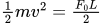 , जिससे
 ।
By the work–energy theorem, the work done equals the kinetic energy gained: . So , giving .
त्रिज्या  और एकसमान द्रव्यमान घनत्व
 वाले किसी ग्रह के केंद्र से एक संकीर्ण सुरंग गुज़रती है। सुरंग में कोई कण छोड़ा (released) जाता है। कण के दोलन की कोणीय आवृत्ति (
 ) किसके बराबर है? (प्रतीकों का अपना सामान्य अर्थ है)
A narrow tunnel passes through the centre of a planet of radius and uniform mass density . A particle is released into the tunnel. What is the angular frequency of oscillation of the particle () equal to? (Symbols carry their usual meaning)
एकसमान गोले के भीतर केवल त्रिज्या  के अंदर का द्रव्यमान कण को खींचता है:
 । अतः बल
 , जो सरल आवर्त गति है।
 से तुलना करने पर
 ।
Inside a uniform sphere only the mass within radius pulls the particle: . So the force is , which is simple harmonic. Comparing with gives .
किसी वर्षा वाले दिन, वर्षा की बूँदें v चाल के साथ ऊर्ध्वाधर गिरती हैं। एक प्रेक्षक v चाल के साथ पूर्व की ओर चलता है, जबकि अन्य प्रेक्षक उसी v चाल के साथ उत्तर की ओर चलता है। उनके द्वारा प्रेक्षित की गई वर्षा की आभासी दिशाओं के बीच का कोण क्या है?
On a rainy day, rain drops fall vertically with speed v. An observer is moving towards east with speed v, while another observer moves towards north with the same speed v. What is the angle between apparent rain directions observed by them?
पूर्व = x, उत्तर = y, ऊपर = z मानें। वर्षा का वेग = (0, 0, −v)। पूर्व की ओर चलने वाले प्रेक्षक के सापेक्ष यह (−v, 0, −v) और उत्तर की ओर चलने वाले के सापेक्ष (0, −v, −v) है। cos θ = (0 + 0 + v²)/(√2v × √2v) = 1/2, अतः θ = 60°।
Take east = x, north = y, up = z. Rain velocity = (0, 0, −v). Relative to the east-moving observer it is (−v, 0, −v); relative to the north-moving observer it is (0, −v, −v). cos θ = (0 + 0 + v²)/(√2v × √2v) = 1/2, so θ = 60°.
50 cm लंबाई के किसी सरल लोलक के गोलक को एक पूर्ण वृत्त बनाने के लिए दी गई न्यूनतम क्षैतिज चाल (minimum horizontal speed) क्या है? (मान लीजिए g = 10 m/s²)
What is the minimum horizontal speed given to the bob of a simple pendulum of length 50 cm so that it describes a complete circle? (Take g = 10 m/s²)
डोरी से बँधे गोलक को ऊर्ध्वाधर वृत्त पूरा करने के लिए निम्नतम बिंदु पर कम से कम √(5gL) = √(5 × 10 × 0.5) = √25 = 5 m/s चाल चाहिए।
For a bob on a string to complete a vertical circle, the speed at the lowest point must be at least √(5gL) = √(5 × 10 × 0.5) = √25 = 5 m/s.
एक ही पदार्थ से बने दो चालक तारों की लंबाइयाँ L और 1.2 L हैं। यदि लंबे तार का आयतन छोटे तार से आधा है, तो छोटे तार की तुलना में लंबे तार का वैद्युत प्रतिरोध क्या होगा?
Two conducting wires made of the same material have lengths L and 1.2 L. If the volume of the longer wire is half that of the shorter wire, then what is the electric resistance of the longer wire in comparison with the shorter wire?
R = ρL/A और A = V/L, अतः R = ρL²/V। छोटा तार: ρL²/V। लंबा तार: ρ(1.2L)²/(V/2) = 2.88 ρL²/V। लंबे तार का प्रतिरोध 2.88 गुना है, अर्थात् (2.88 − 1) × 100 = 188% अधिक।
R = ρL/A and A = V/L, so R = ρL²/V. Shorter wire: ρL²/V. Longer wire: ρ(1.2L)²/(V/2) = 2.88 ρL²/V. The longer wire's resistance is 2.88 times, i.e. (2.88 − 1) × 100 = 188% larger.
किसी उभयोत्तल लेंस (biconvex lens) को 2 अपवर्तनांक वाले किसी पदार्थ से इस प्रकार बनाया गया है कि उसके दो फलकों (faces) की वक्रता त्रिज्याओं का अनुपात 1 : 2 है। इस लेंस के मुख्य अक्ष पर वायु में कोई बिंदु स्रोत (point source) रखा जाता है, जो लेंस से u दूरी पर है। यदि ठीक बिंदु स्रोत जितनी दूरी पर प्रतिबिंब बनता है, तो निम्नलिखित में से कौन-सा सही है? (जहाँ R पहले फलक की वक्रता त्रिज्या है)
A biconvex lens is made of a material of refractive index 2 such that the ratio of the radii of curvature of its two faces is 1 : 2. A point source in air is placed on the principal axis of this lens at a distance u from the lens. Which one of the following is correct if the image is formed exactly at the same distance as that of the point source? (where R is the radius of curvature of the first face)
लेंस निर्माता सूत्र: 1/f = (μ − 1)(1/R + 1/2R) = (2 − 1)(3/2R) = 3/(2R), अतः f = 2R/3। उत्तल लेंस वस्तु के बराबर दूरी पर वास्तविक प्रतिबिंब तब बनाता है जब वस्तु 2f पर हो: u = 2f = 4R/3, अर्थात् 3u = 4R।
Lens maker's formula: 1/f = (μ − 1)(1/R + 1/2R) = (2 − 1)(3/2R) = 3/(2R), so f = 2R/3. A convex lens forms a real image at the same distance as the object when the object is at 2f: u = 2f = 4R/3, i.e. 3u = 4R.
कैरम के खेल में, 15 g के द्रव्यमान वाला स्ट्राइकर (striker) 5 g द्रव्यमान की एक गोटी से सीधे टकराता है, जिससे गोटी 0.36 m/s की चाल से गतिमान (moves) होती है। यदि स्ट्राइकर और गोटी के बीच संपर्क का समय 3 मिलीसेकंड है, तो स्ट्राइकर द्वारा गोटी पर लगाया जाने वाला औसत बल क्या है?
In a carrom game, a striker of mass 15 g hits a coin of mass 5 g head on and the coin moves with a speed of 0.36 m/s. If the time of contact between the striker and the coin is 3 milliseconds, then what is the average force applied by the striker on the coin?
औसत बल = गोटी के संवेग में परिवर्तन / समय = (0.005 kg × 0.36 m/s) / 0.003 s = 0.0018/0.003 = 0.60 N। (स्ट्राइकर के द्रव्यमान की आवश्यकता नहीं है।)
Average force = change in momentum of the coin / time = (0.005 kg × 0.36 m/s) / 0.003 s = 0.0018/0.003 = 0.60 N. (The striker's mass is not needed.)
किसी खोखले प्रिज़्म को 1.34 अपवर्तनांक वाले जल से भरा गया है और प्रिज़्म पर श्वेत प्रकाश आपतित (incident) है। यह माना जाता है कि श्वेत प्रकाश का तरंगदैर्घ्य (wavelength) परास 4020 Å से 6700 Å के बीच है। जल में संगत तरंगदैर्घ्य परास (corresponding wavelength range) क्या होगा?
A hollow prism is filled with water of refractive index 1.34 and white light is incident on the prism. The white light is assumed to have wavelengths ranging from 4020 Å to 6700 Å. What is the corresponding wavelength range in water?
जल में प्रवेश करने पर आवृत्ति नहीं बदलती, पर चाल और तरंगदैर्घ्य μ गुना घट जाते हैं: λ_जल = λ/μ। 4020/1.34 = 3000 Å और 6700/1.34 = 5000 Å।
Frequency does not change on entering water, but speed and wavelength drop by the factor μ: λ_water = λ/μ. 4020/1.34 = 3000 Å and 6700/1.34 = 5000 Å.
किसी DC वोल्टता स्रोत से एक तापन तंतु (heating filament) और किसी निर्धारित मान का एक आदर्श प्रतिरोधक श्रेणीक्रम में जुड़े हैं। कुछ समय पश्चात, परिपथ में धारा को अपरिवर्ती रखने के लिए तंतु अपने प्रचालन बिंदु (operating point) पर पहुँचता है। निम्नलिखित में से कौन-सा सही है?
A heating filament and an ideal resistor of fixed value are connected in series with a DC voltage source. After some time, the filament has reached its operating point so that the current in the circuit is steady. Which one of the following is correct?
धातु के तंतु का प्रतिरोध गर्म होने पर बढ़ता है। अतः परिपथ का कुल प्रतिरोध बढ़ता है और धारा घटती है ((a) और (c) गलत)। धारा घटने से निश्चित प्रतिरोधक पर वोल्टता V = IR भी घटती है, अतः (b) सही है। तंतु की अपनी शक्ति बढ़ेगी या घटेगी, यह प्रतिरोधों के मान पर निर्भर है, अतः (d) सदा सत्य नहीं है।
A metal filament's resistance rises as it heats up. So the total resistance of the circuit increases and the current falls (a and c are wrong). With less current, the voltage across the fixed resistor, V = IR, also falls, so (b) is correct. Whether the filament's own power rises or falls depends on the resistor values, so (d) is not always true.
बाह्य बलों से अप्रभावित दो अंतरिक्ष-यात्री X और Y, गहन अंतरिक्ष में तैरते (float) हैं। आरंभ में वे एक-दूसरे के आपेक्षिक विरामावस्था में हैं। X, Y की ओर एक औज़ार प्रक्षेप (throw) करता है। दोनों अंतरिक्ष-यात्रियों और औज़ार को एक निकाय (system) मानिए। निम्नलिखित में से कौन-सा कथन सही है?
Two astronauts X and Y float in deep space far from external forces. Initially, they are at rest relative to one another. X throws a tool towards Y. Consider the two astronauts and the tool as one system. Which one of the following statements is correct?
औज़ार फेंकने में केवल आंतरिक बल लगते हैं। बाह्य बल न होने से कुल संवेग शून्य ही रहता है, इसलिए निकाय का द्रव्यमान केंद्र विराम में रहता है। X पीछे हटता है और औज़ार आगे बढ़ता है, पर द्रव्यमान केंद्र नहीं हिलता।
Throwing the tool involves only internal forces. With no external force, the total momentum stays zero, so the centre of mass of the system stays at rest. X recoils backwards while the tool moves forward, but the centre of mass does not move.
किसी चिकनी घिरनी (smooth pulley) पर कोई एकसमान डोरी (uniform rope) सममित रूप से लटकी हुई है। डोरी के एक सिरे पर मामूली द्रव्यमान लगाया गया है, जो उस सिरे को थोड़ा-सा भारी बना देता है। निम्नलिखित में से कौन-सा सही है?
A uniform rope hangs symmetrically over a smooth pulley. One end of the rope is given a slight mass, making that side slightly heavier. Which one of the following is correct?
न खिंचने वाली डोरी एक इकाई की तरह चलती है, इसलिए हर बिंदु की चाल समान होती है। पर त्वरण सदिश है: भारी भाग नीचे की ओर, दूसरा ऊपर की ओर त्वरित होता है, और घिरनी पर वाले भाग में अभिकेंद्र त्वरण भी होता है। अतः त्वरण समान नहीं है। भारी डोरी में तनाव हर जगह समान नहीं होता, और भारी भाग के गिरने से द्रव्यमान केंद्र नीचे खिसकता है।
An inextensible rope moves as one piece, so every point has the same speed. But acceleration is a vector: the heavier side accelerates downward, the other side upward, and the part over the pulley also has a centripetal acceleration. So the accelerations are not the same. Tension varies along a heavy rope, and the centre of mass moves down as the heavier side falls.
किसी ऊष्मा-रोधी पात्र में 250 g जल है, जो 20°C पर है। 100°C की भाप को उसमें से प्रवाहित किया जाता है, जो उसे 25°C तक गर्म कर देता है। इस प्रक्रिया के दौरान, भाप का कुछ अंश संघनित भी हो जाता है, जिससे जल का द्रव्यमान बढ़कर 252 g हो जाता है। यदि जल की विशिष्ट ऊष्मा 1 Cal g⁻¹ °C⁻¹ है, तो भाप की गुप्त ऊष्मा (latent heat) का मान क्या होगा?
An insulating container contains 250 g of water at 20°C. Steam at 100°C is passed through it, heating it up to 25°C. During this process, part of the steam also gets condensed, raising the mass of water to 252 g. If the specific heat of water is 1 Cal g⁻¹ °C⁻¹, then what is the value of the latent heat of steam?
जल द्वारा ली गई ऊष्मा = 250 × 1 × (25 − 20) = 1250 cal। संघनित भाप = 2 g; यह संघनन पर 2L और 25°C तक ठंडी होने पर 2 × 1 × (100 − 25) = 150 cal देती है। अतः 2L + 150 = 1250, जिससे L = 550 cal/g। (पाठ्यपुस्तक मान लगभग 540 cal/g है; यहाँ दिए आँकड़ों से 550 आता है।)
Heat gained by the water = 250 × 1 × (25 − 20) = 1250 cal. Steam condensed = 2 g; it gives 2L on condensing and 2 × 1 × (100 − 25) = 150 cal on cooling to 25°C. So 2L + 150 = 1250, giving L = 550 cal/g. (The textbook value is about 540 cal/g; the data here give 550.)
1.5, √3 और 1.5 अपवर्तनांक वाले काँच के तीन समांतर स्लैबों की चौड़ाइयाँ क्रमशः 2 mm, 1 mm और 4 mm हैं। यह संयोजन हवा में है। पहले स्लैब पर प्रकाश π/3 आपतन कोण पर आपतित (incident) होता है। अंतिम पृष्ठ (surface) से निकलने वाले प्रकाश का अभिलंब (normal) के साथ क्या कोण होगा?
Three parallel glass slabs of refractive indices 1.5, √3 and 1.5 respectively have widths 2 mm, 1 mm and 4 mm. The combination is in air. Light is incident at the first slab at an angle of incidence π/3. What is the angle with respect to the normal at which the light will emerge from the final surface?
समांतर पृष्ठों के लिए स्नेल का नियम: n_वायु sin i = n₁ sin r₁ = n₂ sin r₂ = … = n_वायु sin e। प्रकाश वायु से शुरू होकर वायु में ही निकलता है, अतः sin e = sin i, यानी e = π/3। किरण केवल पार्श्व में खिसकती है; उसकी दिशा नहीं बदलती। चौड़ाइयों का कोई प्रभाव नहीं।
For parallel surfaces, Snell's law gives n_air sin i = n₁ sin r₁ = n₂ sin r₂ = … = n_air sin e. Since the light starts and ends in air, sin e = sin i, so e = π/3. The ray only shifts sideways; its direction is unchanged. The widths do not matter.
मान लीजिए एक ही लंबाई के तीन तार X, Y और Z इस प्रकार हैं कि उनकी चालकताओं (conductivities) का अनुपात 1 : 2 : 3 है। इसके अतिरिक्त, तार Z का अनुप्रस्थ-काट क्षेत्रफल (cross-sectional area) Y से दुगुना है और X का प्रतिरोध Z के प्रतिरोध के बराबर है। Y के प्रतिरोध का, X के प्रतिरोध से क्या अनुपात है?
Consider three wires X, Y and Z of the same length such that the ratio of their conductivities is 1 : 2 : 3. Further, the cross-sectional area of wire Z is twice that of Y and the resistance of X is equal to the resistance of Z. What is the ratio of the resistance of Y to that of X?
R = L/(σA)। Y का क्षेत्रफल A मानें। तब R_Y = L/(2σA) और R_Z = L/(3σ × 2A) = L/(6σA)। चूँकि R_X = R_Z, अतः R_Y : R_X = (1/2) : (1/6) = 3 : 1।
R = L/(σA). Let Y have area A. Then R_Y = L/(2σA) and R_Z = L/(3σ × 2A) = L/(6σA). Since R_X = R_Z, R_Y : R_X = (1/2) : (1/6) = 3 : 1.
4 C और 16 C के दो बिंदु आवेशों (point charges) को 0.18 m की दूरी पर रखा जाता है। 1 C के एक तीसरे बिंदु आवेश को उन दोनों के बीच में इस प्रकार रखा जाता है कि निकाय की स्थितिज ऊर्जा (potential energy) न्यूनतम हो। 1 C आवेश पर विद्युत क्षेत्र का परिमाण (magnitude) क्या होगा?
Two point charges of 4 C and 16 C are kept at a distance of 0.18 m. A third point charge of 1 C is kept between them such that the potential energy of the system is minimum. What is the magnitude of the electric field at the 1 C charge?
स्थितिज ऊर्जा वहाँ न्यूनतम होती है जहाँ उसका अवकलज शून्य हो, यानी जहाँ 1 C आवेश पर कुल बल (और इसलिए कुल क्षेत्र) शून्य हो। यह बिंदु 4 C आवेश से 0.06 m पर है: 4/x² = 16/(0.18 − x)² से 0.18 − x = 2x, x = 0.06 m। वहाँ क्षेत्र 0 है।
Potential energy is minimum where its derivative is zero, i.e. where the net force (and so the net field) on the 1 C charge is zero. That point is 0.06 m from the 4 C charge: 4/x² = 16/(0.18 − x)² gives 0.18 − x = 2x, x = 0.06 m. The field there is 0.
ध्वनि तरंगों के संबंध में निम्नलिखित कथनों पर विचार कीजिए:
I. यदि वायुमंडलीय दाब समान रहता है, तो तापमान बढ़ने के साथ ध्वनि तरंगों की चाल घट जाती है।
II. यदि वायुमंडलीय दाब समान रहता है, तो आर्द्रता बढ़ने के साथ ध्वनि तरंगों की चाल बढ़ जाती है।
III. वायुमंडलीय दाब में परिवर्तन द्वारा ध्वनि तरंगों की चाल प्रभावित नहीं होती है, बशर्ते कि तापमान को अपरिवर्ती (constant) रखा जाए।
उपर्युक्त में से कौन-से कथन सही हैं?
Consider the following statements in respect of sound waves:
I. The speed of sound waves decreases with an increase in temperature if the atmospheric pressure remains the same.
II. The speed of sound waves increases with increasing humidity if the atmospheric pressure remains the same.
III. The speed of sound waves is not affected by a change in atmospheric pressure, provided the temperature is kept constant.
Which of the statements given above are correct?
गैस में ध्वनि की चाल v = √(γRT/M) है। यह ताप के साथ बढ़ती है (v ∝ √T), अतः I गलत है। आर्द्र वायु का घनत्व शुष्क वायु से कम होता है, इसलिए आर्द्रता बढ़ने पर ध्वनि की चाल बढ़ती है (II सही)। नियत ताप पर P/ρ नियत रहता है, अतः दाब बदलने से चाल नहीं बदलती (III सही)।
The speed of sound in a gas is v = √(γRT/M). It increases with temperature (v ∝ √T), so I is wrong. Moist air has a lower density than dry air, so sound travels faster as humidity rises (II correct). At constant temperature, P/ρ stays constant, so a change in pressure does not change the speed (III correct).
निम्नलिखित कथनों पर विचार कीजिए:
कथन-I: सतह पर जमे हुए जल के बावजूद शीतऋतु में समुद्री जीव जीवित रहते हैं और झीलों के तल के निकट चले जाते हैं।
कथन-II: 4°C पर जल का घनत्व अधिकतम होता है और शीतऋतु में झीलों के तल पर जल गर्म रहता है।
उपर्युक्त कथनों के संबंध में निम्नलिखित में से कौन-सा सही है?
Consider the following statements:
Statement-I: Marine animals remain alive in winter and move near the bottom of lakes despite frozen water on the surface.
Statement-II: The density of water is maximum at 4°C and water at the bottom of lakes remains warm in winter.
Which one of the following is correct in respect of the above statements?
जल का घनत्व 4°C पर अधिकतम होता है (असंगत प्रसार)। झील ठंडी होने पर 4°C का जल नीचे बैठ जाता है और अधिक ठंडा जल व बर्फ ऊपर रहते हैं। बर्फ नीचे के जल को ऊष्मारोधी परत भी देती है, इसलिए तल लगभग 4°C पर अपेक्षाकृत गर्म रहता है और जलीय जीव वहाँ जीवित रहते हैं। कथन-II, कथन-I की व्याख्या करता है।
Water is densest at 4°C (anomalous expansion). As a lake cools, the 4°C water sinks to the bottom and the colder water and ice stay on top. The ice also insulates the water below, so the bottom stays at about 4°C, relatively warm, and aquatic animals survive there. Statement-II explains Statement-I.