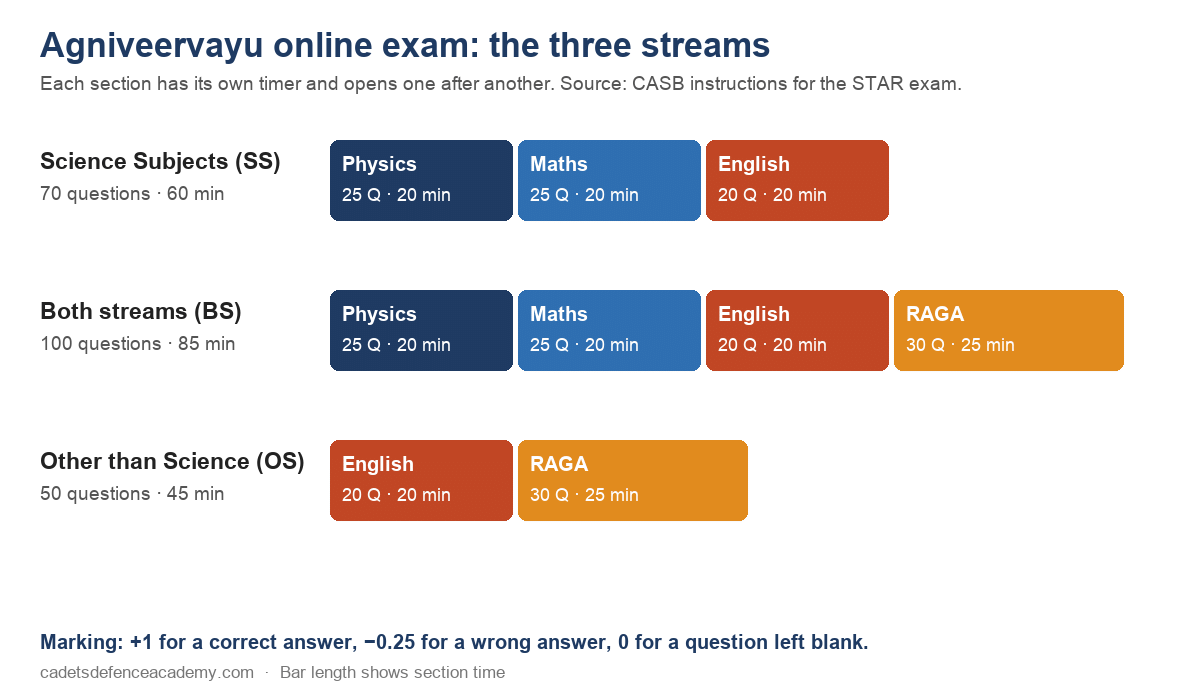
Short answer: The Agniveervayu online exam has three streams. Science Subjects is Physics, Maths and English: 70 questions in 60 minutes. Other than Science is English and Reasoning & General Awareness (RAGA): 50 questions in 45 minutes. Science students can take both in one sitting: 100 questions in 85 minutes. Each right answer gets 1 mark and each wrong answer loses 0.25. Physics, Maths and English follow the 10+2 CBSE syllabus, and CASB publishes the topic list for each subject (CASB advertisement, CASB syllabus books).
Every Air Force batch we teach starts with the same confusion. One student has a 2022 syllabus PDF from a WhatsApp group, another says “X group” has a different paper, and a third has heard that RAGA is only reasoning. So before you buy another book, it is worth reading what the Central Airmen Selection Board (CASB) itself says.
This page puts together the official syllabus that CASB has published for each subject, the exam pattern from its latest advertisement (Intake 02/2027) and its instruction sheet for the online test. We have kept our own advice separate and clearly marked, so you always know which part is official.
Other than Science: English 20 questions (20 minutes) + RAGA 30 questions (25 minutes).
Each section has its own timer. When the time ends it is submitted and you cannot go back to it.
+1 for a right answer, −0.25 for a wrong one. You must qualify each paper separately.
Cut-offs use normalised marks and are set state by state, because vacancies are allotted state-wise.
On 23 November 2026, CASB has not yet announced the next intake. Its site says the Intake 01/2027 PSLs “will be published shortly”.
Agniveervayu exam pattern for each stream
CASB calls the online exam STAR (Scheduled Test for Agniveervayu Recruitment). When you fill the form, you choose a stream based on your 10+2 subjects. Here is the pattern from the CASB instruction sheet:
Agniveervayu STAR Phase-I online test. Source: CASB instructions for candidates and the Intake 02/2027 advertisement.
The three streams at a glance. Each block is one timed section.
Questions come in both English and Hindi, except the English paper. The test is objective, with four options per question.
How the timed sections work (read this twice)
This is the rule that catches most first-timers. The paper is not one open block of 60 or 85 minutes. Each subject opens only after the previous one ends, and as per the CASB instructions:
Each subject has a fixed time. When it runs out, that section is submitted automatically.
Once a section is submitted, you cannot go back to it.
The submit button stays disabled for the first 5 minutes of each section.
You can jump to any question inside the current section, and use “Mark for Review” for doubtful ones. An answered question marked for review is still counted as attempted.
So you cannot “save time” in English and spend it on Physics. In practice, finish each section well, then use the leftover minutes to recheck that section before it closes.
Marking, negative marking and normalisation
The Intake 02/2027 advertisement gives the marking scheme: one mark for every correct answer, zero for a question left blank, and 0.25 marks taken off for every wrong answer.
Because the exam runs in many shifts, CASB converts raw scores into “normalised marks” using a standard deviation model (in use since STAR 01/2023, as per its normalisation notice). The cut-off for Phase-II and the final merit list both use normalised marks, not your raw score. Your normalised mark in a subject can be a little higher or lower than your raw mark.
Two more points from the advertisement matter for planning. First, you must qualify each paper individually, so a great Maths score cannot cover a weak English score. Second, shortlisting is done state-wise, and the cut-off can differ from state to state because vacancies are allotted by state.
Physics syllabus (Science stream)
CASB lists 19 Physics topics, all from the Class 11 and 12 CBSE syllabus:
Physical World and Measurement; Kinematics; Laws of Motion; Work, Energy and Power; Motion of System of Particles and Rigid Body; Gravitation; Properties of Bulk Matter; Thermodynamics; Behaviour of Perfect Gases and Kinetic Theory; Oscillations and Waves; Electrostatics; Current Electricity; Magnetic Effects of Current and Magnetism; Electromagnetic Induction and Alternating Current; Electromagnetic Waves; Optics; Dual Nature of Matter and Radiation; Atoms and Nuclei; Electronic Devices.
The CASB model paper mixes concept questions (why an astronaut feels weightless) with short numericals. With 25 questions in 20 minutes, you have under a minute per question, so formulas must be at your fingertips.
Maths syllabus (Science stream)
The 23 Maths topics in the CASB list are:
Sets, Relations and Functions; Trigonometric Functions; Inverse Trigonometric Functions; Complex Numbers and Quadratic Equations; Cartesian system of coordinates; Permutations and Combinations; Binomial Theorem; Sequences and Series; Straight Lines; Circles; Conic Sections; Three-dimensional Geometry; Matrices and Determinants; Limits and Continuity; Differentiation; Applications of Derivatives; Indefinite Integrals; Definite Integrals; Applications of Integrals; Differential Equations; Vectors; Probability; Statistics.
This is almost the same list as NDA Maths, only with far fewer questions. That is useful: NDA previous year papers are good practice for the harder Agniveervayu Maths questions. You can practise NDA Maths papers free with full solutions, and our NDA Maths chapter-wise weightage shows which chapters come up most.
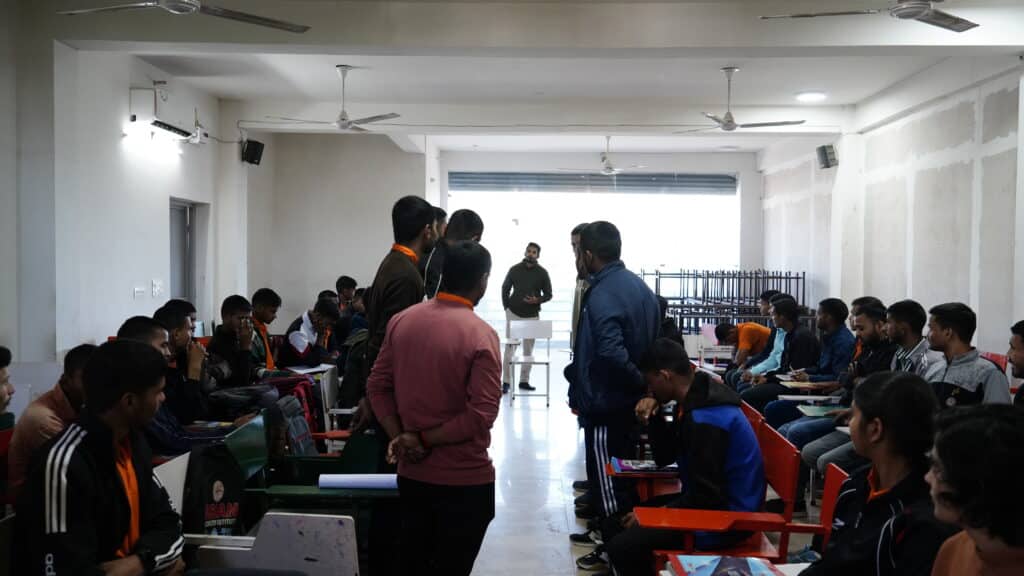
A classroom session at our Dehradun campus. Maths and Physics need daily timed practice for the 20-minute sections.
English syllabus (all streams)
English is common to every stream, and it is the one paper every candidate must clear. CASB lists seven areas:
Comprehension: a short passage with four questions on understanding, inference and vocabulary.
Grammar 1: subject-verb agreement, forms of verbs, sequence of tenses.
Grammar 2: word formation, determiners, prepositions, nouns and pronouns, adjectives, adverbs, conjunctions, modals.
The level is Class 12, but 20 questions in 20 minutes with negative marking is tight. Grammar rules and vocabulary give the fastest marks.
RAGA syllabus: Reasoning and General Awareness
RAGA is the second paper for Other than Science candidates, and the fourth for students who take both streams. CASB divides it into three parts:
Agniveervayu RAGA syllabus, as listed in the CASB RAGA syllabus and model paper.
Part
Official topics
Reasoning (verbal and non-verbal)
Series completion, direction sense, mathematical operations, number ranking and time sequence, classification, missing character, blood relations, coding-decoding, clocks, Venn diagrams, tallest/youngest relations, alphabet test, analogy, non-verbal reasoning, logical sequence of words, sitting arrangement
Elementary Mathematics
Ratio and proportion, average, LCM and HCF, profit and loss, time-distance-speed, percentage, simplification, fractions, area of triangle, square, circle and rectangle, surface area and volume of cuboid, cylinder, cone and sphere, probability, simple trigonometry
General Knowledge and Current Affairs
General science, civics, geography, current events, history, basic computer operations
Many students prepare only reasoning for RAGA and lose easy marks. The CASB model paper has plenty of general knowledge questions (for example on radar waves and the Sikh Gurus), so keep 15 minutes a day for GK and current affairs.
X group and Y group: is the syllabus different?
Students still say “X group” and “Y group”, the old names for technical and non-technical airmen trades. In the Agniveervayu advertisements, CASB uses Science Subjects and Other than Science Subjects instead. Roughly, what people call the X group paper is the Science stream (Physics, Maths, English), and the Y group paper is Other than Science (English, RAGA).
Science-eligible students can choose to sit both papers in one go. The advertisement allows this at the time of registration. Our view: if your Physics and Maths are reasonably strong, taking both gives you two chances on the merit list for the cost of 25 extra minutes. If you are weak in RAGA general knowledge, start that preparation early.
Who can apply: age and education (latest intake)
For Intake 02/2027, the most recent advertisement, the rules were:
Source: CASB advertisement for Agniveervayu Intake 02/2027. The next intake will have its own date-of-birth window.
Rule
Intake 02/2027 (official)
Date of birth
Born between 1 July 2005 and 1 January 2010 (both dates included)
Science Subjects
10+2 with Maths, Physics and English, 50% aggregate and 50% in English; or a 3-year engineering diploma, or a 2-year vocational course with Physics and Maths, with the same 50% rules
Other than Science
10+2 in any stream with 50% aggregate and 50% in English, or a 2-year vocational course with the same 50% rules
Marital status
Unmarried men and women only
The age window moves with every intake, so check the new advertisement when it comes out.
After the online test: PFT, adaptability tests and medical
Clearing the online test only gets you to Phase II at an Airmen Selection Centre. The advertisement sets these physical standards:
PFT-II starts 10 minutes after the run, with 2-minute breaks between exercises. Source: CASB advertisement, Intake 02/2027.
Test
Men
Women
1.6 km run (PFT-I)
Within 7 minutes
Within 8 minutes
Push-ups
10 in 1 minute
Not required
Sit-ups
10 in 1 minute
10 in 1 minute 30 seconds
Squats
20 in 1 minute
15 in 1 minute
After the PFT come Adaptability Test-I (an objective written test) and Adaptability Test-II, and then the medical examination. Our Agniveer Air Force physical test guide explains the run and exercises in detail.
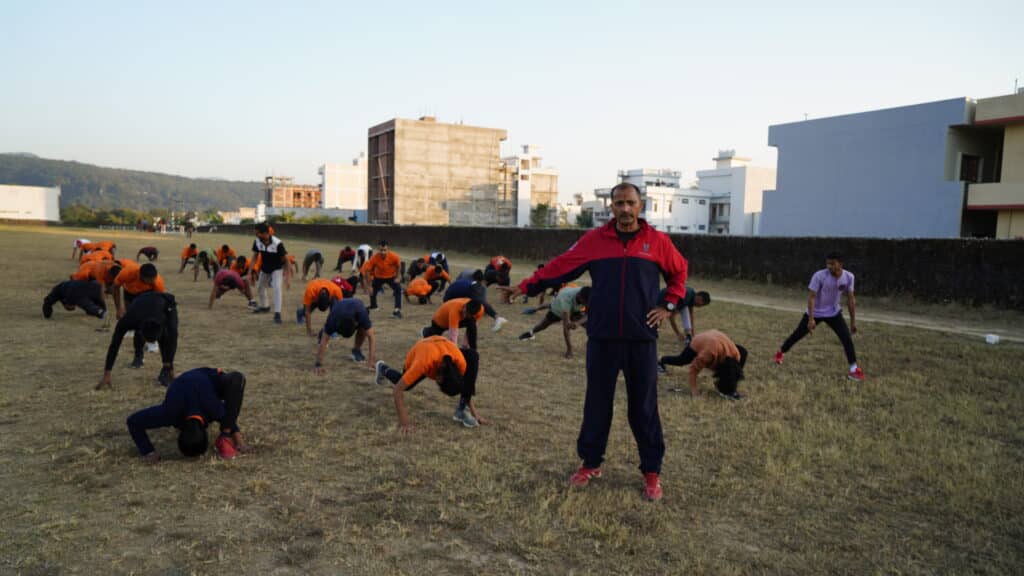
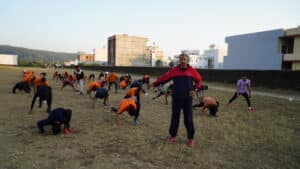
Morning physical training at our Dehradun ground. Start running practice alongside your written preparation, not after it.
An 8-week study plan for the Science stream
This is our suggestion, not an official plan. It assumes about four hours a day.
A suggested 8-week plan. Other than Science candidates can replace Physics and Maths with RAGA reasoning, elementary maths and GK.
When we checked the CASB portal on 23 November 2026, there was no new advertisement. The latest notices said that the PSLs for Intake 01/2027 “will be published shortly” and that STAR Phase-I results for Intake 02/2027 “are under process”. For Intake 02/2027, registration ran from 6 to 26 July 2026 and the online exam was held on 22–23 September 2026.
We will not guess a date for the next intake. Keep checking the CASB website, and read our explainer on the Air Force PSL list for Intake 01/2027 if you are waiting on that result.
Our honest view
The Agniveervayu syllabus is not hard. What makes the exam hard is the time: 20 minutes for 25 Physics questions, with a section that locks when the clock runs out. Students who clear it are usually the ones who practised in timed sections from the first month.
If you want guided preparation for Air Force and NDA exams, with daily tests and physical training, see how our programme works on the best NDA coaching in India page, or send us your details below.
Preparing for the next Agniveervayu intake?
Share your details and our team at Cadets Defence Academy, Dehradun will call you about our Air Force course, timed mock tests and physical training.
Frequently Asked Questions
What is the syllabus of Agniveervayu 2027?
For the Science stream it is Physics, Maths and English as per the 10+2 CBSE syllabus. For Other than Science it is English and RAGA (reasoning, elementary maths, general knowledge and current affairs). CASB publishes a topic list and model paper for each subject on its website.
How many questions are there in the Agniveervayu exam?
Science Subjects: 70 questions in 60 minutes (Physics 25, Maths 25, English 20). Other than Science: 50 questions in 45 minutes (English 20, RAGA 30). Both streams together: 100 questions in 85 minutes.
Is there negative marking in the Agniveervayu exam?
Yes. A correct answer gets 1 mark, a wrong answer loses 0.25 marks, and an unattempted question gets zero.
Can a Science student appear in both Science and Other than Science?
Yes. Candidates eligible for Science Subjects can choose to appear in both papers in one sitting when they register online. The combined test has 100 questions in 85 minutes.
What is RAGA in the Air Force exam?
RAGA stands for Reasoning and General Awareness. It has 30 questions in 25 minutes, covering verbal and non-verbal reasoning, elementary mathematics, and general knowledge with current affairs.
Is there a sectional cut-off in the Agniveervayu exam?
Yes, you must qualify each paper individually. Cut-offs are applied to normalised marks and can differ from state to state, because vacancies are allotted state-wise. CASB does not publish the cut-off marks in advance.
What is the running time for the Air Force Agniveer physical test?
The 1.6 km run must be completed within 7 minutes for men and within 8 minutes for women. After that, men do 10 push-ups, 10 sit-ups and 20 squats, and women do 10 sit-ups and 15 squats, each within set times.
When will the next Agniveervayu notification come?
As of 23 November 2026, CASB has not announced the next intake. Check iafrecruitment.edcil.co.in for the official advertisement, which gives the dates, age window and exam schedule.
Official Agniveervayu syllabus 2027 from CASB: Physics, Maths, English and RAGA topics, exam pattern for each stream, negative marking, normalisation and PFT.