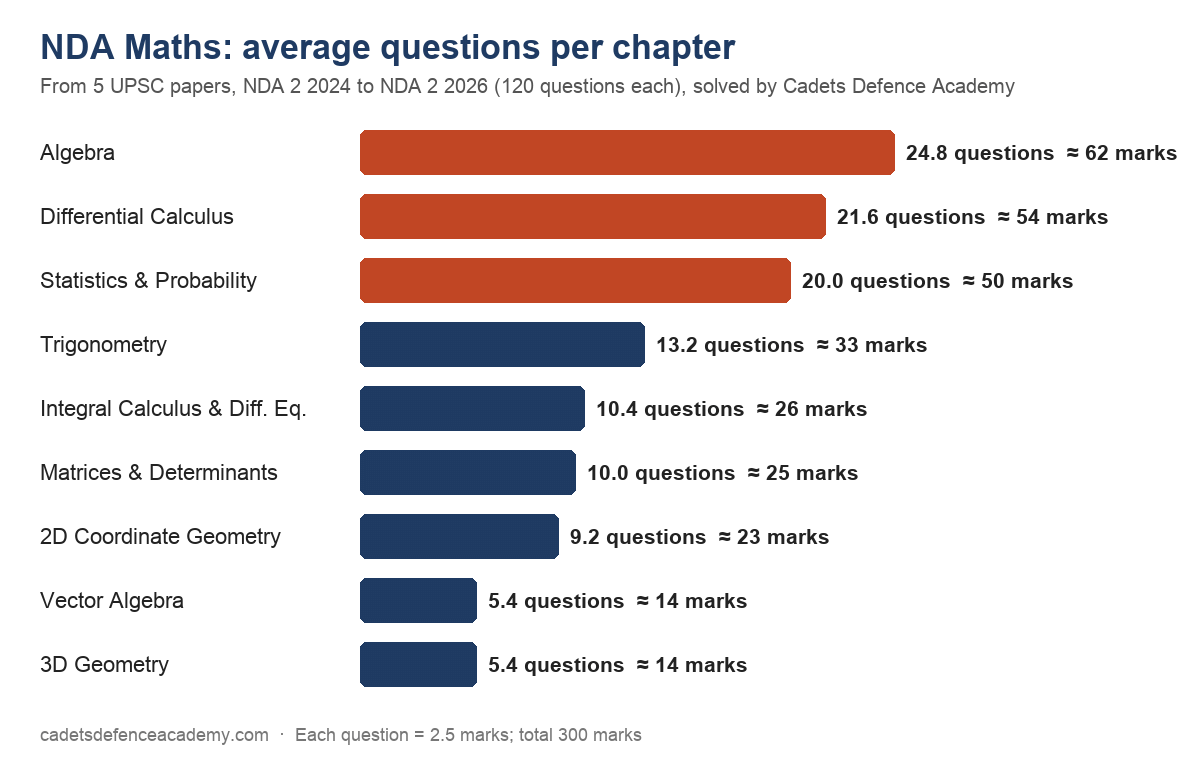
Short answer: Across the last five NDA Maths papers (NDA 2 2024 to NDA 2 2026), Algebra carried the most questions, about 25 of 120 on average. Differential Calculus came next with about 22, and Statistics & Probability had exactly 20 in every paper. These three chapters alone are worth about 165 of the 300 marks. Vectors and 3D Geometry are the smallest, at about 5 questions each. The counts come from our own solving of the official UPSC papers, which you can practise free.
Every year, around the time the NDA notification comes out, students ask us the same thing: “Sir, which chapters should I do first?” The honest answer used to be “all of them”. That is still true, because UPSC can ask from anywhere in the syllabus. But time is short, and it helps to know where the marks have actually been.
So we sat down with the five most recent NDA Maths papers that we have fully solved and put on this site: NDA 2 2024, NDA 1 2025, NDA 2 2025, NDA 1 2026 and NDA 2 2026. Every one of the 600 questions was solved and tagged to a chapter by our faculty. This post is what those 600 questions tell us.
Table of Contents
Key takeaways
NDA Maths has 120 questions for 300 marks in 150 minutes. Each question is 2.5 marks, and a wrong answer costs one-third of that (about 0.83).
Algebra (avg 24.8 questions), Differential Calculus (21.6) and Statistics & Probability (20.0) together make up about 55% of the paper.
Statistics & Probability was exactly 20 questions in all five papers. It is the most predictable block in NDA Maths.
Trigonometry swings the most, from 9 to 18 questions. Do not skip it.
Vectors and 3D Geometry give about 5 questions each, but those questions are usually short and formula-based.
The NDA & NA (I) 2027 notification is due on 2 December 2026, and the exam on 11 April 2027, as per the UPSC calendar.
How did we work out the NDA Maths weightage?
We took the official question papers from UPSC for the five exams listed above. Our faculty solved every question and tagged it to one of the nine chapter groups in the UPSC NDA syllabus: Algebra, Matrices & Determinants, Trigonometry, 2D Coordinate Geometry, 3D Geometry, Differential Calculus, Integral Calculus & Differential Equations, Vector Algebra, and Statistics & Probability.
One caution before you read the numbers. Some questions mix two chapters. A question on the area between two curves needs both coordinate geometry and integration. We put each such question under the chapter where most of the work happens. Another teacher may tag one or two questions differently, so treat the counts as a strong guide, not a law.
Here is how many questions each chapter got in each paper. Every column adds up to 120.
Questions per chapter in NDA Maths, out of 120. Source: official UPSC papers, solved and tagged by the Cadets Defence Academy faculty.
Chapter
NDA 2 2024
NDA 1 2025
NDA 2 2025
NDA 1 2026
NDA 2 2026
Average
Algebra
28
19
29
25
23
24.8
Differential Calculus
20
25
23
18
22
21.6
Statistics & Probability
20
20
20
20
20
20.0
Trigonometry
12
18
9
14
13
13.2
Integral Calculus & Diff. Equations
11
7
10
13
11
10.4
Matrices & Determinants
9
11
9
10
11
10.0
2D Coordinate Geometry
9
10
9
8
10
9.2
Vector Algebra
5
5
5
6
6
5.4
3D Geometry
6
5
6
6
4
5.4
Average questions and marks per chapter across NDA 2 2024 to NDA 2 2026.
Two things stand out. First, calculus as a whole (differential plus integral) averages 32 questions, which is about 80 marks. That is more than a quarter of the paper. Second, Statistics & Probability did not move at all: 20 questions, five times in a row. If you are looking for marks that are almost guaranteed to be there, this is it.
Which chapter has the most weightage in NDA Maths?
Algebra. It averaged 24.8 questions, about 62 marks, and was the biggest chapter in four of the five papers. Only NDA 1 2025 broke the pattern, when Differential Calculus (25) went ahead of Algebra (19).
Algebra in NDA is wide. In the four papers from NDA 1 2025 onwards, these topics came up again and again:
Sequences and series (AP, GP, sums): 17 questions
Permutations and combinations: 17 questions
Quadratic equations: 14 questions
Complex numbers: 13 questions
Binomial theorem: 10 questions
Sets, relations and functions also appear, but in smaller numbers. Our NDA Maths formula sheet covers the formulas for each of these.
Calculus: the second biggest block
Differential Calculus averaged 21.6 questions and ranged from 18 to 25. The usual mix is limits, continuity and differentiability, derivatives, and applications such as maxima, minima, tangents and increasing or decreasing functions. Functions (domain, range, composition) are often asked inside this block too.
Integral Calculus and Differential Equations added another 7 to 13 questions. Area under curves came up in three of the last four papers, and definite integrals with properties are asked almost every time. Differential equations questions are usually about order, degree and simple variable-separable forms. These are quick marks if you have practised the standard types.
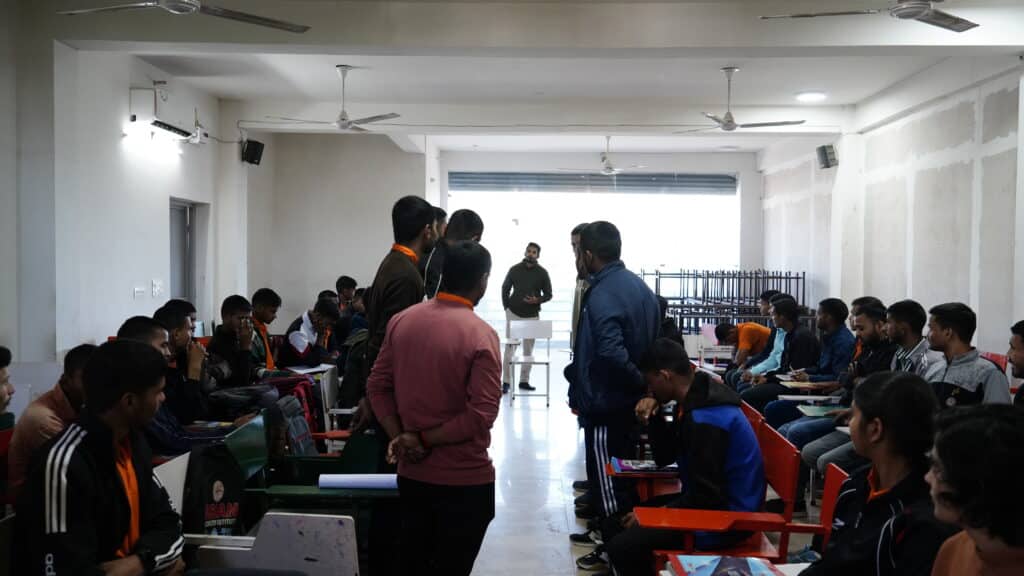
A maths class at our Dehradun campus. Calculus and algebra take most of the classroom time before the NDA exam.
Statistics and Probability: the most predictable 50 marks
Exactly 20 questions in every paper we checked. That is 50 marks you can plan for with confidence. Probability questions cover classical probability, dice and cards, conditional probability, Bayes’ theorem and the binomial distribution. Statistics covers mean, median, mode, variance and standard deviation, correlation and regression, and reading data from tables and graphs.
Many students leave this block for the end because it sits at the end of the syllabus. That is a mistake. Statistics questions are often the fastest in the paper, and a few weeks of steady practice can make this your strongest block.
Trigonometry, matrices and coordinate geometry
Trigonometry is the chapter that moves the most: 18 questions in NDA 1 2025 but only 9 in NDA 2 2025. On average it is 13.2 questions. Properties of triangles, inverse trigonometric functions, trigonometric equations and heights and distances are the topics we saw most.
Matrices and Determinants is the steadiest after statistics, at 9 to 11 questions every time. Properties of determinants, inverse of a matrix and types of matrices are the core.
2D Coordinate Geometry gave 8 to 10 questions. Straight lines dominate (17 questions in the last four papers), followed by circles and conic sections.
Vectors and 3D Geometry: small but quick
Each gives about 5 questions, so roughly 13 to 14 marks. Students often skip these because the chapters feel new. We would not. Most of these questions test one formula: dot product, cross product, angle between lines, direction cosines or the distance of a point from a plane. Two or three focused days are usually enough to get most of them right.
How many questions should you attempt, given negative marking?
Each correct answer gives 2.5 marks and each wrong answer takes away one-third of that, about 0.83 (as per the UPSC notice). So accuracy matters more than the number of attempts. Look at these three students:
Net Maths marks for different attempt and accuracy levels, using 2.5 marks per right answer and 0.83 per wrong answer.
Attempts
Accuracy
Right / Wrong
Net marks (out of 300)
60
80%
48 / 12
120 − 10 = 110
80
75%
60 / 20
150 − 16.7 = 133.3
100
65%
65 / 35
162.5 − 29.2 = 133.3
100
80%
80 / 20
200 − 16.7 = 183.3
The student who attempted 80 at 75% accuracy scored the same as the one who attempted 100 at 65%, while taking 20 fewer risks. Pure guessing among four options is break-even on average. If you can rule out one option, a guess has a small positive value. If you cannot rule out anything, leave it.
UPSC does not publish a fixed pass mark in advance. It fixes minimum qualifying marks for each paper at its discretion, so aim well above the minimum. Our guide on how to score 150 marks in NDA Maths explains how to build up to that level.
A chapter-wise plan for NDA 1 2027
As per the UPSC calendar for 2027, the NDA & NA (I) 2027 notification is due on 2 December 2026, applications close on 22 December 2026, and the exam is on 11 April 2027. That leaves about 20 weeks. Our dates guide for NDA 1 2027 has the full schedule. Here is how we suggest splitting the Maths preparation:
Suggested study time for a 20-week plan, leaving about 3 weeks for full mock tests and revision.
Chapter
Avg questions
Avg marks
Priority
Suggested time
Algebra
24.8
62
Very high
4 weeks
Differential Calculus
21.6
54
Very high
3 weeks
Statistics & Probability
20.0
50
Very high
2.5 weeks
Trigonometry
13.2
33
High
2 weeks
Integral Calculus & Diff. Equations
10.4
26
High
2 weeks
Matrices & Determinants
10.0
25
High
1 week
2D Coordinate Geometry
9.2
23
Medium
1.5 weeks
Vector Algebra
5.4
14
Medium
4 days
3D Geometry
5.4
14
Medium
4 days
Keep the last three weeks for full papers. Take one previous year paper every week as a timed test from the start, not only at the end. Mark every wrong answer and the chapter it came from. After four or five papers you will see your own weak chapters clearly, and that tells you more than any general weightage table.
Practise the five papers free
Each paper is available as a free 150-minute timed test and as a practice page with solutions in English and Hindi:
Weightage tells you where to start, not where to stop. Every chapter in the syllabus has given at least four questions in each of the last five papers, so skipping a chapter costs you real marks. Start with Algebra, Calculus and Statistics, because that is where more than half the paper is. Then close the gaps with the smaller chapters and keep testing yourself with full papers.
If you want guided preparation with daily practice and regular mock tests, read our page on the best NDA coaching in India to see how our Dehradun programme works, or send us your details below.
Morning assembly at Cadets Defence Academy, Dehradun.
Preparing for NDA 1 2027?
Share your details and our team at Cadets Defence Academy, Dehradun will call you about our NDA programme, mock tests and doubt sessions.
Frequently Asked Questions
Which chapter has the most weightage in NDA Maths?
Algebra. In the last five UPSC papers (NDA 2 2024 to NDA 2 2026) it averaged about 25 of 120 questions, roughly 62 marks. Differential Calculus (about 22) and Statistics & Probability (20) come next.
How many questions come from Statistics and Probability in NDA?
Exactly 20 questions in each of the last five NDA Maths papers, worth 50 marks. It is the most consistent block in the paper.
How many questions come from calculus in NDA Maths?
Differential and Integral Calculus together averaged about 32 questions (about 80 marks) across the last five papers: about 22 from Differential Calculus and about 10 from Integral Calculus and Differential Equations.
Can I skip any chapter in NDA Maths?
We do not advise it. Every chapter gave at least four questions in each of the last five papers. Even the smallest, Vectors and 3D Geometry, are worth about 13 to 14 marks each, and their questions are usually quick.
How many questions should I attempt in NDA Maths?
There is no fixed number. A wrong answer costs about 0.83 marks, so accuracy matters more than attempts. Attempting 80 questions at 75% accuracy gives about 133 marks, the same as 100 attempts at 65% accuracy. Attempt only where you can solve the question or rule out at least one option.
What is the negative marking in NDA Maths?
Each question carries 2.5 marks. For every wrong answer, one-third of the marks for that question (about 0.83) is deducted. There is no penalty for a question left blank.
Is the NDA Maths syllabus from Class 11 and 12?
Mostly, yes. The UPSC syllabus covers Algebra, Matrices and Determinants, Trigonometry, 2D and 3D Geometry, Differential and Integral Calculus, Differential Equations, Vector Algebra, and Statistics and Probability, which are mainly Class 11 and 12 topics.
When will the NDA 1 2027 notification come out?
As per the UPSC calendar for 2027, the NDA & NA (I) 2027 notification is due on 2 December 2026, the last date to apply is 22 December 2026, and the exam is on 11 April 2027. UPSC can change these dates, so check upsc.gov.in.
AFCAT 01/2027 syllabus from the official notice: 100 questions, 300 marks, 2 hours, +3/-1. Topic-wise English, GA, Maths and Reasoning list, and no EKT.