
बारंबारता बंटन (वर्ग अंतराल: श्रेणी-I, श्रेणी-II): 10-20: 20, 4; 20-30: 15, 8; 30-40: 10, 4; 40-50:  ,
 ; 50-60:
 , ; कुल: 100, 100।
श्रेणी-I के बारंबारता बंटन का माध्य क्या है?
Frequency distribution (class interval: Series-I, Series-II): 10-20: 20, 4; 20-30: 15, 8; 30-40: 10, 4; 40-50: , ; 50-60: , ; Total: 100, 100.
What is the mean of frequency distribution of Series-I?
श्रेणी-I से  , श्रेणी-II से
 ; अतः
 ,
 ।
 ; माध्य
 ।
From Series-I:  , so . From Series-II:
 , so . Hence , . Mid-values 15, 25, 35, 45, 55 with frequencies 20, 15, 10, 29, 26: sum
 . Mean
 .
बारंबारता बंटन (वर्ग अंतराल: श्रेणी-I, श्रेणी-II): 10-20: 20, 4; 20-30: 15, 8; 30-40: 10, 4; 40-50: , ; 50-60: , ; कुल: 100, 100।
श्रेणी-II के बारंबारता बंटन का बहुलक क्या है?
Frequency distribution (class interval: Series-I, Series-II): 10-20: 20, 4; 20-30: 15, 8; 30-40: 10, 4; 40-50: , ; 50-60: , ; Total: 100, 100.
What is the mode of the frequency distribution of Series-II?
श्रेणी-I से , श्रेणी-II से ; अतः , । बहुलक वर्ग 40-50; बहुलक 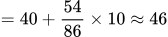 ।
From Series-I: , so . From Series-II: , so . Hence , . Series-II frequencies: 4, 8, 4, 58, 26. Modal class 40-50. Mode  , about 46.
S1 = शोरूम A, B, C, D, E द्वारा कंपनी X और Y दोनों के बेचे गए स्कूटरों का प्रतिशत (कुल 6400): 19%, 21%, 15%, 33%, 12%। S2 = केवल कंपनी X के स्कूटरों का प्रतिशत (कुल 3000): 24%, 18%, 20%, 30%, 8%।
शोरूम E द्वारा बेचे गए कंपनी Y के स्कूटर, शोरूम C द्वारा बेचे गए दोनों कंपनियों के स्कूटरों का कितना प्रतिशत हैं?
S1 = share of scooters of companies X and Y together sold by showrooms A, B, C, D, E (total 6400): 19%, 21%, 15%, 33%, 12%. S2 = share of scooters of company X only (total 3000): 24%, 18%, 20%, 30%, 8%.
Number of scooters of company Y sold by showroom E is what per cent of the number of scooters of both companies sold by showroom C?
E पर Y  ; C पर दोनों
 ;
 ।
E, both companies: 12% of 6400 = 768; E, company X: 8% of 3000 = 240; so company Y at E = 528. C, both: 15% of 6400 = 960. .
S1 = शोरूम A, B, C, D, E द्वारा कंपनी X और Y दोनों के बेचे गए स्कूटरों का प्रतिशत (कुल 6400): 19%, 21%, 15%, 33%, 12%। S2 = केवल कंपनी X के स्कूटरों का प्रतिशत (कुल 3000): 24%, 18%, 20%, 30%, 8%।
शोरूम B द्वारा बेचे गए दोनों कंपनियों के स्कूटर, शोरूम A द्वारा बेचे गए कंपनी X के स्कूटरों से कितने प्रतिशत अधिक हैं?
S1 = share of scooters of companies X and Y together sold by showrooms A, B, C, D, E (total 6400): 19%, 21%, 15%, 33%, 12%. S2 = share of scooters of company X only (total 3000): 24%, 18%, 20%, 30%, 8%.
Number of scooters of both the companies sold by showroom B is what per cent more than the number of scooters of company X sold by showroom A?
B पर दोनों  , A पर X
 ;
 ।
B, both: 21% of 6400 = 1344. A, company X: 24% of 3000 = 720. Excess  , and .
S1 = शोरूम A, B, C, D, E द्वारा कंपनी X और Y दोनों के बेचे गए स्कूटरों का प्रतिशत (कुल 6400): 19%, 21%, 15%, 33%, 12%। S2 = केवल कंपनी X के स्कूटरों का प्रतिशत (कुल 3000): 24%, 18%, 20%, 30%, 8%।
शोरूम A, C और E द्वारा बेचे गए कंपनी Y के स्कूटरों की औसत संख्या क्या है?
S1 = share of scooters of companies X and Y together sold by showrooms A, B, C, D, E (total 6400): 19%, 21%, 15%, 33%, 12%. S2 = share of scooters of company X only (total 3000): 24%, 18%, 20%, 30%, 8%.
What is the average number of scooters of company Y sold by the showrooms A, C and E?
Y: A 496, C 360, E 528; औसत  ।
Company Y = both minus X. A:  . C:
 . E:
 . Average .
S1 = शोरूम A, B, C, D, E द्वारा कंपनी X और Y दोनों के बेचे गए स्कूटरों का प्रतिशत (कुल 6400): 19%, 21%, 15%, 33%, 12%। S2 = केवल कंपनी X के स्कूटरों का प्रतिशत (कुल 3000): 24%, 18%, 20%, 30%, 8%।
शोरूम A द्वारा बेचे गए दोनों कंपनियों के स्कूटरों और शोरूम B तथा E द्वारा मिलकर बेचे गए कंपनी X के कुल स्कूटरों में क्या अंतर है?
S1 = share of scooters of companies X and Y together sold by showrooms A, B, C, D, E (total 6400): 19%, 21%, 15%, 33%, 12%. S2 = share of scooters of company X only (total 3000): 24%, 18%, 20%, 30%, 8%.
What is the difference between the number of scooters of both companies sold by showroom A and total number of scooters of company X sold by showrooms B and E together?
 ।
A, both: 19% of 6400 = 1216. X at B and E: 18% + 8% = 26% of 3000 = 780. Difference  .
भारत में सड़क मौतें (2014, 2015, 2016, 2017): मारे गए बाइक सवार 40957, 46070, 52750, 48746; मारे गए पैदल यात्री 12330, 13894, 15746, 20457; मारे गए साइकिल सवार 4037, 3125, 2585, 3559।
वर्ष 2017 में प्रतिदिन मारे गए पैदल यात्रियों की औसत संख्या क्या थी?
Road deaths in India (2014, 2015, 2016, 2017): bikers killed 40957, 46070, 52750, 48746; pedestrians killed 12330, 13894, 15746, 20457; cyclists killed 4037, 3125, 2585, 3559.
What was the average number of pedestrians killed per day in the year 2017?
 ।
 .
भारत में सड़क मौतें (2014, 2015, 2016, 2017): मारे गए बाइक सवार 40957, 46070, 52750, 48746; मारे गए पैदल यात्री 12330, 13894, 15746, 20457; मारे गए साइकिल सवार 4037, 3125, 2585, 3559।
2014-17 की अवधि में पैदल यात्रियों की मौतों में लगभग कितने प्रतिशत का परिवर्तन हुआ?
Road deaths in India (2014, 2015, 2016, 2017): bikers killed 40957, 46070, 52750, 48746; pedestrians killed 12330, 13894, 15746, 20457; cyclists killed 4037, 3125, 2585, 3559.
What is the approximate percentage change in the pedestrians' fatalities during the period 2014-17?
 ।
 , about 66%.
भारत में सड़क मौतें (2014, 2015, 2016, 2017): मारे गए बाइक सवार 40957, 46070, 52750, 48746; मारे गए पैदल यात्री 12330, 13894, 15746, 20457; मारे गए साइकिल सवार 4037, 3125, 2585, 3559।
वर्ष 2017 में सड़क दुर्घटनाओं में प्रतिदिन मारे गए बाइक सवारों की औसत संख्या क्या है?
Road deaths in India (2014, 2015, 2016, 2017): bikers killed 40957, 46070, 52750, 48746; pedestrians killed 12330, 13894, 15746, 20457; cyclists killed 4037, 3125, 2585, 3559.
What is the average number of bikers killed daily in road accidents in the year 2017?
 ।
 , about 134.
भारत में सड़क मौतें (2014, 2015, 2016, 2017): मारे गए बाइक सवार 40957, 46070, 52750, 48746; मारे गए पैदल यात्री 12330, 13894, 15746, 20457; मारे गए साइकिल सवार 4037, 3125, 2585, 3559।
2017 में सड़क दुर्घटनाओं में प्रतिदिन मारे गए साइकिल सवारों की औसत संख्या क्या है?
Road deaths in India (2014, 2015, 2016, 2017): bikers killed 40957, 46070, 52750, 48746; pedestrians killed 12330, 13894, 15746, 20457; cyclists killed 4037, 3125, 2585, 3559.
What is the average number of cyclists killed daily in road accidents in 2017?
 ।
 , about 10.
मान लीजिए  और
 दो धनात्मक वास्तविक संख्याएँ हैं जिनके लिए
 और
 ।
 का मान क्या है?
Let and be two positive real numbers such that and . What is the value of ?
 , अतः
 ,
 ;
 , उत्तर 9।
Put  ,
 :
 and
 . Then
 , so
 and
 .
 , so
 .
यदि  और
 है, तो निम्नलिखित में से किस समीकरण को संतुष्ट करता है?
If and , then satisfies which one of the following equations?
 ; मूलों का योग
 , गुणनफल
 ; समीकरण
 ।
 . With its conjugate
 : sum
 , product
 . So
 , i.e. .
दो संख्याओं का HCF 12 है। निम्नलिखित में से कौन-सा कभी उनका LCM नहीं हो सकता?
HCF of two numbers is 12. Which one of the following can never be their LCM?
LCM सदैव HCF का गुणज होता है; 80, 12 का गुणज नहीं है।
The LCM must be a multiple of the HCF. 80 is not a multiple of 12.
निम्नलिखित कथनों पर विचार कीजिए:
1.  का इकाई अंक 7 है।
2. किन्हीं दो विषम संख्याओं के वर्गों का अंतर सदैव 8 से विभाज्य होता है।
3. दो क्रमागत विषम संख्याओं के गुणनफल में 1 जोड़ने पर पूर्ण वर्ग बनता है।
उपर्युक्त में से कौन-से कथन सही हैं?
Consider the following statements:
1. Unit digit in is 7.
2. Difference of the squares of any two odd numbers is always divisible by 8.
3. Adding 1 to the product of two consecutive odd numbers makes it a perfect square.
Which of the above statements are correct?
1: इकाई अंक 9 है, असत्य। 2: सत्य। 3:  , सत्य।
1: unit digits of powers of 7 repeat 7, 9, 3, 1;  , so the unit digit is 9. False. 2:
 and each
 is even, so it is divisible by 8. True. 3: . True.
दो अलग योजनाओं पर ब्याज दर समान, 20% है। एक योजना में ब्याज अर्धवार्षिक और दूसरी में वार्षिक संयोजित होता है। दोनों में बराबर राशि निवेश की गई। यदि 2 वर्ष बाद प्रतिफल का अंतर ₹ 482 है, तो प्रत्येक योजना में मूलधन कितना है?
The rate of interest on two different schemes is the same and it is 20%. But in one of the schemes, the interest is compounded half yearly and in the other the interest is compounded annually. Equal amounts are invested in the schemes. If the difference of the returns after 2 years is ₹ 482, then what is the principal amount in each scheme?
 , अतः P = ₹20000।
Half-yearly:  . Annually:
 . Difference
 , so
 .
 के किस मान के लिए व्यंजक
 को तीन रैखिक गुणनखंडों में बाँटा जा सकता है?
For what value of can the expression be resolved into three linear factors?
 :
 । अन्य मानों पर कोई परिमेय मूल नहीं।
For :  . For k = 1, 2, 3 none of ±1, ±2, ±3, ±6 is a root, so there is no rational linear factor.
X, Y और Z एक वृत्ताकार स्टेडियम के चारों ओर एक ही बिंदु से, एक ही समय, एक ही दिशा में दौड़ना शुरू करते हैं। X एक चक्कर 252 सेकंड में, Y 308 सेकंड में और Z 198 सेकंड में पूरा करता है। वे फिर से आरंभिक बिंदु पर कितने समय बाद मिलेंगे?
X, Y and Z start at same point and same time in the same direction to run around a circular stadium. X completes a round in 252 seconds, Y in 308 seconds and Z in 198 seconds. After what time will they meet again at the starting point?
LCM  सेकंड
 मिनट 12 सेकंड।
 ,
 ,
 . LCM
 s min 12 s.
 ,
 ,
 ,
 का LCM क्या है?
What is the LCM of , , , ?
भिन्नों का LCM  ।
LCM of fractions  .
यदि समीकरणों  और
 का एक उभयनिष्ठ मूल है, तो का मान क्या है?
If the equations and have a common root, then what is the value of ?
पहले समीकरण के मूल  ,
 ; इनसे
 या
 ।
Roots of the first equation are and . For  :
 , so . For
 :
 , so
 .
A ने B को ₹ 25000 और उसी समय C को कुछ राशि, दोनों 7% साधारण ब्याज पर उधार दी। 4 वर्ष बाद A को B और C से ब्याज के रूप में ₹ 11200 मिले। A ने C को कितना उधार दिया?
A lent ₹ 25000 to B and at the same time lent some amount to C at same 7% simple interest. After 4 years A received ₹ 11200 as interest from B and C. How much did A lend to C?
B से ब्याज 7000; C से 4200; C को दी गई राशि  = ₹15000।
Interest from B  . Interest from C
 , so the sum lent to C
 .
एक व्यापारी दो कंप्यूटर समान मूल्य पर बेचता है, एक पर 30% लाभ और दूसरे पर 30% हानि। इस सौदे पर कुल लाभ या हानि प्रतिशत क्या है?
A trader sells two computers at the same price, making a profit of 30% on one and a loss of 30% on the other. What is the net loss or profit percentage on the transaction?
समान विक्रय मूल्य पर  लाभ-हानि से सदैव
 हानि।
Equal selling prices with equal profit and loss of always give a loss of  .
A और B की मासिक आय का अनुपात 4 : 3 है। प्रत्येक ₹ 600 बचाता है। यदि उनके व्यय का अनुपात 3 : 2 है, तो A की मासिक आय क्या है?
The monthly incomes of A and B are in the ratio 4 : 3. Each saves ₹ 600. If their expenditures are in the ratio 3 : 2, then what is the monthly income of A?
 से
 ; A की आय ₹2400।
Incomes  ,
 :
 gives
 , so and A's income
 .
दो स्टेशनों के बीच रेल किराए और बस किराए का अनुपात 3 : 4 है। यदि रेल किराया 20% और बस किराया 30% बढ़ जाए, तो संशोधित रेल किराए और संशोधित बस किराए का अनुपात क्या है?
The train fare and bus fare between two stations is in the ratio 3 : 4. If the train fare increases by 20% and bus fare increases by 30%, then what is the ratio between revised train fare and revised bus fare?
 ।
 .
N को 17 से भाग देने पर भागफल 182 आता है। भागफल और शेषफल का अंतर 175 है। N का मान क्या है?
When N is divided by 17, the quotient is equal to 182. The difference between the quotient and the remainder is 175. What is the value of N?
शेषफल 7;  ।
Remainder  , so
 .
अनाज का एक भंडार 240 व्यक्तियों के लिए 48 दिन के लिए पर्याप्त है। यही भंडार 160 व्यक्तियों के लिए कितने दिन चलेगा?
A stock of food grains is enough for 240 men for 48 days. How long will the same stock last for 160 men?
 दिन।
days.