
यदि किसी समांतर श्रेढ़ी के प्रथम 9 पदों का योग प्रथम 11 पदों के योग के बराबर है, तो प्रथम 20 पदों का योग क्या है?
If the sum of the first 9 terms of an AP is equal to sum of the first 11 terms, then what is the sum of the first 20 terms?
 ;
 ।
 , and
 , so
 .
यदि किसी समांतर श्रेढ़ी का 5वाँ पद  और 10वाँ पद
 है, तो प्रथम 50 पदों का योग क्या है?
If the 5th term of an AP is and its 10th term is , then what is the sum of first 50 terms?
 ;
 ।
 ,
 .
 .
 किसके बराबर है?
What is equal to?
 ।
.
यदि  और
 है, तो
 किसके बराबर है?
If and , then what is equal to?
 ।
 , i.e.
 .
असमिकाओं 5x − 4y + 12 < 0, x + y < 2, x < 0 और y > 0 पर विचार कीजिए। निम्नलिखित में से कौन-सा बिंदु उभयनिष्ठ क्षेत्र में स्थित है?
Consider the inequations 5x − 4y + 12 < 0, x + y < 2, x < 0 and y > 0. Which one of the following points lies in the common region?
(−1, 2) सभी असमिकाओं को संतुष्ट करता है।
(−1, 2):  ,
 ,
 ,
 — all hold. (−2, 4) and (−1, 4) fail
 ; (0, 0) fails .
फलन y = [x], x ∈ (−1, 1), जहाँ [.] महत्तम पूर्णांक फलन है, के संबंध में निम्नलिखित कथनों पर विचार कीजिए:
1. x = 0·5 पर इसका अवकलज 0 है
2. यह x = 0 पर संतत है
उपर्युक्त कथनों में से कौन-सा/कौन-से सही है/हैं?
Consider the following statements in respect of the function y = [x], x ∈ (−1, 1) where [.] is the greatest integer function:
1. Its derivative is 0 at x = 0·5
2. It is continuous at x = 0
Which of the above statements is/are correct?
0.5 के पास अचर (अवकलज 0); 0 पर असंतत। केवल 1।
Near 0.5 the function is constant 0 (derivative 0). At 0 it jumps from −1 to 0, so it is discontinuous. 1 only.
अवकल समीकरण  की घात क्या है?
What is the degree of the differential equation ?
घन करने पर  ; घात 4।
Cubing:  , so the degree is 4.
एक रेडियोधर्मी पदार्थ उपस्थित पदार्थ की मात्रा के समानुपाती दर से क्षय होता है। यदि आधा पदार्थ 100 वर्षों में क्षय हो जाता है, तो क्षय नियतांक (समानुपातिकता नियतांक) क्या है?
A radioactive substance decays at a rate proportional to the amount of substance present. If half of the substance decays in 100 years, then what is the decay constant (proportionality constant)?
 ।
 ;
 .
फलन  का प्रांत क्या है?
What is the domain of the function ?
 ,
 ।
 .
परवलय  , जहाँ
 , और इसके नाभिलंब से घिरे क्षेत्र का क्षेत्रफल 24 वर्ग इकाई है। k का मान क्या है?
The area of the region bounded by the parabola , where and its latus rectum is 24 square units. What is the value of k?
 ,
 ।
Area  .
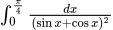 किसके बराबर है?
What is equal to?
 ।
Divide by  :
 .
 किसके बराबर है?
What is equal to?
 का समाकल
 ।
Integrand  , so the integral is .
यदि  और
 है, तो
 किसके बराबर है?
If and , then what is equal to?
 ।
 , so .
 किसके बराबर है?
What is equal to?
वहाँ  ; उत्तर
 ।
On  , ; integral
 .
 , जहाँ
 , के कितने चरम मान हैं?
How many extreme values does , where have?
 के दो हल; 2 चरम मान।
 ,
 in
 . Both are sign changes: 2 extreme values.
फलन  , जहाँ , का अधिकतम मान क्या है?
What is the maximum value of the function , where ?
 , अधिकतम
 ।
 .
यदि  है, तो f(2) किसके बराबर है?
If , then what is f(2) equal to?
दोनों समीकरणों से  ;
 ।
RHS  . Replacing x by
 :
 . Solving the pair gives
 , , .
यदि  है, तो
 किसके बराबर है?
If , then what is equal to?
 ; बार-बार भी ।
, so repeated application stays .
यदि  है, तो (1, 1) पर
 किसके बराबर है?
If , then what is at (1, 1) equal to?
(1, 1) पर  ,
 ।
 . Differentiating:
 ; at (1, 1): , .
यदि  है, तो x = 1 पर का मान क्या है?
If , then what is the value of at x = 1?
 ;
 पर 1।
 , ; at :
 .
मान लीजिए y = [x + 1], −4 < x < −3, जहाँ [.] महत्तम पूर्णांक फलन है। x = −3·5 पर x के सापेक्ष y का अवकलज क्या है?
Let y = [x + 1], −4 < x < −3 where [.] is the greatest integer function. What is the derivative of y with respect to x at x = −3·5?
वहाँ y अचर (−3), अवकलज 0।
On  ,
 is constant, so the derivative is 0.
यदि  और
 है, तो y(1) किसके बराबर है?
If with , then what is y(1) equal to?
 ;
 ।
 , so .
फलन  के संबंध में निम्नलिखित पर विचार कीजिए:
1. इसका प्रांत  है
2. यह एक संतत फलन है
3. यह x = 0 पर अवकलनीय है
उपर्युक्त कथनों में से कौन-से सही हैं?
Consider the following in respect of the function :
1. Its domain is
2. It is a continuous function
3. It is differentiable at x = 0
Which of the above statements are correct?
चरघातांकी फलन सर्वत्र परिभाषित, संतत और अवकलनीय है।
The exponential function is defined, continuous and differentiable everywhere. All three.
 किसके बराबर है?
What is equal to?
 ।
 .
 किसके बराबर है?
What is equal to?
 ।
 .