
- 100 questions
Questions with answers
Pick an option and check your answer. Tap the question number to open it on its own page.
13 cm व्यास वाले एक वृत्त की दो समांतर जीवाएँ क्रमशः 5 cm और 12 cm लंबी हैं। यदि दोनों जीवाएँ व्यास के एक ही ओर हैं, तो उनके बीच की दूरी है
Two parallel chords of a circle whose diameter is 13 cm are respectively 5 cm and 12 cm in length. If both the chords are on the same side of the diameter, then the distance between these chords is
केंद्र से दूरियाँ 6 और 2.5 cm; एक ही ओर होने पर अंतर 3.5 cm।
Radius 6.5 cm. Distance of the 5 cm chord from the centre  ; of the 12 cm chord
 . On the same side the gap is
 cm.
यदि किसी लंब वृत्तीय शंकु की ऊँचाई बदले बिना उसकी त्रिज्या p% बढ़ा दी जाए, तो शंकु के आयतन में कितने प्रतिशत की वृद्धि होगी?
If the radius of a right circular cone is increased by p% without increasing its height, then what is the percentage increase in the volume of the cone?
आयतन  ; वृद्धि
 ।
Volume varies as  : new/old
 . The percentage increase is
 .
एक ताँबे का तार वर्ग के आकार में मोड़ने पर 121 cm² क्षेत्रफल घेरता है। यदि उसी तार को वृत्त के आकार में मोड़ा जाए, तो वह कितना क्षेत्रफल घेरेगा?
A copper wire when bent in the form of a square encloses an area of 121 cm². If the same wire is bent in the form of a circle, it encloses an area equal to
तार 44 cm;  ; क्षेत्रफल 154 cm²।
Side 11 cm, so the wire is 44 cm. As a circle,  gives
 cm and area
 cm².
ABC एक त्रिभुज है और D भुजा BC पर एक बिंदु है। यदि BC = 12 cm, BD = 9 cm और ∠ADC = ∠BAC है, तो AC की लंबाई है
ABC is a triangle and D is a point on the side BC. If BC = 12 cm, BD = 9 cm and ∠ADC = ∠BAC, then the length of AC is equal to
त्रिभुज ADC ~ BAC;  ;
 cm।
Triangles ADC and BAC share angle C and have  , so they are similar. Hence
 , i.e. and cm.
यदि किसी गोले का पृष्ठीय क्षेत्रफल घटकर एक-नौवाँ रह जाए, तो उसकी त्रिज्या घटकर रह जाएगी
If the surface area of a sphere is reduced to one-ninth of the area, its radius reduces to
क्षेत्रफल ; त्रिज्या  ।
Surface area varies as , so  becomes
 of the original.
समलंब ABCD में AB, CD के समांतर है और विकर्ण एक-दूसरे को O पर काटते हैं। OA और OC का अनुपात किसके बराबर है?
In a trapezium ABCD, AB is parallel to CD and the diagonals intersect each other at O. What is the ratio of OA to OC equal to?
त्रिभुज OAB ~ OCD;  ।
Triangles OAB and OCD are similar (AB ∥ CD), so  .
35 cm व्यास और 32 cm ऊँचाई वाले बेलन में पूरी भरी आइसक्रीम को 4 cm व्यास और 7 cm ऊँचाई वाले समरूप डिस्पोज़ेबल शंकुओं को पूरा भरकर परोसना है। इस प्रकार अधिकतम कितने व्यक्तियों को परोसा जा सकता है?
Ice-cream, completely filled in a cylinder of diameter 35 cm and height 32 cm, is to be served by completely filling identical disposable cones of diameter 4 cm and height 7 cm. The maximum number of persons that can be served in this way is
संख्या  ।
Number  .
एक वृत्त की त्रिज्या इतनी बढ़ाई जाती है कि उसकी परिधि 15% बढ़ जाती है। वृत्त का क्षेत्रफल कितना बढ़ेगा?
The radius of a circle is increased so that its circumference increases by 15%. The area of the circle will increase by
त्रिज्या 15% बढ़ी; क्षेत्रफल  गुना; वृद्धि 32.25%।
The radius grows by 15%, so the area grows by the factor : an increase of 32.25%.
ABCD एक आयत है। विकर्ण AC और BD, O पर प्रतिच्छेद करते हैं। यदि AB = 32 cm और AD = 24 cm है, तो OD किसके बराबर है?
ABCD is a rectangle. The diagonals AC and BD intersect at O. If AB = 32 cm and AD = 24 cm, then what is OD equal to?
 cm;
 cm।
 cm, and the diagonals bisect each other, so cm.
एक मैदान को चित्र के अनुसार चार भागों में बाँटा गया है: ऊपर 2 m × 1 m का आयत; उसके नीचे 2 m (ऊपरी) और 3 m (ऊर्ध्वाधर) भुजाओं वाला समकोण त्रिभुज; बाईं ओर 2 m, 3 m और 4 m भुजाओं वाला त्रिभुज (4 m भुजा = आयत की 1 m भुजा + 3 m भुजा); और दाईं ओर एक चतुर्भुज जिसकी ऊपरी भुजा 2 m, दाईं ऊर्ध्वाधर भुजा 3 m और बाईं भुजा 1 m (आयत से साझा) है। मैदान का क्षेत्रफल वर्ग मीटर में क्या है?
A field is divided into four regions as shown in the figure: a 2 m × 1 m rectangle at the top; below it a right triangle with legs 2 m (top) and 3 m (vertical); on the left a triangle with sides 2 m, 3 m and 4 m (the 4 m side being the rectangle's 1 m edge plus the 3 m leg); and on the right a quadrilateral with a 2 m top, a vertical 3 m right side, and a 1 m left side shared with the rectangle. What is the area of the field in square metres?
आयत 2, समकोण त्रिभुज 3, समलंब 4, और 2-3-4 त्रिभुज (हीरोन)  ; कुल
 ।
Rectangle:  . Right triangle:
 . Right quadrilateral (a trapezium with parallel vertical sides 1 and 3, width 2):
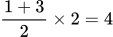 . Left triangle with sides 2, 3, 4 (Heron,
 ):
 . Total
 .
चित्र में D व्यास वाले चार समान वृत्त 2 × 2 वर्ग में इस प्रकार रखे हैं कि प्रत्येक अपने दो पड़ोसियों को स्पर्श करता है, और बीच का एक छोटा छायांकित वृत्त चारों को स्पर्श करता है। छायांकित वृत्त का व्यास क्या है?
In the figure, four equal circles of diameter D are arranged in a 2 × 2 square so that each touches its two neighbours, and a small shaded circle in the middle touches all four. What is the diameter of the shaded circle?
केंद्रों से बने वर्ग का विकर्ण  ; छायांकित व्यास
 ।
The four centres form a square of side D, whose diagonal is . Along the diagonal this length equals one radius + the shaded diameter + one radius, so the shaded diameter is  .
चित्र में A, B, C एक सरल रेखा पर हैं और E, D उसके समांतर रेखा पर हैं (AC ∥ ED), AB = DE = 5 cm और BC = 7 cm है; रेखाखंड AE, EB, BD और DC खींचे गए हैं। क्षेत्रफल ABDE : क्षेत्रफल BDE : क्षेत्रफल BCD किसके बराबर है?
In the figure, A, B, C lie on a straight line and E, D lie on a line parallel to it (AC ∥ ED), with AB = DE = 5 cm and BC = 7 cm; the segments AE, EB, BD and DC are drawn. What is area ABDE : area BDE : area BCD equal to?
सभी की ऊँचाई h समान; ABDE  , BDE
 , BCD
 ; अनुपात 10:5:7।
All three figures have the same height h (the distance between the parallel lines). ABDE is a parallelogram (AB = ED, AB ∥ ED) of area 5h; BDE has area  ; BCD has area
 . Ratio
 .
चित्र में PQRS एक समांतर चतुर्भुज है। PA कोण P को और SA कोण S को समद्विभाजित करते हैं और समद्विभाजक समांतर चतुर्भुज के भीतर A पर मिलते हैं। कोण PAS किसके बराबर है?
In the figure, PQRS is a parallelogram. PA bisects angle P and SA bisects angle S, the bisectors meeting at A inside the parallelogram. What is angle PAS equal to?
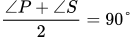 ; अतः
 ।
Adjacent angles of a parallelogram add to 180°, so 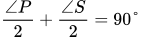 . In triangle PAS,
 .
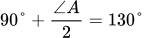
चित्र में त्रिभुज ABC में ∠A = 80° और ∠ABC = 60° है। BD और CD क्रमशः कोण B और C को समद्विभाजित करते हैं और D पर मिलते हैं; कोण C का प्रत्येक आधा भाग x° और ∠BDC को y° अंकित किया गया है। x और y के मान क्रमशः क्या हैं?
In the figure, ∠A = 80° and ∠ABC = 60° in triangle ABC. BD and CD bisect angles B and C respectively, meeting at D; each half of angle C is marked x° and ∠BDC is marked y°. What are the values of x and y respectively?
 ,
 ;
 ।
 , so . In triangle BDC,
 (also
 ).
चित्र में PQR एक असमद्विबाहु समकोण त्रिभुज है जिसका Q पर समकोण है। T, PR पर एक बिंदु है और L, M क्रमशः QR और PR पर बिंदु हैं। यदि LM और QT समांतर हैं और QT = PT है, तो ∠RLM किसके बराबर है?
In the figure, PQR is a non-isosceles right-angled triangle, right angled at Q. T is a point on PR and L, M are points on QR and PR respectively. If LM and QT are parallel and QT = PT, then what is ∠RLM equal to?
 ;
 ; LM ∥ QT से
 ।
QT = PT gives  , so . Since LM ∥ QT,
 .
चित्र में PQ, RS के समांतर है और PR, QS के समांतर है। रेखा LM, P से होकर जाती है (L, P के नीचे-बाएँ और M ऊपर-दाएँ), U, RS को S से आगे बढ़ाने पर है, और T, QS को S से आगे बढ़ाने पर है। यदि ∠LPR = 35° और ∠UST = 70° है, तो ∠MPQ किसके बराबर है?
In the figure, PQ is parallel to RS and PR is parallel to QS. The line LM passes through P (L below-left, M above-right of P), U lies on RS produced beyond S, and T lies on QS produced beyond S. If ∠LPR = 35° and ∠UST = 70°, then what is ∠MPQ equal to?
 ;
 ;
 ।
SU runs in the direction of PQ and ST in the direction of PR, so . Then  , and since L, P, M are collinear, .
चित्र में ABC एक त्रिभुज है जिसमें AB = BC है और D त्रिभुज ABC का एक आंतरिक बिंदु है जिससे ∠DAC = ∠DCA है। निम्नलिखित कथनों पर विचार कीजिए:<br>1. त्रिभुज ADC एक समद्विबाहु त्रिभुज है।<br>2. D त्रिभुज ABC का केंद्रक है।<br>3. त्रिभुज ABD, त्रिभुज CBD के सर्वांगसम है।<br>उपर्युक्त कथनों में से कौन-से सही हैं?
In the figure, ABC is a triangle with AB = BC and D is an interior point of the triangle ABC such that ∠DAC = ∠DCA. Consider the following statements:<br>1. Triangle ADC is an isosceles triangle.<br>2. D is the centroid of the triangle ABC.<br>3. Triangle ABD is congruent to the triangle CBD.<br>Which of the above statements are correct?
DA = DC, अतः ADC समद्विबाहु; SSS से ABD ≅ CBD; D सममिति अक्ष पर कहीं भी हो सकता है, केंद्रक होना आवश्यक नहीं।
Equal base angles give DA = DC, so ADC is isosceles. Then AB = CB, AD = CD and BD is common, so ABD ≅ CBD (SSS). D lies on the axis of symmetry but can be anywhere on it, so it need not be the centroid.
चित्र में A, M, B एक रेखा पर हैं और C, D उसके ऊपर हैं; AD और BC एक-दूसरे को काटते हैं तथा MC, MD जोड़े गए हैं। M, AB का मध्य-बिंदु है, ∠DAB = ∠CBA और ∠AMC = ∠BMD है। तब त्रिभुज ADM, त्रिभुज BCM के सर्वांगसम है
In the figure, A, M, B lie on a line with C and D above it; AD and BC cross each other and MC, MD are joined. M is the mid-point of AB, ∠DAB = ∠CBA and ∠AMC = ∠BMD. Then the triangle ADM is congruent to the triangle BCM by
AM = BM,  और
 ; अतः ASA।
AM = BM, , and adding  to both equal angles gives . Two angles and the included side match, so the triangles are congruent by ASA.
ABCD एक वर्ग है। X, AB का मध्य-बिंदु और Y, BC का मध्य-बिंदु है। निम्नलिखित कथनों पर विचार कीजिए:<br>1. त्रिभुज ADX और BAY सर्वांगसम हैं।<br>2. ∠DXA = ∠AYB।<br>3. DX, AY से 60° के कोण पर झुका है।<br>4. DX, AY पर लंब नहीं है।<br>उपर्युक्त कथनों में से कौन-से सही हैं?
ABCD is a square. X is the mid-point of AB and Y is the mid-point of BC. Consider the following statements:<br>1. Triangles ADX and BAY are congruent.<br>2. ∠DXA = ∠AYB.<br>3. DX is inclined at an angle 60° with AY.<br>4. DX is not perpendicular to AY.<br>Which of the above statements are correct?
दोनों त्रिभुज सर्वांगसम हैं और कोण बराबर; निर्देशांकों से DX और AY का बिंदु गुणनफल 0, अतः वे लंब हैं; 3 और 4 गलत।
Both triangles are right-angled with legs a and  , so they are congruent and
 . With A(0,0), B(2,0), C(2,2), D(0,2): DX has direction (1, −2) and AY has (2, 1); their dot product is 0, so DX ⟂ AY. Statements 3 and 4 are false.
एक सीधी क्षैतिज सड़क के ठीक ऊपर स्थित विमान से, विमान के विपरीत ओर स्थित दो क्रमागत किलोमीटर-पत्थरों के अवनमन कोण  और
 हैं। सड़क से विमान की ऊँचाई है
From an aeroplane vertically over a straight horizontal road, the angles of depression of two consecutive kilometre-stones on the opposite sides of the aeroplane are observed to be and . The height of the aeroplane above the road is
 ।
With height h, the stones are  and
 from the point below, and together these make 1 km:
 . So
 km.