
अनुक्रम 25, −125, 625, −3125, … का  वाँ पद क्या है?
What is the  term of the sequence 25, −125, 625, −3125, …?
GP:  ।
It is a GP with first term  and ratio
 : .
मान लीजिए X = {1, 2, 3, 4} और R, X पर एक संबंध है। यदि R = {(1, 1), (2, 2), (3, 3), (1, 2), (2, 1), (2, 3), (3, 2)} है, तो निम्नलिखित में से कौन-सा सही है?
Suppose X = {1, 2, 3, 4} and R is a relation on X. If R = {(1, 1), (2, 2), (3, 3), (1, 2), (2, 1), (2, 3), (3, 2)}, then which one of the following is correct?
(4, 4) नहीं है, अतः स्वतुल्य नहीं; सममित है; (1, 2), (2, 3) हैं पर (1, 3) नहीं, अतः संक्रामक नहीं।
(4, 4) is missing, so R is not reflexive. Every pair has its reverse, so it is symmetric. (1, 2) and (2, 3) are in R but (1, 3) is not, so it is not transitive.
प्राकृत संख्याओं के समुच्चय N पर संबंध R इस प्रकार परिभाषित है:  । तब निम्नलिखित में से कौन-सा सही है?
A relation R is defined on the set N of natural numbers as . Then which one of the following is correct?
 ; स्वतुल्य है; 3R1 पर 1R3 नहीं; 9R3, 3R1 पर 9R1 नहीं।
 , so
 means
 or
 . Reflexive: yes. 3R1 but not 1R3, so not symmetric. 9R3 and 3R1 but not 9R1, so not transitive.
यदि A = {x ∈ Z :  } और B = {x ∈ Z :
 } हैं, जहाँ Z सम्मिश्र संख्याओं का समुच्चय है, तो
 किसके बराबर है?
If A = {x ∈ Z : } and B = {x ∈ Z : }, where Z is set of complex numbers, then what is equal to?
B ⊂ A, अतः 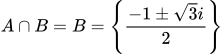 ।
 , so B ⊂ A and
 , the two complex cube roots of unity
 .
दो अरिक्त समुच्चयों A और B के लिए निम्नलिखित कथनों पर विचार कीजिए:
1. 
2. 
उपर्युक्त में से कौन-सा/से कथन सही है/हैं?
Consider the following statements for the two non-empty sets A and B:
1.
2.
Which of the above statements is/are correct?
1 सत्य। 2:  , जो सामान्यतः
 नहीं; असत्य। (कुछ प्रचलित उत्तर कुंजियों में अलग विकल्प दिया है; यहाँ उत्तर ऊपर दिए गए तर्क पर आधारित है।)
1: the three pieces are 'both', 'A only' and 'B only', which together make . True. 2:  , which is not in general (take B with elements outside A). False. (Some answer keys in circulation give a different option; the answer here follows the reasoning above.)
मान लीजिए X एक अरिक्त समुच्चय है और A, B, C इसके उपसमुच्चय हैं। निम्नलिखित कथनों पर विचार कीजिए:
1.  ,

2. सभी समुच्चयों B के लिए 

3. सभी समुच्चयों B के लिए
उपर्युक्त में से कौन-से कथन सही हैं?
Let X be a non-empty set and let A, B, C be subsets of X. Consider the following statements:
1. ,
2. for all sets B
3. for all sets B
Which of the above statements are correct?
1 सीधा है; 2 में B = X, 3 में B = ∅ लेने पर  । तीनों सत्य।
1 is direct. 2: take B = X, giving . 3: take B = ∅, giving . All three are true.
यदि  है, तो B का सहखंडज किसके बराबर है?
If , then what is adjoint of B equal to?
सहखंड: पहली पंक्ति 0, 0, −2; दूसरी 0, 0, −1; तीसरी 0, 0, 8। इनका परिवर्त सहखंडज है: अंतिम पंक्ति −2, −1, 8।
Cofactors:  ,
 ,
 ;
 ,
 ,
 ;
 ,
 ,
 . The adjoint is the transpose of the cofactor matrix: rows (0, 0, 0), (0, 0, 0), (−2, −1, 8).
समीकरण  के मूल क्या हैं?
What are the roots of the equation ?
पहली स्थिति से  ,
 ; दूसरी से
 ; मूल −2, 2, 4।
Case 1:  gives
 , so or . Case 2:
 gives
 , so . All of −2, 2, 4 check (both sides 0, 4, 6).
यदि  है, तो आव्यूह A है
If , then the matrix A is a/an
 ; A अंतर्वलनी है।
, so A is involutory. Its determinant is −1, so it is not singular.
यदि 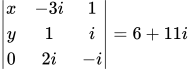 है, तो
 और
 के मान क्रमशः क्या हैं?
If , then what are the values of and respectively?
सारणिक  ;
 ,
 से
 ,
 ।
Expanding along the first column:  . So and , giving , .
समीकरणों  और
 के उभयनिष्ठ मूल हैं
The common roots of the equations and are
पहले के मूल  ,
 ,
 ; दूसरे को संतुष्ट नहीं करता; उभयनिष्ठ मूल , ।
 , roots , , . For
 the second gives 1, not 0. For
 :
 ; similarly for . Common roots: and .
यदि C(20, n + 2) = C(20, n − 2) है, तो किसके बराबर है?
If C(20, n + 2) = C(20, n − 2), then what is equal to?
 ,
 ।
C(n, r) = C(n, s) with  means
 : , so .
एक तल में 10 बिंदु हैं, जिनमें से कोई तीन एक सरल रेखा में नहीं हैं। बिंदुओं को मिलाकर कुल कितनी सरल रेखाएँ बनाई जा सकती हैं?
There are 10 points in a plane. No three of these points are in a straight line. What is the total number of straight lines which can be formed by joining the points?
 ।
.
समीकरण  (जहाँ
 ,
 ,
 सभी धनात्मक हैं) के भिन्न वास्तविक मूल
 और
 हैं। निम्नलिखित में से कौन-सा सही है?
The equation (where , , all are positive) has distinct real roots and . Which one of the following is correct?
गुणनफल धनात्मक और योग ऋणात्मक; दोनों मूल ऋणात्मक।
Product  , so the roots have the same sign; sum
 , so both are negative.
यदि A = {λ, {λ, μ}} है, तो A का घात समुच्चय है
If A = {λ, {λ, μ}}, then the power set of A is
A के दो अवयव λ और {λ, μ}; उपसमुच्चय φ, {λ}, {{λ, μ}}, {λ, {λ, μ}}।
A has two elements, λ and {λ, μ}. Its subsets are φ, {λ}, {{λ, μ}} and A itself, {λ, {λ, μ}}.
एक विद्यालय में सभी विद्यार्थी तीन इनडोर खेलों – शतरंज, कैरम और टेबल टेनिस – में से कम से कम एक खेलते हैं। 60 शतरंज, 50 टेबल टेनिस, 48 कैरम, 12 शतरंज और कैरम, 15 कैरम और टेबल टेनिस, तथा 20 टेबल टेनिस और शतरंज खेलते हैं।
विद्यालय में विद्यार्थियों की न्यूनतम संख्या कितनी हो सकती है?
In a school, all the students play at least one of three indoor games – chess, carrom and table tennis. 60 play chess, 50 play table tennis, 48 play carrom, 12 play chess and carrom, 15 play carrom and table tennis, 20 play table tennis and chess.
What can be the minimum number of students in the school?
कुल  ,
 ; न्यूनतम 111।
Total  , where is the number who play all three, . Minimum (with
 ) is 111.
एक विद्यालय में सभी विद्यार्थी तीन इनडोर खेलों – शतरंज, कैरम और टेबल टेनिस – में से कम से कम एक खेलते हैं। 60 शतरंज, 50 टेबल टेनिस, 48 कैरम, 12 शतरंज और कैरम, 15 कैरम और टेबल टेनिस, तथा 20 टेबल टेनिस और शतरंज खेलते हैं।
विद्यालय में विद्यार्थियों की अधिकतम संख्या कितनी हो सकती है?
In a school, all the students play at least one of three indoor games – chess, carrom and table tennis. 60 play chess, 50 play table tennis, 48 play carrom, 12 play chess and carrom, 15 play carrom and table tennis, 20 play table tennis and chess.
What can be the maximum number of students in the school?
 ; अधिकतम
 ।
Total , and (all three games) cannot exceed the smallest pair count, 12. Maximum  .
यदि A कोटि 3 का तत्समक आव्यूह है, तो उसका व्युत्क्रम 
If A is an identity matrix of order 3, then its inverse
 ;
 ।
, so  .
A कोटि 3 का एक वर्ग आव्यूह है जिसका सारणिक 4 है। उसके परिवर्त का सारणिक क्या है?
A is a square matrix of order 3 such that its determinant is 4. What is the determinant of its transpose?
 ।
.
6 प्रोग्रामरों और 4 टाइपिस्टों में से एक कार्यालय 5 लोगों की भर्ती करना चाहता है। कम से कम एक टाइपिस्ट भर्ती करने के कितने तरीके हैं?
From 6 programmers and 4 typists, an office wants to recruit 5 people. What is the number of ways this can be done so as to recruit at least one typist?
 ।
All selections minus those with no typist: .
 के प्रसार में कितने पद हैं?
What is the number of terms in the expansion of ?
व्यंजक  है; 5 पद।
The expression is , which has  terms.
 के प्रसार में पहले तीन पद क्रमशः 1,
 और
 हैं। किसके बराबर है?
In the expansion of , the first three terms are respectively 1, and . What is equal to?
 ,
 से
 ।
and 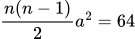 . Substituting
 :
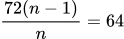 , so
 and .
संख्याएँ 1, 5 और 25 किसके तीन पद (आवश्यक नहीं कि क्रमागत) हो सकती हैं?
The numbers 1, 5 and 25 can be three terms (not necessarily consecutive) of
 (m = 1, 2, 3, …) हर मान के लिए 1, 5, 25 पद बनते हैं; अनंत AP।
We need  and
 for whole numbers
 ,
 :
 ,
 , so
 . Any (m = 1, 2, 3, …) works, giving infinitely many APs.
किसी AP के  वें और
 वें पदों का योग किसके बराबर है?
The sum of  and
 terms of an AP is equal to
 ।
 .
यदि A कोटि  का एक वर्ग आव्यूह है, तो निम्नलिखित में से कौन-सा सही है?
If A is a square matrix of order , then which one of the following is correct?
पंक्तियाँ से गुणा होती हैं;  ।
Each of the rows is multiplied by , so  .